The short answer
As of September 2026, a Fort Worth car whose key turns all the way to start and does nothing at all almost always has one of four faults: the 12-volt battery or its connections, the electrical half of the ignition switch, the starter or its solenoid, or a safety interlock such as the neutral or clutch switch. What you hear at the moment of the attempt — silence, one loud click, or rapid clicking — narrows it immediately. Ignition work in this market runs $150 to $400; a battery or starter is a different repair entirely.
Start by listening, because the sound is the diagnosis
Before anything is unbolted, sit in the car and pay attention to what happens at the exact moment you turn the key or press the button. The three possible outcomes point in three different directions, and the difference between them is worth several hundred dollars.
Absolute silence. No click, no whir, nothing. The command is not reaching the starter, or there is not enough power to act on it. This is the ignition switch, the interlock, the wiring or a very flat battery.
One firm click and then nothing. The starter solenoid engaged. The command arrived and the circuit worked. What failed is downstream: the starter motor itself, the heavy cable feeding it, or a battery with enough power to throw the solenoid but not enough to spin the engine.
Rapid machine-gun clicking. Classic low voltage. The solenoid pulls in, the voltage collapses under load, the solenoid drops out, voltage recovers, and the cycle repeats several times a second. This is a battery or connection problem far more often than it is anything else.
Then note the dashboard. Dash dark and the answer is power. Dash fully lit and steady and you have eliminated most battery-related explanations, because a cluster that bright is receiving healthy voltage at rest. Dash lit but dimming hard when you turn the key is voltage collapsing under load, which is the battery or a connection again.
The four causes, in the order they are worth checking
1. The battery and its connections
The most common cause and the cheapest to rule out, which is why it goes first regardless of what anybody suspects.
A battery can read a healthy voltage at rest and still fail completely under the enormous load a starter demands. That is why a load test matters and a simple voltage reading does not settle anything. Equally common, and frequently missed, is corrosion at the terminals — a green or white crust that looks cosmetic and acts like a broken wire. In Texas heat, battery life shortens, and the American Automobile Association has consistently found that extreme heat is harder on battery life than cold.
Check it yourself in two minutes: are the terminals clean and tight enough that you cannot twist them by hand? Do the headlights stay bright when a helper turns the key, or do they visibly collapse? If they collapse, you have found your problem and it is not a lock.
2. The electrical half of the ignition switch
This is the one people conflate with the cylinder, and it is the single most useful distinction in this whole article.
The cylinder is mechanical. It is the lock your key enters, and its failures are mechanical: a key that will not turn, a key that turns too easily, a cylinder that binds. Those symptoms are covered in why a key will not turn in the ignition and in what a freely spinning key means.
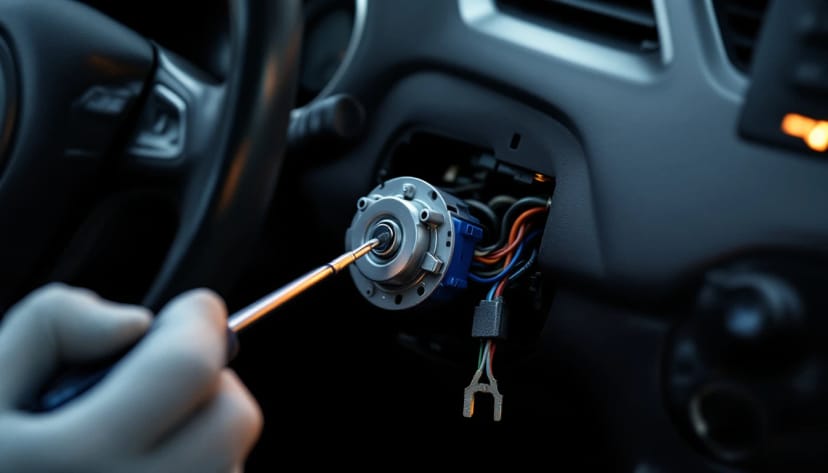
The switch is electrical. It sits behind the cylinder and is turned by it, and its job is to route current: accessory, run, start. Its contacts wear, burn or lose their spring, and when the start contact goes, the key rotates perfectly, the dash may light normally, and the starter never receives a signal. Total silence with a healthy-looking dashboard is the signature.
Two supporting clues make this diagnosis much more likely. First, accessories that flicker or die when the key is jiggled in the run position — a radio that cuts out over bumps, dash lights that blink when the key is nudged. Second, an intermittent pattern that gets worse over weeks, because worn contacts degrade gradually rather than failing cleanly.
3. The starter or its solenoid
The single-click case, and occasionally the silent case when the solenoid fails outright.
A starter draws more current than any other component in the vehicle. Its failure modes are heat-related, so a starter that works cold and refuses after the engine is hot is a classic and reliably diagnostic pattern. The heavy positive cable feeding it fails in the same way and produces identical symptoms, which is why a good technician tests voltage at the starter rather than replacing it on the strength of a click.
This is mechanic work, not locksmith work, and any honest operator will say so at the point the diagnosis lands there.
4. Safety interlocks
Every automatic vehicle has a neutral safety switch preventing a start in gear; every manual has a clutch interlock requiring the pedal down. Both are cheap parts that produce dramatic symptoms.
Test it in thirty seconds and it costs nothing. On an automatic: put the car firmly in Park, try again, then try in Neutral. If it starts in Neutral but not Park, the switch or its adjustment is your answer and the ignition is innocent. On a manual: press the clutch fully to the floor — further than feels necessary — and try again.
This is the cause most often missed, because it feels too simple to be the explanation for a car that will not start at all.
The diagnostic table
| What you observe | Most likely cause | Who fixes it | Typical range |
|---|---|---|---|
| Total silence, dashboard dark | Battery, terminals, or main power connection | Battery service or mechanic | Battery replacement cost |
| Total silence, dashboard fully lit | Ignition switch electrical contacts, or interlock | Locksmith (switch) / mechanic (interlock) | $150–$400 ignition work |
| Starts in Neutral but not Park | Neutral safety switch or its adjustment | Mechanic | Mechanic diagnostic |
| One firm click, no crank | Starter, solenoid or main starter cable | Mechanic | Mechanic repair |
| Rapid clicking | Low voltage — battery or connection | Battery service | Battery replacement cost |
| Cranks strongly but will not fire | Fuel, spark, or vehicle security — not the switch | Depends on cause; often security | $120–$400 if key-side |
| Starts then dies after 1–2 seconds | Immobiliser rejecting the key | Locksmith | Key-side pricing |
| Key will not turn at all | Cylinder or steering lock bind — a different fault | Locksmith | $150–$400 ignition work |
The final two rows exist to keep you out of the wrong article. If the engine cranks — turns over audibly, even without catching — this page is not your diagnosis, because the entire starting circuit demonstrably works. Go instead to anti-theft light on and the car will not start, which covers the security side of a cranking no-start.
Where security genuinely does cause silence
On most vehicles a security failure lets the engine crank and then kills it a second or two later, because the immobiliser blocks fuel or spark rather than the starter. That is the normal pattern, and it is why a silent car is usually not a key problem.
There are real exceptions, and they matter in Fort Worth because they are common on vehicles people actually own here.
Some platforms use an electronic steering lock that must release before the vehicle will allow a start attempt. When that module faults, the car can sit silent with a security or steering-lock warning displayed, and the fault is genuinely electronic rather than mechanical.
Some platforms gate the starter relay itself through the security system, so an unrecognised key produces no crank at all rather than a crank-and-die.
And on push-button vehicles, a fob the car cannot detect frequently produces nothing at all. That is usually a fob battery rather than anything expensive, and the diagnostic path is set out in push-button start not working.
The tell in all three cases is the security or immobiliser indicator on the dash — a car, a padlock, or a key symbol, lit steady or flashing. Read it before assuming anything mechanical. A flashing security light on a silent car changes the diagnosis completely and moves the job to the key side, where our transponder key programming work lives.
What each outcome costs in Fort Worth
Ignition work — $150 to $400 as of September 2026. This covers the locksmith side: repairing a worn cylinder, replacing a cylinder and keying it to your existing key so you are not carrying two different keys afterwards, or replacing the switch behind it. Where in that band you land depends on the vehicle, on whether the column has to come apart, and on whether the replacement needs to be married to your existing key. The comparison of repairing versus replacing an ignition works through that decision in detail.
Battery or starter. A different trade and a different bill. We will say so plainly rather than sell you an ignition repair that leaves you exactly where you started — that is what an honest diagnostic visit is for, and it is why our general locksmith pricing guide is upfront about what is and is not our work.
Key-side security faults. If the diagnosis lands on a key the vehicle no longer recognises, the numbers follow key pricing rather than ignition pricing — basic transponder work from $120, smart and proximity keys higher, all set out in the full cost guide.
An ALOA-credentialed automotive locksmith who works this market described the professional standard for this exact call: "You do not sell an ignition to somebody with a battery problem. Half the no-start calls I run end with me telling the customer it is not my job, and that is the visit that earns the next three."
Do not do these four things
Do not keep cranking. Repeated attempts overheat a failing starter, flatten a marginal battery past the point of easy diagnosis, and make everything harder to test. Three attempts is the sensible limit.
Do not force a stiff key. If the key is hard to turn, that is a different fault and forcing it turns a $150 repair into a snapped key inside a ruined cylinder. Our page on broken key extraction exists because this happens weekly.
Do not buy parts on a guess. Starters and ignition switches are both expensive enough that replacing one speculatively is a costly way to obtain a diagnosis. Test first.
Do not jump-start repeatedly on a car with electronic security. Voltage spikes from careless jump-starting are a documented way to damage vehicle electronics, and the resulting fault is far more expensive than the battery you were trying to avoid replacing. If jump-starting is needed, follow the vehicle manufacturer's stated procedure — the Federal Trade Commission publishes useful consumer guidance on avoiding unnecessary auto repair costs, and not creating new faults is the cheapest saving available.
When to call us
Call when the dashboard lights up normally and the car is silent, when accessories flicker as the key is moved, when the fault is intermittent and worsening, when the key is difficult to turn, or when a security light is showing on a car that will not crank. Those are ignition and key-side conditions and they are our work — our ignition repair service covers cylinders, switches and keyed-to-match replacements at your location.
Call somebody else — and we will tell you so on the phone if the symptoms say it — when the dash is dark, when the clicking is rapid, or when the car starts fine in Neutral but not in Park. Those are battery, starter and interlock faults, and a locksmith is the wrong trade for all three.
Frequently Asked Questions
My key turns all the way and nothing happens at all. What is the most likely cause?
In order of frequency: the 12-volt battery or its connections, then the ignition switch's electrical half, then the starter or its solenoid, then a safety interlock such as the neutral or clutch switch. Total silence with a dead dashboard points hard at power. Total silence with a fully lit dashboard points away from the battery and toward the switch, the interlock or the starter circuit. That single observation cuts the list in half before anybody touches the car.
What is the difference between the ignition cylinder and the ignition switch?
The cylinder is the mechanical lock your key goes into — it accepts the key, rotates, and can wear or seize. The switch is the electrical component behind it that actually sends current to the accessories, the fuel system and the starter. They are physically connected but they fail differently and cost differently. A key that will not turn is usually a cylinder problem. A key that turns freely and produces nothing is usually a switch or a circuit problem.
Does one loud click mean the starter is dead?
It means the starter solenoid received a signal and tried to engage, which is genuinely useful information. It rules out most of the switch and interlock faults, because the command clearly reached the starter. Whether the fault is the starter itself, the heavy cable feeding it, or a battery that is strong enough to click but not to crank still needs testing, and a starter is expensive enough to be worth testing rather than assuming.
The dashboard lights up but there is no crank. Is that the battery?
Less often than people assume. Dash lights draw very little current, and a battery can light a full instrument cluster while being far too weak to turn an engine. That said, the reverse is also true: a battery weak enough to fail under load will often still look fine at rest. Load testing settles it in a couple of minutes, and it is the cheapest test on the list, which is why it is done first.
Can a bad key cause a no-crank condition?
On most vehicles a security failure produces a crank-but-no-start rather than total silence, so a worn or unrecognised key is not the first suspect for a silent car. There are exceptions. Some platforms use an electronic steering lock or a security-gated starter relay that will hold the starter circuit open until the key is authorised, and on those a key or immobiliser fault genuinely can produce silence. That is why the security light on the dash is worth reading before drawing conclusions.
Why does it start sometimes and not others?
Intermittent is a strong signal, not a frustrating absence of one. Worn ignition switch contacts, a corroded battery terminal and a heat-affected starter solenoid all fail intermittently before they fail permanently. Note the pattern honestly — does it fail when hot, when cold, in a particular gear position, after the car has sat — because the pattern often identifies the component faster than any test.
How much does ignition repair cost in Fort Worth?
Ignition work in this market generally runs $150 to $400 as of September 2026, depending on whether the job is a cylinder repair, a full cylinder replacement keyed to your existing key, or switch replacement. That range covers the locksmith side of the problem. If the diagnosis lands on the starter or the battery, the repair belongs with a mechanic and the number is different, which we will tell you rather than sell you a lock repair you do not need.
Is it safe to keep trying to start it?
Repeated attempts do more harm than most people expect. Cranking against a failing starter overheats it, repeated attempts flatten a marginal battery to the point where the diagnosis becomes harder, and forcing a stiff cylinder is how a repairable lock becomes a broken one with the key snapped off in it. Three attempts is a reasonable limit. If it will not go by then, stop and diagnose.
References
- American Automobile Association — research on battery life, extreme heat and roadside breakdown causes.
- Federal Trade Commission — consumer guidance on auto repair estimates and avoiding unnecessary work.
- National Highway Traffic Safety Administration — vehicle safety standards including starter interlock and anti-theft requirements.
- Associated Locksmiths of America — professional standards for automotive ignition and security service.
- National Automotive Service Task Force — secure vehicle data access for qualified independent technicians.
- Insurance Institute for Highway Safety — immobiliser and vehicle security system research.
- U.S. Bureau of Labor Statistics — motor vehicle maintenance and repair price trends.
Tell us what you hear when you turn the key
Silence, one click or rapid clicking — plus whether the dash lights up — is usually enough for us to tell you on the phone whether this is our job or a mechanic's. Call 817-842-1256 or get in touch here, and if it is ignition or key-side we will come to the car.