What a freely spinning key actually means
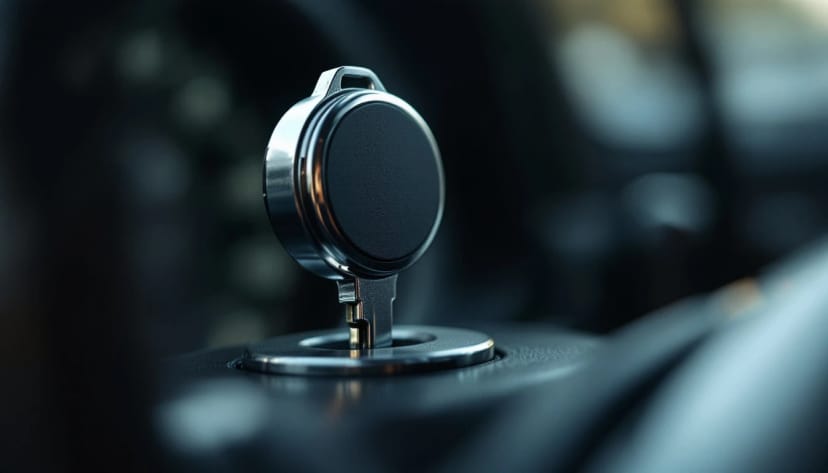
Your key goes in, turns, and just keeps going. No detents. No accessory position. No dash lights. No crank. It feels light — almost like turning a knob that is not attached to anything.
That last impression is close to literally correct. In a healthy ignition, four things happen in sequence: the key lifts the wafers, the plug rotates, the plug drives a cam or pushes an actuator rod, and that cam or rod operates the electrical switch. A key that spins with no resistance means the chain broke somewhere between step two and step four. The plug is still turning. Nothing downstream of it is.
This is genuinely different from a key that will not turn, and the distinction matters because the repairs are different. If your key is stuck or refuses to rotate, read the car key will not turn in the ignition instead — that is a binding problem, and this is a breakage problem.
As of August 2026, this repair runs $150 to $400 mobile in Fort Worth. Call (817) 842-1256 with your year, make and model and a description of exactly how the key feels.
The three ways this failure happens
Nearly every freely spinning ignition we open in Fort Worth is one of these three.
1. The drive cam has sheared
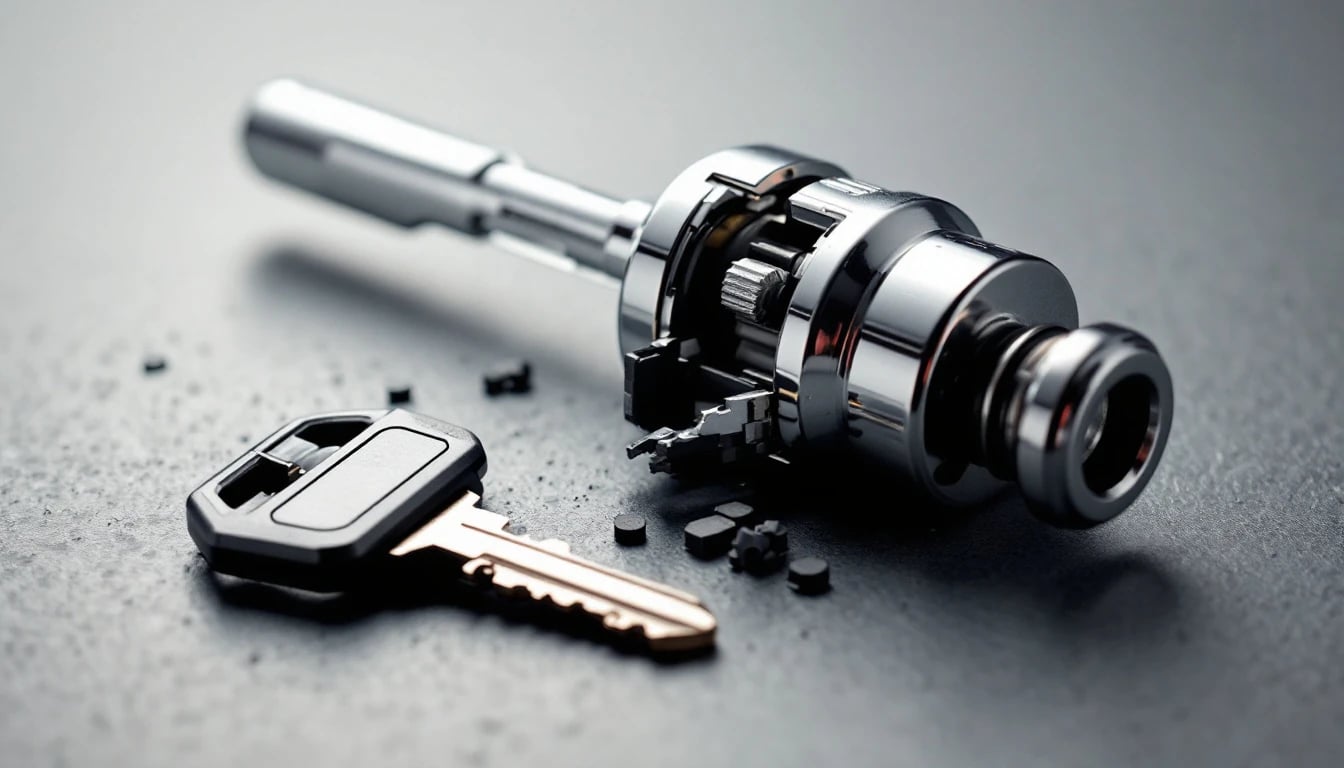
On the back of the lock cylinder sits a cam — often moulded plastic, sometimes a stamped metal tab — that engages the ignition switch. It is a deliberately modest part, and on high-mileage vehicles it is a known failure point.
When it shears, the plug becomes a free-spinning cylinder driving nothing. The key rotates through a full 360 degrees with no stops at all, because the detents you normally feel come from the switch, not from the lock.
Tell: completely smooth rotation, all the way around, endlessly. No position feels different from any other.
2. The wafers have collapsed or been removed
Less common but very diagnostic. If enough wafers wear away, break, or lose their springs, the plug loses its mechanical relationship to the cylinder wall. It may then rotate freely with the key — and often with anything inserted, which is the giveaway.
Tell: the key turns freely, but so does a flat screwdriver, or another car's key, or your finger. If any object rotates the plug, the lock has effectively stopped being a lock.
Worth saying plainly: this state is not just an inconvenience, it is a security failure. The Insurance Institute for Highway Safety's research on vehicle theft is a useful reminder of what the mechanical lock is still doing on an immobilized car — the immobilizer stops the engine starting, but the cylinder is what stops someone rotating your steering lock and rolling the car onto a truck. A cylinder that any object turns should not be left in service.
3. The actuator rod or lock housing has separated
On many platforms — particularly full-size trucks and older domestic sedans — the cylinder does not touch the switch directly. A rod, link, or intermediate lever transmits the motion down the column. Those parts snap, back out of their retaining clip, or wear through their engagement point.
Tell: partial or vague resistance rather than none at all, sometimes with a clunk, a dropped feeling, or a rattle inside the column when you turn the key. Occasionally the key still reaches accessory but nothing beyond.
Rule out the two look-alikes first
Two other failures produce "I turn the key and nothing happens" and are worth eliminating in your driveway before anyone is dispatched.
A dead battery. Obvious, but it makes the key feel oddly weightless because none of the usual electrical feedback happens. The difference is that a dead battery does not change how the key mechanically feels. You should still feel the detents click as you rotate through accessory and run. If the detents are there, the lock is fine and you have an electrical problem. If they are gone, you have this article's problem.
A failed electrical switch with an intact cylinder. The cylinder turns normally with proper detents, but the switch behind it is not closing its contacts. Same result — nothing happens — but a completely different repair, sitting at a different point in the price band. Our ignition switch repair versus replacement cost breakdown separates the two in detail.
The single question that splits them: can you feel the positions? Detents present means the mechanical side is working. Detents absent means it is not.
A thirty-second self-check before you call
Nothing here requires tools and none of it can make things worse.
- Turn the key slowly through a full rotation. Count the distinct stops you feel. A healthy ignition gives you three or four. Zero confirms the diagnosis.
- Watch the dash while you turn. Any light at all, even briefly, means some electrical contact is still being made and the failure may be partial.
- Try the key in a door lock. If the door lock operates normally, the key itself is cut correctly and is not the problem — which rules out the cheapest possible cause and saves a wasted line of enquiry.
- Listen inside the column. A rattle, a click, or a loose object sound when you turn points strongly at a sheared cam or a dropped rod.
- Try something other than your key. If a screwdriver or an unrelated key rotates the plug, the wafers are gone. Do not leave the vehicle unattended in that state.
- Check the steering lock. With the key out, does the wheel lock? If the lock no longer engages at all, the column has more going on than the cylinder alone.
Bring those six answers to the phone call and you will get a range rather than a shrug.
What each repair costs in Fort Worth
All prices below are mobile, at your location, and include the part, the labour and the travel. As of August 2026.
| Finding | What is actually done | Typical cost | Time on-site |
|---|---|---|---|
| Sheared cam, cylinder sound | Cam replaced, cylinder re-fitted, all positions verified | $150 – $220 | 60 – 90 min |
| Broken actuator rod or link | Column opened, rod or link replaced, engagement checked | $180 – $275 | 60 – 120 min |
| Collapsed wafers, housing sound | Cylinder rebuilt with new wafers and springs to your existing key | $175 – $250 | 60 – 90 min |
| Cylinder replacement, key matched | New cylinder keyed to your original key so the same key still works | $220 – $300 | 90 – 120 min |
| Cylinder replacement plus new key | New cylinder, key cut, transponder programmed to the immobilizer | $275 – $375 | 90 – 150 min |
| Lock housing damage, column work | Housing serviced or replaced, lock assembly re-fitted and aligned | $300 – $400 | 120 – 180 min |
| Additional key programmed same visit | Second key enrolled while the technician is already on-site | $65 | +15 min |
Where you land depends on three things: whether the cylinder body survived, whether you still hold a working key, and how much of the column has to come apart to reach the assembly. The band tops at $400 because past that point you are into steering column repair or module work, which are separate jobs.
Dealer pricing for the same repair generally sits well above these figures, and the gap widens because of something dealer quotes leave out: with a freely spinning ignition the car cannot be driven, so the dealer route adds a tow. Mobile work does not, because the technician comes to the car. Hourly shop labour rates are the other structural driver — Bureau of Labor Statistics data on automotive service technicians tracks the wage base those posted rates are built on.
Why it broke, and how not to repeat it
Ignition cams and actuator rods fail from cumulative load rather than a single event.
Heavy keyrings are the most preventable cause. A key hanging with a carabiner, a house set and a fob loads the plug downward every mile you drive. Manufacturers have raised this specific concern in service literature and in past recall activity — NHTSA's safety issue and recall database is the place to check whether your platform has a known history of ignition-related actions, and several well-publicised campaigns over the last decade concerned exactly this failure mode. Take everything off the ring except the car key and the fob.
Forcing a bound steering lock. If you routinely have to muscle the key while wrenching the wheel, you are applying torque the cam was never sized for. The correct technique is light rotational pressure on the key while rocking the wheel gently — the lock releases and the key turns with no force at all.
Ignoring the warning phase. Almost every sheared cam gives notice first: a key that gets gritty, needs jiggling, or occasionally sticks in accessory. That is the cheap window. Servicing a worn cylinder is a rebuild; servicing it after the cam lets go is a replacement.
As one credentialed automotive locksmith who reviews our technical standards put it: "Nobody calls us when the key gets stiff. They call us six months later when it spins. Same car, same part, twice the bill — and now they're stranded instead of scheduled."
What the repair visit looks like
A technician arrives with a cutting machine, diagnostic tablet, wafer kits and cylinder stock. Ownership is verified first — registration or title plus matching photo ID. That is the baseline standard in the Associated Locksmiths of America code of ethics, and it applies to a broken ignition exactly as it applies to a lost key.
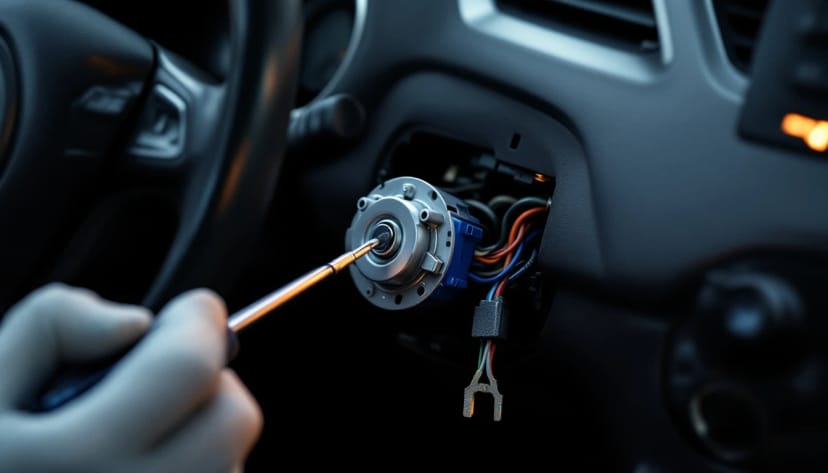
The column shrouds come off, the cylinder is extracted, and the failed component is identified in front of you on the mat. That inspection is the whole diagnosis: a sheared cam is visible instantly, and so is a collapsed wafer stack. There is no guessing at this stage and there should be no quote revision either, unless the column turns out to hold damage that was not visible from the driver's seat.
The repair is then whichever of the table rows above applies. If a new key is needed, it is cut on-site and programmed to the immobilizer. Where a key must be originated without an existing one, that access runs through the National Automotive Service Task Force Vehicle Security Professional registry, which is why the credentialing of whoever you call is not a formality.
Before the technician leaves: every key position verified, every key you own tested, the steering lock confirmed to engage and release properly, and a scan to confirm no faults were introduced.
Related Fort Worth reading
Adjacent symptoms with different causes: key stuck in the ignition and the car key will not turn. If your key turns fine but the engine will not stay running, that is the immobilizer rather than the lock — see anti-theft light flashing and the car will not start.
For pricing across the wider service menu, our car key replacement cost in Fort Worth TX breakdown uses the same bands. Service pages: ignition repair in Fort Worth and steering column lock repair. A model-specific example of this failure class: Buick LaCrosse, Regal and Enclave ignition repair.
Frequently Asked Questions
What does it mean when the ignition key turns freely with no resistance?
It almost always means the lock plug has separated from the part it is supposed to drive. In a healthy ignition the key rotates the plug, the plug rotates a cam or pushes an actuator rod, and that operates the electrical switch. When the cam shears or the rod snaps, the plug spins on happily and the switch never moves. The key feels light and loose because it is no longer doing any work, and the car gets no signal that anything happened.
Is a freely spinning key the same as a worn ignition?
No, and confusing the two costs money. A worn ignition feels gritty, notchy and reluctant but still reaches its detents and still starts the car, at least sometimes. A freely spinning key has no detents at all — it goes round and round like a dial with nothing behind it. Worn is a candidate for a rebuild. Freely spinning is almost always a broken part that needs replacing, because something has physically failed rather than gradually eroded.
Can I still drive the car if the key spins freely?
If the engine is already running, do not shut it off until you are somewhere the vehicle can safely be left, because you very likely will not restart it. If it is not running, it is not going anywhere under its own power. There is also a safety issue worth taking seriously: on some vehicles a failed ignition can leave the steering lock in an unpredictable state, so nothing should be pushed, towed or rolled until the fault is understood.
How much does it cost to fix in Fort Worth?
As of August 2026, this repair runs $150 to $400 mobile in Fort Worth. A sheared cam or a broken actuator rod with a sound cylinder sits at the low end. A full cylinder replacement keyed to your existing key sits in the middle. A cylinder replacement plus a new key cut and programmed, or a lock housing that has to come out with the column opened, sits at the top of that band. All of those prices are all-in on-site including the part and travel.
Does this need a new key as well?
Not usually. The failure is in the lock, not in the key, so your existing key is generally fine and a replacement cylinder can normally be keyed to match it. A new key is only needed when the original is lost, when it is too worn to copy accurately, or when the replacement lock cannot be keyed to your existing pattern. If a new key is cut, it also needs programming to the immobilizer on any vehicle from roughly the mid-1990s onward.
What causes an ignition cam or actuator to shear?
Cumulative force, usually. Years of turning a key against a partly bound steering lock, or against a worn cylinder that needs extra pressure, fatigues the plastic cam or the metal actuator rod until it fails. Heavy keyrings accelerate it by hanging load on the plug every mile you drive. On some platforms the cam is a known weak point and fails on high-mileage examples regardless of how carefully the car was treated.
Can this be repaired at my location or does it need a tow?
Almost always at your location. The technician removes the steering column shrouds in your driveway or parking lot, extracts the cylinder, replaces the failed component and re-installs. The car does not move. A tow only enters the picture if the column itself has been damaged, if a previous forced attempt destroyed the lock housing, or on a small number of platforms where the assembly sits behind an airbag and is safer to service in a shop.
Book ignition repair in Fort Worth
Fort Worth Car Keys is a mobile-only automotive locksmith serving Fort Worth and the surrounding cities seven days a week, 8 AM to 8 PM. A freely spinning ignition is repaired where the car is sitting — no tow, no shop visit. Automotive locksmith licensing in Texas is administered by the Texas Department of Public Safety Private Security Program, and any operator should be able to produce that credential on request.
Call (817) 842-1256 or email contact@fortworthcarkeys.com with your year, make and model, how many detents you can feel, and whether anything other than your key will turn the plug.
References
- NHTSA — Recalls and vehicle safety issues
- IIHS — Vehicle theft research
- Associated Locksmiths of America
- National Automotive Service Task Force — Vehicle Security Professional registry
- Federal Trade Commission — Hiring a Locksmith
- Bureau of Labor Statistics — Automotive Service Technicians and Mechanics
- AAA — Auto repair consumer guidance