The engine starts and idles as if nothing were wrong. But the radio is blank, the blower will not push air, the wipers are frozen, and the power windows ignore the switches. Sometimes it all comes back if you touch the key. This is one of the most misread faults we see, because everything about it says electrical gremlin and very little says ignition. Call or text 817-842-1256 if this sounds like your car and we will help you sort the cheap causes from the real one.
The Short Answer
As of October 2026, when several accessories go dead together while the engine keeps running, the most likely causes are a worn ignition switch, a blown accessory fuse or a failed accessory relay. If jiggling or slightly turning the key restores them, the switch is the prime suspect. Ignition repair in Fort Worth runs $150 to $400 on site. Do not ignore it: the same switch also feeds the engine.
What the Ignition Switch Actually Does
Most drivers think of the ignition as one thing. It is two.
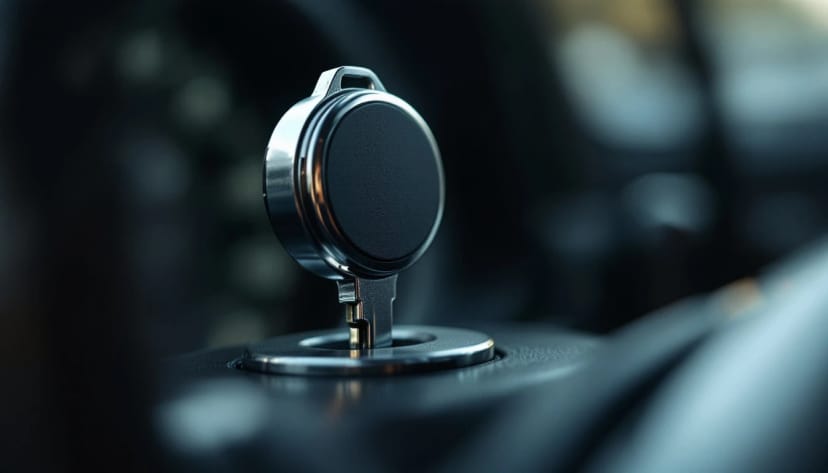
The lock cylinder is mechanical. Your key goes in, the tumblers line up, and the cylinder turns. Its job is to decide whether you are allowed to turn it.
The ignition switch is electrical. It sits behind or below the cylinder, often further down the steering column, and the cylinder turns it by a rod or gear. Inside are several sets of contacts. As the key moves through its positions, different contacts close:
- Accessory: radio, and on many cars the blower, wipers and power windows.
- On or Run: engine computer, fuel, ignition, instrument cluster, plus the accessories.
- Start: the starter circuit, momentarily.
Each of those is a separate electrical path through the same part. That is the key to this whole symptom. One set of contacts can burn, pit or lose tension while the others stay healthy. When the accessory contact fails and the run contact does not, you get a car that drives with half its interior dead.
We explain the two parts side by side in ignition switch vs ignition cylinder.
Symptom Patterns and What They Point To
| What you notice | Most likely cause | Quick check | Typical fix |
|---|---|---|---|
| Radio, blower, wipers and windows all dead; engine runs | Ignition switch accessory contact, or main accessory relay | Gently rock the key in Run; see if they flicker back | Ignition switch or relay replacement |
| Accessories cut out over bumps or when the key ring swings | Worn ignition switch or worn cylinder letting the switch drift | Remove heavy items from the key ring and retest | Ignition switch, sometimes cylinder too |
| Only one item dead, such as only the radio | Fuse or the item itself | Check that item's fuse | Fuse or component repair |
| Accessories dead in the Accessory position but fine in Run | Accessory-only contact in the switch | Compare both key positions | Ignition switch replacement |
| Accessories stay on after the key is out | Stuck contact, relay or retained-power fault | Open the driver door; see if they shut off | Switch, relay or body module diagnosis |
| Everything dims or resets together, engine stumbles too | Battery, cable or ground fault | Inspect and wiggle the battery terminals | Battery or cable service |
| Push-button car: accessories dead, engine runs | Accessory relay or body control module | Scan for body module fault codes | Relay or module diagnosis |
The first two rows are the classic ignition switch pattern and they account for most of the calls we take on this symptom.
Likely Causes, in Order
1. A worn ignition switch
The contacts inside carry real current every time the car is used. Over years they pit and lose spring tension. Heat makes it worse, and Fort Worth summers supply plenty. A switch in this state often works when cold and drops out when hot, or works until the key is disturbed. Many drivers discover that pressing the key slightly forward or back brings the radio back. That is the worn contact being nudged into place, and it is as close to a confirmed diagnosis as you can get without a meter.
2. A heavy key ring and a worn cylinder
A pound of keys and accessories hanging from the ignition pulls on the cylinder for the life of the car. Once the cylinder has play in it, the weight can rotate it a few degrees on a bump, and the switch follows. The result is accessories, or worse, the engine, cutting out on rough pavement. Lighten the ring first. If the key itself has become sloppy in the lock, see the key won't turn in the ignition for the wear signs.
3. A fuse or relay
Many vehicles feed the accessory circuit through a relay and one or more fuses. A relay can fail outright or intermittently. A fuse fails once and stays failed. This is why the fuse panel is the first stop: it costs nothing to look.
4. Battery connections and grounds
A loose or corroded battery terminal produces strange partial failures. The difference is that it rarely respects circuit boundaries. If the cluster flickers, the engine hesitates and the radio resets all at once, look at the battery before the switch. Our guide to a car that won't start after a battery replacement covers the terminal and relearn issues that follow battery work.
5. Aftermarket wiring
Remote starters, alarm systems and stereo installations are commonly spliced into the ignition harness. A poor splice at the accessory wire behaves exactly like a failing switch. If the problem began after an installation, start there.
6. On push-button cars, a relay or body module
There is no rotating switch. The start button asks a body module to energize accessory, ignition and start relays. A fault in that chain gives the same symptom by a different route. See our push-button start diagnostic.
How to Diagnose It at Home
You do not need tools for the first four steps.
- List what is dead. One item or several? Several unrelated items that share the accessory circuit point upstream.
- Compare key positions. Do the accessories work in Accessory? In Run? Engine running or off? A difference between positions implicates the switch.
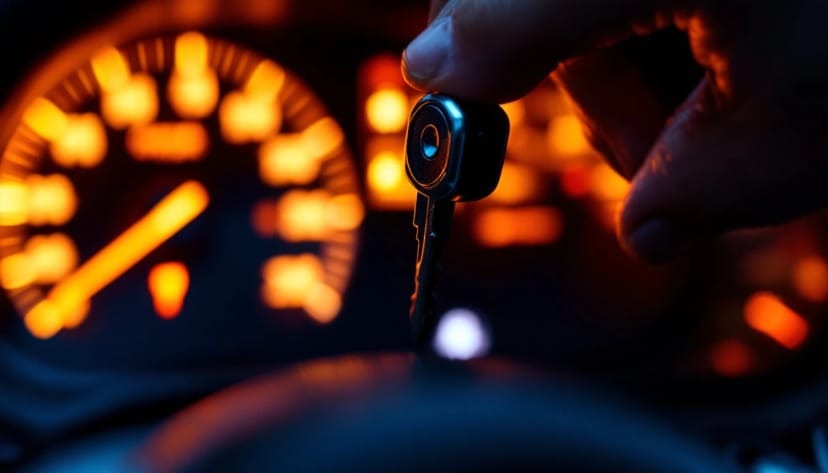
- Rock the key. With the engine idling and the car in Park with the brake set, apply very light pressure to the key in each direction. If the accessories flicker, you have found it. Do not force anything.
- Lighten the key ring. Take everything off except the car key and drive your normal route.
- Check the fuses. The owner manual identifies the accessory, radio and blower fuses. Look for a broken element. Replace like for like only; never fit a larger fuse.
- Look at the battery terminals. They should be tight and clean.
- Note the conditions. Hot or cold, wet or dry, smooth road or rough. Intermittent faults are diagnosed by pattern.
If step 3 or step 4 changes the behavior, the fault is at the ignition. If a replaced fuse blows again, stop. That is a short circuit and needs to be traced, not fed more fuses.
Why This Is a Safety Issue and Not an Annoyance
A switch that drops the accessory circuit is one worn contact away from dropping the run circuit. When that happens at speed, the engine stops. Power steering assist goes with it, brake assist fades after a press or two, and on many vehicles the airbags are disabled because the system has lost power.
This is not hypothetical. In 2014 General Motors recalled roughly 2.6 million small cars, including the Chevrolet Cobalt and Saturn Ion, because the ignition switch could move out of the Run position under the weight of a key ring or a jolt. The compensation program set up afterward ultimately approved claims for 124 deaths. The National Highway Traffic Safety Administration keeps a free VIN lookup, and it is worth thirty seconds to run yours, because several manufacturers have issued ignition-related recalls and a recall repair is free.
Federal Motor Vehicle Safety Standard 114, administered by NHTSA, governs theft protection and rollaway prevention, including how the key and ignition interact with the transmission. Research published through SAE International has examined ignition switch torque and inadvertent rotation in detail since those recalls. The engineering lesson for an owner is simple: a switch that moves or drops out when it should not is a defect to fix, not a quirk to live with.
Four numbers worth keeping in mind:
- About 2.6 million vehicles in the 2014 GM ignition switch recall.
- 124 deaths recognized by the related compensation fund.
- Three separate circuits, at minimum, run through a typical ignition switch.
- $150 to $400 is the Fort Worth band for ignition repair as of October 2026.
What It Costs in Fort Worth
As of October 2026, ignition repair at your location runs $150 to $400. Where your job falls depends on:
- Switch only, or switch and cylinder. If the cylinder is healthy, only the electrical switch is replaced.
- Where the switch is mounted. Some are reached by removing a lower dash panel. Others sit deep in the column.
- Whether a key has to be matched. Replacing a cylinder means keying the new one to your existing key so one key still does everything.
- Whether electronics are involved. Some vehicles house key recognition in an ignition module. Replacing that kind of unit includes programming.
Fuses and relays are minor items and are handled within the same visit. We break the price down further in ignition repair cost by ignition type and ignition switch repair versus replacement cost. For the overall menu, see how much is a locksmith for a car.
For context, AAA's Your Driving Costs research, published through the AAA newsroom, puts the average annual cost of owning and operating a new vehicle at around $12,000. An ignition repair is a small part of that, and the alternative is a tow from wherever the car finally quits.
Locksmith, Mechanic or Dealer?
All three can replace an ignition switch. The practical differences:
- A mobile automotive locksmith works on ignitions daily, comes to the car, and can also rekey or replace the cylinder and handle any key or immobilizer work in the same visit. That last part matters when the switch and the anti-theft system share a housing.
- A general mechanic is a good choice when the diagnosis points to the battery, charging system or a wiring short.
- A dealership has brand-specific data and is the right place for a recall repair. For non-recall work the car has to be brought to them.
The Federal Trade Commission notes that under federal warranty law a manufacturer generally cannot void a warranty simply because an independent shop performed the repair, so you are free to choose.
In Texas, locksmith companies are licensed by the Texas Department of Public Safety through its Private Security Program. ALOA Security Professionals Association maintains the automotive credentials, and security data access for independents is credentialed through the National Automotive Service Task Force.
What the Trade Says
"The radio is the canary. It is the first thing to drop out because it sits on the lightest contact in the switch. When a customer tells me the radio cuts out and comes back when they bump the key, I already know what I am going to find, and I know they should not wait for the engine to do the same thing." — an ALOA-credentialed Master Automotive Locksmith working the DFW metro
When to Stop Driving and Call
- Accessories cut out when you hit a bump or touch the key.
- The engine has stumbled or shut off even once along with them.
- The key feels loose, or can be removed in a position where it should be held.
- The area around the ignition is warm or smells of hot plastic.
- A fuse blows as soon as it is replaced.
Any of those moves this from an inconvenience to something to fix this week. Related symptoms have their own guides: the key turns but nothing happens, the car won't turn off with the key and, for GM sedans in particular, Buick ignition repair.
What to Tell Us When You Call
- Year, make and model.
- Turn key or start button.
- Exactly which items go dead, and whether the engine has ever cut out with them.
- Whether moving the key changes anything.
- Whether any remote start, alarm or stereo work has been done.
We diagnose and repair at your location across Fort Worth and nearby cities. See ignition repair for the service and service areas for coverage.
Frequently Asked Questions
Can a bad ignition switch cause the radio and power windows to stop working?
Yes. The ignition switch feeds several separate circuits, and the accessory circuit usually powers the radio, blower fan, wipers and power windows. When the contacts for that circuit wear or overheat, those items go dead or cut in and out while the engine, which is fed by a different contact, keeps running. If moving the key slightly brings them back, the switch is the leading suspect.
How much does ignition switch repair cost in Fort Worth?
As of October 2026, ignition repair in Fort Worth runs $150 to $400 at your location. An electrical switch on its own sits toward the lower part of that band, and a job that also needs the lock cylinder or involves the steering column sits higher. We confirm the figure for your vehicle before we dispatch.
What is the difference between the ignition switch and the ignition lock cylinder?
The lock cylinder is the mechanical part your key slides into and turns. The ignition switch is the electrical part behind it that the cylinder operates, sending power to the starter, the engine electronics and the accessories. A key that will not turn is usually a cylinder problem. Accessories that die while the key turns normally is usually a switch problem. They are separate parts on most vehicles and can be replaced separately.
Is it safe to drive with accessories cutting out?
Treat it as a warning, not a nuisance. The same worn switch that drops the radio today can drop the engine circuit tomorrow, and an engine that shuts off while moving takes power steering and power brake assist with it. If accessories cut out when you hit a bump or brush the key, stop driving on highways and have it looked at promptly.
Could it just be a fuse?
It could, and it is the first thing to check. A single dead item, such as only the radio, is more often a fuse or the item itself. Several unrelated items that all die together and all share the accessory circuit point upstream of the fuses, toward the switch or a relay. If a replaced fuse blows again immediately, there is a short and the switch is not the cause.
Will replacing the ignition switch mean I need new keys?
Usually not. The electrical switch has no relationship to the cut of your key or the chip inside it. Your existing keys keep working. New keys or reprogramming only come into it if the lock cylinder is replaced without being matched to your key, or if the vehicle has an electronic ignition module that stores key data and that module is the part being replaced.
My car has push-button start. Can it have this problem?
A push-button car has no mechanical ignition switch, but it can show the same symptom for a different reason. The accessory mode is controlled by a body module and relays instead of a rotating switch. A failed relay, a module fault or a weak battery can leave the accessories dead while the engine runs. The diagnosis is electronic rather than mechanical, and it starts with reading the modules.
References
- NHTSA — Recalls Lookup
- NHTSA — Federal Motor Vehicle Safety Standards
- SAE International
- AAA Newsroom — Your Driving Costs
- FTC — Businessperson's Guide to Federal Warranty Law
- National Automotive Service Task Force (NASTF)
- ALOA Security Professionals Association
Accessories cutting out? Call or text 817-842-1256 with the year, make and model and what goes dead. We diagnose and repair ignitions on site across Fort Worth, Mon-Sun 8AM to 8PM.
Reviewed against the ALOA Master Automotive Locksmith (MAL) standard. Prices are Fort Worth mobile service ranges current as of October 2026 and are confirmed per vehicle before dispatch.