TL;DR — diagnose before buying anything
When the push-button start button does nothing — or starts the car intermittently, or says "Key not detected" — the most expensive possible answer is "you need a new fob." Many situations that look like fob failures are actually $5-$300 fixes elsewhere in the system.
The diagnostic priority order (cheapest to most expensive root cause):
- Dead fob battery — $5-$20 DIY
- 12V vehicle battery weakness — $0 jump, $180-$320 replacement
- Parking pawl engaged at odd angle (manuals: clutch not depressed) — $0 fix
- Key fob fluid damage — $40-$150 housing replacement
- Aftermarket remote-start interference — $0-$200 reset
- Push-button switch internal failure — $80-$220 switch replacement
- Antenna ring failure — $180-$500
- Steering lock (ESL) failure — $400-$900
- BCM / authority module fault — $400-$1,500
- Anti-theft lockout from prior failed programming — $200-$400 reset
- Fob itself failed (water, drop damage, electronics) — $80-$350 fob replacement
- Genuine all-keys-lost programming need — $350-$1,400 depending on platform
A credentialed operator runs a diagnostic scan before recommending any solution. Per the FTC's locksmith hiring guidance, the diagnose-before-sell discipline is the single most reliable filter between credentialed operators and scam operators.
Cause #1 — dead fob battery (the most common cause by a wide margin)
Roughly 40-50% of "push-button start not working" calls turn out to be a weak or dead CR2032 / CR2025 lithium coin cell in the fob. Symptoms: intermittent failure, fails more often when cold or hot, increasing distance from vehicle required to authenticate, "low key battery" or "key not detected" warnings.
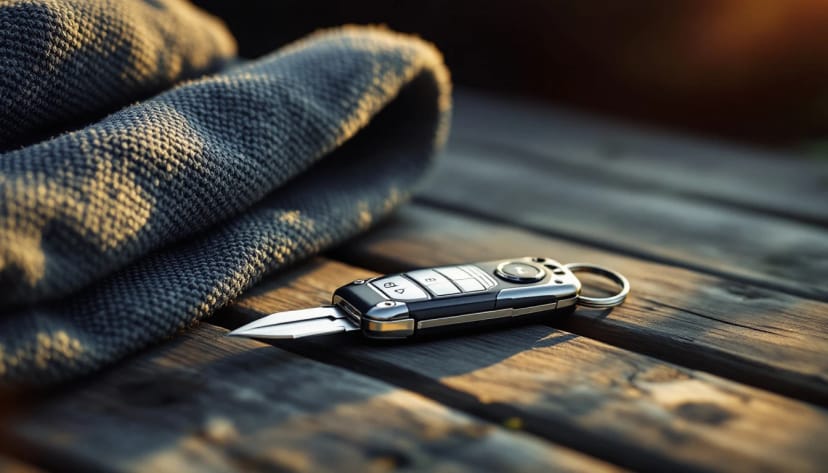
DIY test: most vehicles will let you start the engine by holding the fob directly against the push-button or against a specific spot on the steering column (passive entry override). Check your owner's manual for the location. If the engine starts with this method, the fob battery is the issue.
Fix: $5-$20 at any pharmacy, gas station, or auto parts store. Battery type is printed inside the fob (open it with a small flat screwdriver). CR2032 is the most common; CR2025 is slimmer and used on some Honda and Toyota fobs.
Lifetime: 2-4 years for daily-driver use. Replace as a $5 preventive maintenance item if your fob is 3+ years old.
Cause #2 — weak 12V vehicle battery
Push-button start systems require sufficient 12V battery voltage to power the immobilizer + start sequence. If the vehicle battery is below ~10.5V at rest, the push-button start can refuse to engage even though the dashboard lights up and the radio works.
Symptoms: clicking from under the hood when push-button is pressed, "ignition off" or "press brake to start" error despite brake being depressed, dim instrument cluster.
Test: jump the vehicle from another car. If push-button start works after the jump, the 12V battery is the issue. Replace battery: $180-$320 installed at most DFW auto shops, per AAA's 2024 driving cost data.
Frequency: roughly 15-20% of push-button-start failure calls. More common in Texas summer heat, which accelerates battery degradation.
Cause #3 — operator error (yes, really)
Easily 5-10% of calls turn out to be the driver not satisfying a precondition for start. The common ones:
- Brake pedal not fully depressed (automatic).
- Clutch not depressed (manual).
- Vehicle in any gear other than Park or Neutral.
- Steering wheel locked from being turned with the wheel locked at parking — try rocking the wheel left-right while pressing the start button.
- Multiple fobs in close proximity (rare, but some platforms get confused).
These are $0 fixes that don't require a service call. Try them before calling anyone.
Diagnostic triage table
As of August 2026, work down this table in order before you authorise any parts. The first two rows resolve the clear majority of push-button-start complaints and cost almost nothing.
| Cause | Tell-tale sign | Owner-fixable | Typical cost if not |
|---|---|---|---|
| Dead fob battery | Backup start method works, range dropped for weeks | Yes | Under $20 in parts |
| Weak 12V vehicle battery | Dim lights, slow crank, multiple warnings at once | Sometimes | Battery replacement |
| Operator error | Works after using the backup start position | Yes | None |
| Push-button switch failure | No click, no response, fob otherwise healthy | No | $150-$400 |
| Antenna ring failure | Backup start position also fails | No | $150-$400 |
| Electronic steering lock fault | Wheel stays locked, dash shows a steering warning | No | $150-$400 |
The most expensive mistake in this whole diagnostic is buying a replacement fob for what turns out to be a 12V battery problem. A weak main battery produces exactly the same symptom set as a failing key, and no amount of new key hardware will fix it.
Cause #4 — push-button switch failure
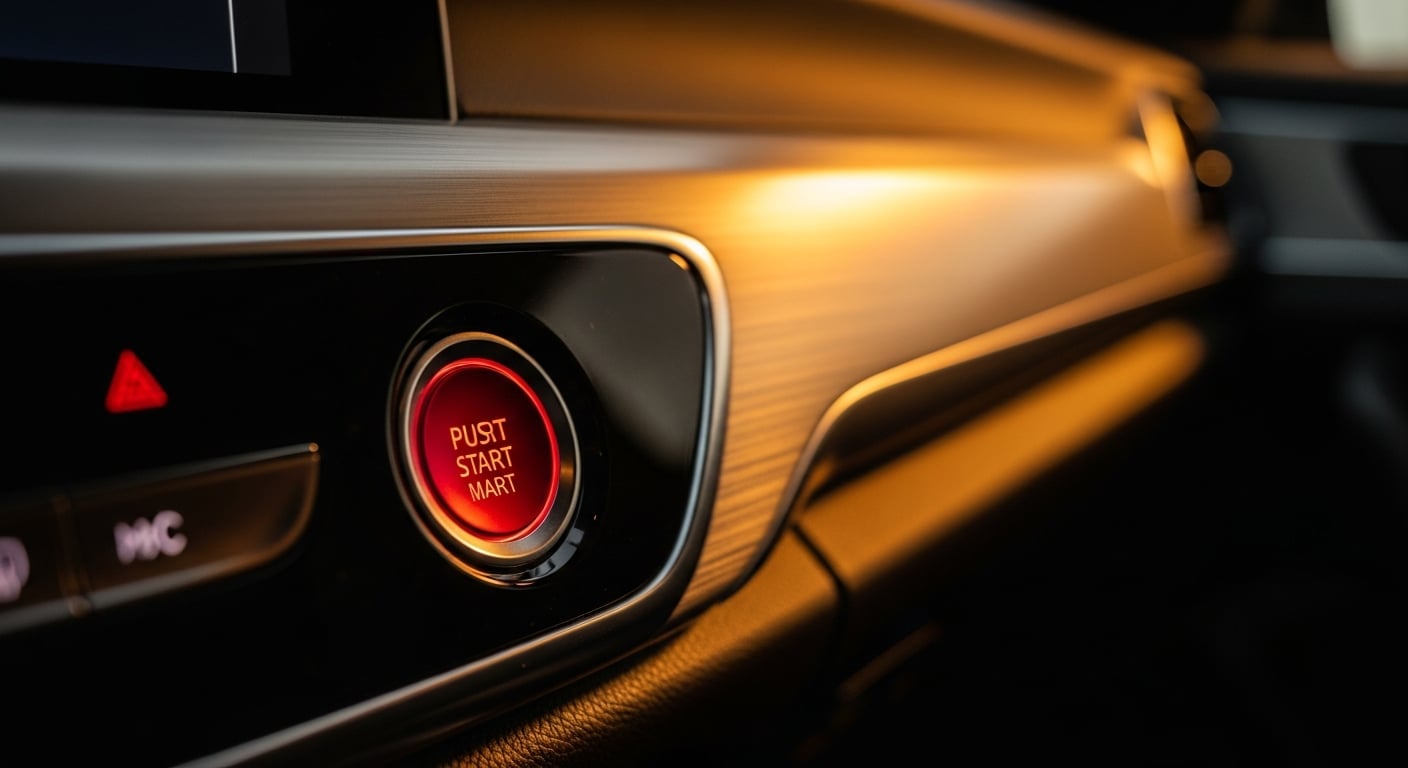
The button itself is a mechanical switch with finite cycles. After 200,000-500,000 presses (typical 10-15 year lifecycle on a daily driver), the contacts can fail.
Symptoms: button physically depresses but no click, no dashboard response. Sometimes works on multiple presses but not first press.
Test: a credentialed operator scans the BCM for "ignition switch status" while pressing the button. If the BCM doesn't see the press signal, the switch is the issue.
Fix: switch replacement $80-$220 depending on make. On most platforms this is a 20-45 minute job.
Frequency: 3-5% of calls, mostly on vehicles 8+ years old with high mileage.
Cause #5 — antenna ring failure
Modern vehicles have multiple LF antennas — typically one near the push-button or steering column, additional antennas in the door handles, trunk, and sometimes in the center console. These antennas have small coils that develop cold-solder joints over time, especially with temperature cycling.
Symptoms: works in some positions but not others (fob in pocket fails, fob in cup holder works, or vice versa). Works in summer but not winter. Works at the steering column but not at the door handle.
Test: a credentialed operator uses a diagnostic scanner that can read individual antenna status and isolate the failed unit.
Fix: $180-$500 depending on which antenna and access complexity. Steering column antennas are easiest; trunk and door-handle antennas can run longer.
Per J.D. Power's Customer Service Index data, antenna repair is one of the most under-diagnosed automotive electronics repairs — it's frequently misdiagnosed as a fob issue and "fixed" with a new fob that doesn't solve the actual problem.
Cause #6 — electronic steering lock (ESL) failure
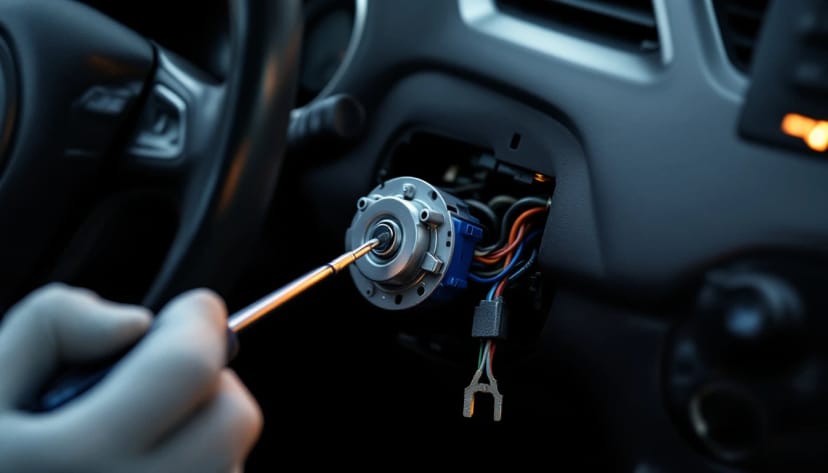
Vehicles with electric steering locks have an ESL module that releases the steering wheel when the push-button is pressed. When the ESL fails, the steering wheel remains locked and the push-button cannot complete the start sequence.
Symptoms: button press produces a click/clunk from the steering column, dashboard says "steering lock" or shows a steering wheel warning icon, engine does not crank.
Most affected platforms: certain Mercedes W211 / W219 / W203 production windows, some BMW E60 / E61, some Audi B6 / B7. The Mercedes ESL failure is the most common in the DFW used-luxury market.
Fix: ESL replacement $400-$900 depending on platform plus labor. Some Mercedes ESL units are bench-reflashable (EEPROM-level work) which avoids the part-replacement cost.
Frequency: 2-4% of push-button-start failure calls in Fort Worth, but much higher on certain Mercedes / BMW chassis.
Cause #7 — BCM or immobilizer module fault
The Body Control Module (BCM) — or equivalent immobilizer authority module — coordinates the push-button start sequence. When the BCM has an internal fault, the entire start sequence fails despite the fob and button being fine.
Symptoms: complete failure (no response when pressed), often accompanied by other electrical anomalies (lighting issues, central locking glitches, dashboard warning lights).
Test: scan the BCM for stored diagnostic trouble codes. BCM internal faults typically produce specific DTCs (B-codes or U-codes depending on protocol).
Fix: BCM replacement $400-$1,500 depending on platform + module pricing + programming. Some platforms (Land Rover, certain Audi) require EEPROM-level virginization of the swap-in BCM.
Frequency: 1-3% of calls. Higher on older vehicles (10+ years) and certain known-fault platforms.
Cause #8 — anti-theft lockout from previous failed programming
If your vehicle has had a prior locksmith programming attempt that failed mid-process, the immobilizer can enter a protected state that locks out all further programming attempts. Symptom: push-button-start fails completely, no codes register, manufacturer-side diagnostic shows "immobilizer locked."
This is more common than it should be in the DFW used-vehicle market — vehicles that have changed hands multiple times sometimes carry hidden lockouts from earlier owners' failed key-replacement attempts.
Fix: a credentialed operator can typically clear the lockout via OEM diagnostic access ($200-$400) or, on stubborn cases, EEPROM-level bench reset ($300-$600). Once cleared, normal programming can proceed.
Per the Better Business Bureau locksmith advisory, the prior-failed-attempt scenario is one of the most common reasons customers find themselves with vehicles the dealer claims are "BCM replacement" jobs when they're actually $200-$400 lockout resets.
When you really do need a new fob
After ruling out 1-10 above, the remaining cases where you genuinely need new fob hardware:
- Fob physically damaged by water, drop, or crush — internal electronics failed and cannot be repaired economically.
- Fob fluid contaminated (washing machine, swimming pool) — sometimes recoverable with thorough drying + chip transplant to new housing, but often not worth the labor.
- All keys genuinely lost (no working fob exists) — AKL programming is the only path.
In these cases, expect Fort Worth 2026 pricing per the smart-fob or transponder-key articles for your specific platform. The diagnostic discipline matters: arriving at "you need a new fob" should be the conclusion of a process of elimination, not the first answer.
Per BLS Occupational Employment data on the locksmith trade, the credentialed operator's value-add on push-button-start calls is the diagnostic discipline — distinguishing $5 fixes from $1,000 fixes is where the credential actually pays for itself.
Field-operator perspective
My first 90 seconds at every push-button-start call is the diagnostic question: when was the last time the fob battery was replaced? Maybe 50% of the time the answer is "never" or "I don't know" and the fob is 3-5 years old. Replace the battery on the spot — $5 — problem solved. The operator who walks straight to "you need a new key fob, that's $400" is the one you should be skeptical of.
— ALOA Master Automotive Locksmith (MAL), 11 years experience, DFW metroplex (anonymized)
A real-world example
Operator: Anonymized 2016 BMW 535i (F10) owner, residential driveway in Arlington, intermittent push-button-start failure
Before:
- Symptoms developing over 2 months — push-button start would work sometimes, fail other times, more often when cold.
- BMW Arlington dealer quote: $1,420 covering "fob replacement + module diagnostics," 5-day appointment wait.
- Customer suspected the dealer was over-quoting based on the diagnostic pattern (cold-morning failure suggested antenna, not fob).
What changed: Customer called a NASTF-registered mobile operator. Pre-dispatch quote: $85 diagnostic visit + flat-rate-range for whatever the diagnosis revealed. Technician arrived in 38 minutes, scanned the BCM and FEM, isolated the issue to the steering-column antenna ring (cold-solder joint on the LF coil). Replaced the antenna ring on-site in 95 minutes.
Outcome:
- Final invoice: $85 diagnostic + $320 antenna ring repair = $405 total.
- Push-button-start tested working in all expected conditions (cold, hot, fob in various positions).
- 90-day labor warranty + 1-year part warranty.
- Original fob retained — no replacement needed.
Net: Customer saved approximately $1,015 vs the dealer's "new fob + module diagnostics" quote. The dealer would have replaced the fob (irrelevant to the actual problem), found the antenna issue eventually, and charged for both. The mobile diagnostic discipline — scan first, identify the actual fault, fix the actual fault — is what produced the cost delta. Per J.D. Power's CSI data, this kind of misdiagnosis-driven over-charging is a documented dealer-side pattern, not specific to this incident.
Frequently Asked Questions
My push-button start does nothing — what should I try first?
Three free checks: (1) press the brake all the way to the floor (or clutch on manual), (2) try holding the fob directly against the push-button or steering column (passive entry override location is in your owner's manual), (3) try jumping the vehicle from another car if you suspect 12V battery weakness. If any of these gets the car started, the underlying issue is one of those — not a fob replacement need.
How do I know if it's my key fob battery vs the fob itself?
Replace the CR2032 / CR2025 battery first ($5 at any pharmacy). If the issue resolves, it was the battery. If it doesn't, the next test is whether passive-entry override (holding the fob directly against the start button area) works — if yes, your fob is fine and the issue is elsewhere (likely antenna or BCM). A credentialed operator can confirm by scanning whether the fob signal is reaching the vehicle.
Why does my push-button start work sometimes and not others?
Intermittent failure usually points to one of: (a) weak fob battery (will get progressively worse), (b) failing antenna ring with cold-solder joint (temperature-dependent), (c) BCM internal fault with marginal failure pattern, (d) ignition switch wear on older vehicles. The intermittent pattern is your diagnostic clue — the operator should ask whether failures correlate with temperature, fob position, or specific times of day.
Can I damage my car by repeatedly pressing the push-button start?
No. Pressing the button when the car won't start is harmless. The button is a small electronic switch, not a starter trigger — the BCM controls the actual start sequence and will simply ignore presses when start preconditions aren't met. Press as many times as you want while troubleshooting.
My dealer says I need a new BCM — is that right?
Sometimes, but BCM replacement should be the conclusion of a process of elimination, not the first answer. A credentialed independent operator can typically diagnose at the same depth as the dealer for a flat fee ($65-$150) and produce a second opinion. If the dealer's BCM diagnosis is correct, the independent operator will confirm; if a cheaper repair (antenna, switch, lockout reset) addresses the symptom, you save 60-80% of the dealer's BCM quote.
Should I call a locksmith or a mechanic for push-button-start failure?
Depends on the diagnosis. If the symptom points to fob, antenna, BCM, ESL, or anti-theft lockout: locksmith. If the symptom points to 12V battery, starter motor, fuel system, or engine-side issue: mechanic. A credentialed locksmith can scan and diagnose to determine which trade is right — if it's not a locksmith-scope job, they tell you (and you pay only the diagnostic fee, not the full repair).
References & external sources
- FTC Consumer Advice — Hiring a Locksmith — Federal Trade Commission guidance on verifying locksmith legitimacy before service.
- Better Business Bureau — Locksmith Scam Advisory — BBB consumer protection guidance on locksmith bait-and-switch operators.
- Associated Locksmiths of America (ALOA) — Trade association governing locksmith certifications including the Master Automotive Locksmith (MAL) credential.
- J.D. Power — Customer Service Index — Annual study of dealership service department satisfaction and cost.
- AAA — Your Driving Costs 2024 — Annual ownership cost study including unscheduled maintenance projections.
- U.S. Bureau of Labor Statistics — Occupational Employment and Wages, Locksmiths (49-9094) — BLS OEWS national wage + employment data for locksmith occupation.
- NASTF Vehicle Security Professional (VSP) Registry — National Automotive Service Task Force registry for credentialed access to OEM security data.
Related Pages
- No Key Detected / Immobilizer
- Key Fob Programming
- Module Programming
- Ignition Repair
- Smart Key Fob Replacement
Talk to a technician about your push-button start fault
Every vehicle is different, and the fastest way to a real number is a short call with the VIN in front of you. We will tell you the band, the realistic time on site, and anything about your specific car that changes either.
Call or text 817-842-1256, Mon-Sun 8AM-8PM. We are fully mobile across Fort Worth and Tarrant County, or reach us through the contact page.