TL;DR — transponder key work, summarized
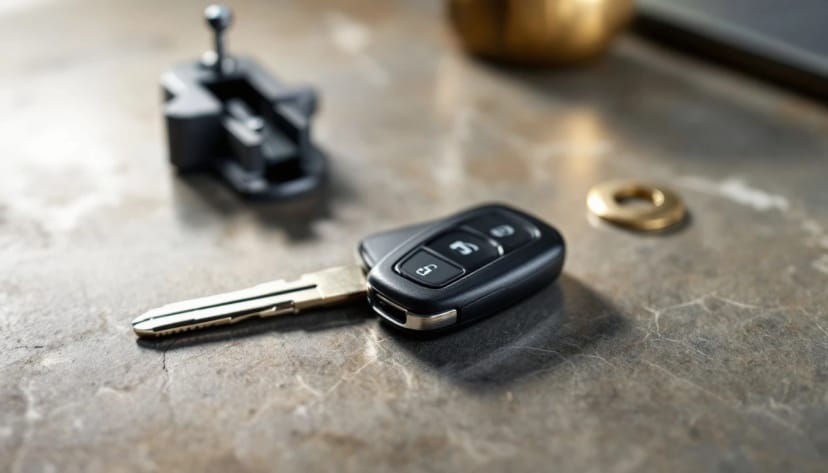
A transponder key is the mechanical-plus-chip key that authenticates only when keyed (no buttons, no push-button start). It dominated automotive design from roughly 1995 through 2015 and is still common on entry-trim sedans, fleet vehicles, and older platforms in the Fort Worth used-car market.
As of September 2026, Fort Worth pricing ranges are:
- Spare transponder key (working key present, mass-market): $120-$220
- All-keys-lost transponder (mass-market domestic/Asian, 2005-2015): $250-$450
- Pre-2005 chip-key (simpler systems): $90-$180 spare, $200-$350 AKL
- Encrypted platforms (Toyota 8A, Ford H75/H85, GM Hitag2): $200-$320 spare, $350-$600 AKL
The technical context that matters: not all transponder chips are equal. A Philips ID33 (early generic chip) is programmable with $300 of generic tooling. A Texas Instruments DST80 / Toyota 8A is encrypted and requires NASTF VSP-level OEM data access or specialized tooling running $3,000-$6,000. Pricing reflects this real cost difference.
How transponder keys actually work
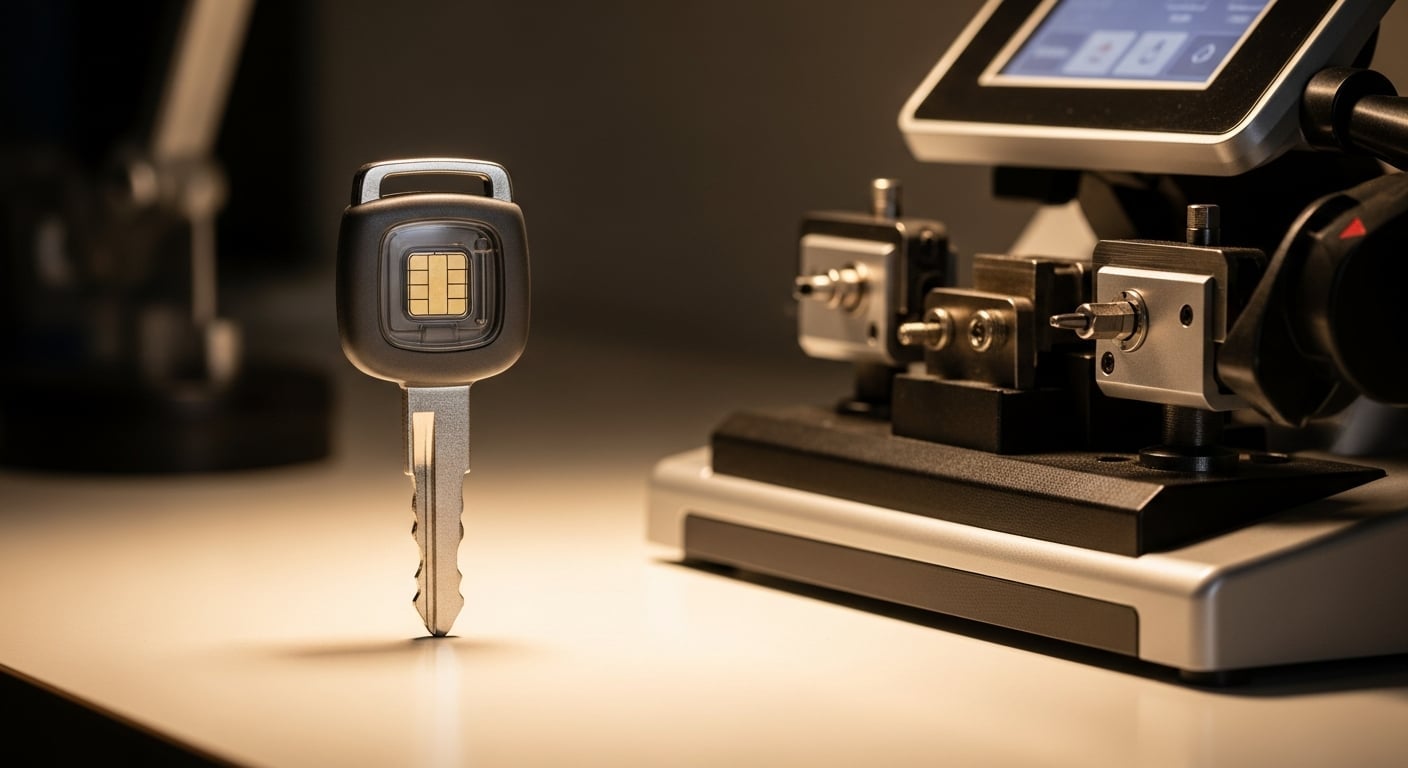
Inside the plastic key head: a tiny inductively-powered RFID chip — no battery. When you insert the key into the ignition and turn, the antenna ring around the ignition cylinder generates a low-frequency RF field (typically 125 kHz). That field powers the chip just enough to wake up, receive a cryptographic challenge from the vehicle, compute a response, and transmit it back.
The vehicle's immobilizer module (PATS on Ford, PCM on GM, ECM/BCM on most others) verifies the response. If it matches, the immobilizer enables the engine. If it doesn't match, fuel injectors stay disabled and the engine cranks but doesn't start.
The cryptography varies by chip generation:
- Philips ID33, ID40, ID42 (Megamos generation 1): 1995-2005, mostly fixed-code, easy to clone.
- Texas Instruments DST40: 2005-2014, rolling code, requires OEM data or sophisticated tooling.
- TI DST80 / Toyota 8A: 2014-present, AES-encrypted, requires NASTF VSP access or top-tier aftermarket tooling.
- NXP Hitag2: GM domestic, late-1990s through 2010s, varies in security level by generation.
- Megamos AES: VW, Audi, and others 2010s+, AES-encrypted, requires specialized tooling.
Per the NHTSA's published guidance on anti-theft systems and FMVSS 114, the entire transponder/immobilizer architecture exists specifically to prevent unauthorized key generation — and the cryptography evolution is driven by each generation's resistance to theft.
Spare-key add (working key present)
When you have a working transponder key, the locksmith can typically clone or pair a new key without OEM data access. The process: connect to the vehicle's OBD-II port (or the ignition antenna on older platforms), read the rolling-code or fixed-code data from the working key, write that data to the new chip, cut the mechanical blade from the lock or VIN.
Typical time on-site: 20-45 minutes for mass-market platforms. Pricing:
- Pre-2005 Philips / fixed-code: $80-$160
- 2005-2014 DST40 / mass-market: $120-$220
- 2014+ DST80 / encrypted: $180-$320
The spare-key job is the highest-value preventative purchase you can make on any transponder-equipped vehicle. AKL costs run 2-3× spare-add costs — losing both keys after never having added a spare is the textbook expensive mistake.
All-keys-lost transponder programming
When no working key is available, the job changes substantially. The locksmith needs OEM-level access to the immobilizer module to write a new transponder-vehicle pairing from scratch. This requires either:
- NASTF VSP registry credentials with the appropriate manufacturer-data subscription, or
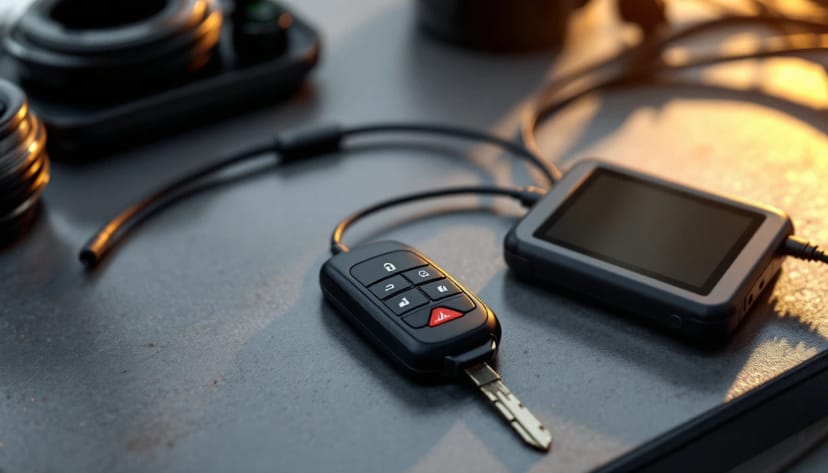
- Specialized aftermarket tooling (Autel IM608, AVDI, Xhorse Key Tool Plus) with relevant make-specific modules and current data subscriptions.
Time on-site for AKL transponder work: 45-120 minutes depending on platform. The job sequence:
- Verify ownership documents.
- Scan the immobilizer module for current pairing data and any stored fault codes.
- Authenticate to the immobilizer via NASTF-credentialed data access.
- Cut the mechanical blade from the VIN-derived key code (or by decoding the door / ignition lock).
- Write new pairing data into both the new transponder chip and the immobilizer module.
- Verify the new key starts the vehicle and operates all functions correctly.
Pricing in Fort Worth 2026:
- Domestic mass-market (Ford PATS, GM Hitag2, Chrysler SKIM/SKREEM): $250-$450
- Asian mass-market (Honda, Nissan, older Toyota DST40): $250-$450
- Toyota 8A / DST80 platforms: $300-$550
- VW / Audi Megamos AES (pre-MQB): $400-$700
- Land Rover / Jaguar older: $500-$900
Chip families and what they cost
Transponder pricing is driven by the chip family inside the key head, which correlates closely with make and era.
| Chip family | Common makes | Typical era | Fort Worth range |
|---|---|---|---|
| Fixed-code (4C, 4D) | Toyota, Honda, Ford, GM | 1997-2010 | $120-$200 |
| Crypto (46, 4D-6x) | Nissan, Chrysler, Hyundai, Kia | 2004-2016 | $120-$200 |
| 128-bit AES (G, H, Hitag-AES) | Toyota, Lexus, Ford, GM | 2010-present | $120-$200 |
| European crypto | VW, Audi, BMW, Mercedes | 2004-present | $350-$800 |
Note that the first three rows land in the same band. The chip generation changes how long the job takes and which tool is required, but for mainstream makes it does not change your price much. The jump happens when you cross into the European column.
Common transponder key failure modes
Many "I need a new transponder" calls are actually something else. The five most-common diagnoses:
- Chip damage from drops or water exposure: rare but real. If the chip is physically damaged, the working key fails. Replace chip (not full key) where possible: $40-$120.
- Antenna ring failure (the LF coil around the ignition cylinder): cold-solder joint or coil damage. Symptoms: key works intermittently, especially in temperature extremes. Repair = antenna replacement, $180-$400.
- Immobilizer module fault: BCM, ECM, or PCM has an internal fault. Repair = module replacement and re-programming, $400-$1,200.
- Cylinder mechanical failure: the key cylinder is worn or broken, key won't turn fully. Repair = cylinder replacement, $200-$500.
- Anti-theft lockout from previous failed programming: reset by a credentialed operator, $150-$350.
Per the Better Business Bureau locksmith scam advisory, a common scam pattern is operators who skip diagnosis and sell a new key for a problem that isn't actually a key problem. A credentialed operator scans first.
Chip-by-chip pricing logic
Why different chips cost different amounts, in operational terms:
- Older Philips / fixed-code: hardware cost $2-$8, tooling already amortized across millions of operations. Cheap to program.
- TI DST40: hardware $8-$25, tooling cost moderate ($800-$2,500 amortized). Mid-tier pricing.
- TI DST80 / Toyota 8A: hardware $25-$60, tooling cost high ($3,000-$6,000 plus annual subscription). Higher pricing reflects real tooling cost.
- Megamos AES (VW/Audi): hardware $30-$80, tooling cost very high ($4,000-$8,000), required-tools specialized. Highest mass-market pricing.
Per BLS Occupational Employment data on the locksmith trade and the Associated Locksmiths of America credentialing standards, the tooling and continuing-education investment required to do encrypted transponder work at the credentialed level is significant — and the pricing reflects it. A locksmith offering "any car key, $79" is either advertising bait or skipping the encryption-tier work.
When the dealer is the right call
For routine transponder programming, the dealer is almost never the most cost-effective path. Per J.D. Power's Customer Service Index analysis, dealer-side transponder pricing runs 1.6-2.2× independent mobile rates, before tow.
The narrow set of cases where dealer makes sense:
- Open recall or TSB on your specific chassis touches the immobilizer system.
- The vehicle is already at the dealer for other warranty work.
- A specific TSB-required calibration is part of the work.
For the other 95%+ of transponder programming work in Fort Worth, mobile is faster, cheaper, and more flexible.
Verification checklist before booking transponder work
Before authorizing dispatch:
- The operator names the chip type and tooling for your specific year/make/model (e.g., "Toyota 8A on your 2018 Camry — we use Autel IM608 Pro with the Toyota 8A module").
- They quote a flat-rate price range, in writing.
- They are NASTF VSP-registered if your platform requires OEM data access (most 2014+ encrypted platforms).
- They are Texas DPS-licensed (verify on the TX DPS public lookup).
- They will scan your vehicle for fault codes before cutting any key.
- They issue a written invoice with company license number, chip type installed, and warranty terms.
A transponder job that satisfies all six is a job worth booking.
Honest boundaries
Transponder work is one of the more predictable corners of automotive locksmithing, but it is not unlimited, and the limits are worth stating before you call.
The newest encrypted platforms need verification rather than a phone promise. Vehicles from roughly the last two or three model years, along with Volkswagen Audi Group cars carrying Component Protection and Mercedes platforms on FBS4, sit behind manufacturer-side authorization that independent tooling does not reach on every model year. On those the honest answer starts with your VIN and ends with a technician confirming your exact setup.
A key does not fix a mechanical ignition. If the cylinder is worn, the wafers are damaged, or the steering column lock has failed, a perfectly programmed key still will not turn. That is a separate repair, and an operator who quotes you a key when the real fault is the cylinder has misdiagnosed the job.
Maximum key count is real. Some platforms cap how many credentials the immobilizer will hold. When a vehicle is at its limit, an existing key has to be deleted before a new one is written — which is straightforward, but it means every key you own should come to the appointment.
No credential without proof of ownership. On any all-keys-lost transponder job we check the title or a current registration against a government-issued photo ID in a matching name and record it on the invoice. The FTC's consumer guidance on hiring a locksmith treats that verification as a baseline expectation, and immobilizer access is exactly the kind of power that earns the check.
How the on-site visit works in Fort Worth
We are mobile-only, which is the right shape for this work — a car that will not start is a car that is not driving to a service department. Hours are 8AM to 8PM, seven days a week, across Fort Worth and Tarrant County.
The call comes first and should be specific: year, make, model, and whether you have a working key. Those four facts determine the chip family, the tooling loaded on the van, and whether the job is a spare-key add or a full all-keys-lost recovery. You get a flat-rate range before anyone is dispatched.
On arrival the technician verifies ownership, then scans the vehicle before cutting anything. That scan matters more on transponder work than most people expect, because a meaningful share of "I need a new key" calls turn out to be an antenna ring, a tired 12-volt battery, or a worn cylinder — the failure modes listed above. Diagnosing first is what keeps you from paying for a key that was never the problem.
Once the diagnosis holds, the blade is cut from your vehicle's key code rather than traced from a worn original, the chip is written into the immobilizer, and every key you own is tested before the invoice: start, restart after a full shutdown, and the mechanical blade in the driver's door.
Coverage runs across Fort Worth and out to Arlington, Bedford, Hurst, Keller and North Richland Hills. If you want the cross-service pricing picture first, our guide to car key replacement cost in Fort Worth TX sets the context, and if you are not certain what kind of key you are holding, transponder key vs key fob sorts that out in about a minute.
Talk to a technician
Call 817-842-1256 with your year, make and model and we will name the chip family, the method, and a flat-rate range before anyone is dispatched — 8AM to 8PM, seven days a week, anywhere in Fort Worth and Tarrant County.
Field-operator perspective
The biggest misconception about transponder keys is that they're all the same. A 2003 Toyota Camry and a 2020 Toyota Camry both have transponder keys — but the 2020 has a DST80 chip with AES encryption and needs a $4,000 tool plus a NASTF data subscription to program. The 2003 needs a $300 tool. Same brand, same model, completely different jobs. When a locksmith doesn't know which they're dealing with on the phone, that's a red flag.
— a NASTF-registered Fort Worth automotive locksmith, ALOA Master Automotive Locksmith (MAL) credential, DFW metroplex (anonymized)
A real-world example
Operator: Anonymized 2017 Toyota Tacoma owner, residential garage in Bedford, AKL on Toyota 8A platform
Before:
- Customer lost both transponder keys during a fishing trip — keys went into a lake.
- Toyota dealer quote: $480 + $185 tow = $665, 4-day wait for keys to arrive.
- First non-dealer call (paid ad operator): "starts at $89" — refused to commit to a price range when pressed on chip type.
What changed: Customer called a NASTF-registered mobile operator. Pre-dispatch flat-rate quote: $345-$395 covering Toyota 8A AKL on the Tacoma, 2 keys programmed, 90-day labor warranty. Technician arrived in 41 minutes, verified ownership (TX DL + insurance card + title), used Autel IM608 Pro with Toyota 8A module to execute AKL in 62 minutes on-site.
Outcome:
- Final invoice: $360 (within quoted range). No tow.
- Two working transponder keys delivered.
- 90-day labor + 1-year transponder hardware warranty.
- Total time from initial call to working vehicle: 1 hour 43 minutes.
Net: Customer saved approximately $305 vs the dealer path, plus 4 days of dealer wait that would have meant a rental or rideshare cost. Per AAA driving cost averages, 4 days of alternate transport in DFW runs $120-$240 in additional indirect cost. Total economic delta: $425-$545 in mobile path's favor.
"Chip key replacement" — the same job under a different name
Worth saying plainly, because it is the phrase most people actually use on the phone: a chip key and a transponder key are the same thing. The chip is the transponder. If you have been searching for chip key replacement, everything on this page applies to you, and the pricing is identical because it is one job.
The reason two names exist is historical. Manufacturers called the component a transponder; owners called it "the chip in the key" because that is what a dealer told them when they asked why a hardware-store copy would not start the engine. Both are correct. What matters is that a chip key is not a plain metal key with a fancier head — it is a security credential, and the credential has to be written into your vehicle before the engine will run.
That distinction is the whole reason a key from a marketplace listing arrives and disappoints. The blade can be cut, the plastic can be a perfect match, and the engine still will not start, because the chip inside was never registered to your immobilizer. What you bought was a component. The job is the registration.
September 2026 field notes
Updated for September 2026. Prices on this page are unchanged from our August figures. What follows is what these visits have actually looked like recently.
The spare-key visit is still the one people regret skipping. The gap between adding a key while one works and rebuilding a key list from nothing is the largest single price jump in automotive lock work, and it is entirely under the owner's control right up until the moment it is not. We put real numbers on that trade-off in bought a used car with one key, which is worth five minutes if your car currently has exactly one key on the ring.
Chip generation mismatches are the most common failed-DIY we are called to finish. A listing describes a key as fitting a broad model-year span, the span actually contains two different chip generations, and the customer receives hardware that cannot be made to work by programming harder. The tell is a key that turns the ignition normally and produces either a crank-and-die or a no-crank with a security light. The remedy is the correct generation, not another attempt at the same part. Before buying anything, confirm the generation, the blade profile and the frequency with an operator who can read your existing key.
Mainstream sedans and crossovers remain the bulk of the work, and the process is well-trodden on all of them. If your vehicle is one of the common ones, the make-specific notes are more useful than a general guide: Honda Civic key replacement, Ford Escape key replacement and Volkswagen Jetta key replacement each cover the platform quirks that decide how long the visit takes. For larger family vehicles, Chevrolet Traverse spare keys covers the add-a-key case on a three-row crossover.
One boundary that has not moved. On the newest and most heavily encrypted platforms, the security data needed to write a key is released through a documented channel to vetted locksmiths, and a small number of systems sit outside that framework entirely. Where your vehicle is one of them, the honest answer is the dealer, and we would rather tell you that on the phone than after a wasted visit. That has been true all year and remains true in September.
Frequently Asked Questions
What's the difference between a transponder key and a smart key fob?
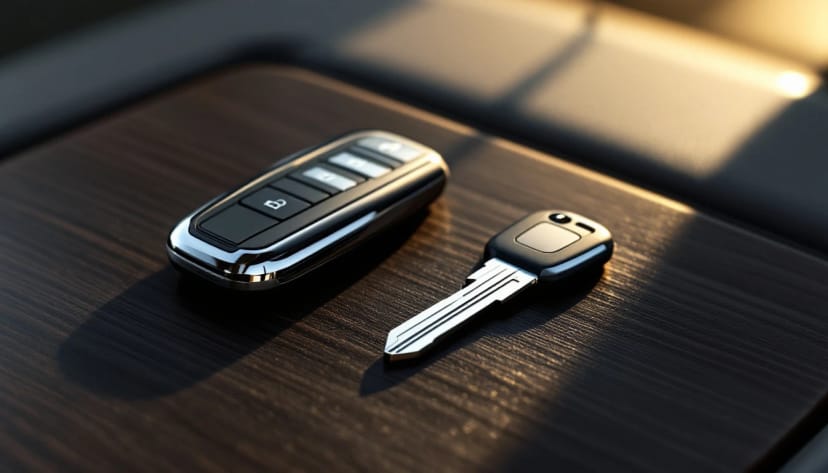
A transponder key is a mechanical key with an embedded RFID chip — it must be inserted into the ignition and turned to authenticate. No buttons. A smart key fob is wireless — it authenticates from a few feet away via short-range RF and lets you start the vehicle with a push-button. Smart fobs are more cryptographically complex and more expensive. Most vehicles built between 1995-2015 use transponder keys; most built 2015+ use smart fobs.
How much does it cost to program a transponder key in Fort Worth?
2026 ranges by chip type: pre-2005 Philips / fixed-code: $80-$180 spare, $200-$350 AKL. 2005-2014 DST40 / mass-market: $120-$220 spare, $250-$450 AKL. 2014+ DST80 / Toyota 8A / Megamos AES: $180-$320 spare, $300-$700 AKL. The price differences track real differences in chip cost, tooling cost, and labor time per chip generation.
Can I clone my transponder key at AutoZone or a hardware store?
For very old, fixed-code transponders (pre-2005 Philips ID33/ID40 generation), sometimes yes — these chips are cloneable with $100-$300 of tooling. For rolling-code or encrypted chips (DST40, DST80, Megamos AES, Hitag2 later generations), no — the cryptography requires OEM data access or specialized tooling that AutoZone and hardware stores do not have. If your vehicle is 2010 or newer, plan on professional programming.
Why does the chip in my key cost more than the metal blade?
The hardware cost of the chip itself ranges from $2 to $80 depending on generation. The cost you're really paying is for the tooling and the labor: $1,500-$8,000 in shop tooling per chip family, plus $50-$300/year in OEM data subscriptions, plus skilled labor at $35-$65 per hour all-in. A correctly-priced transponder key job amortizes that infrastructure across many calls — the per-job price reflects the per-call share of those costs.
Why does my transponder key work some days and not others?
Most commonly the antenna ring around the ignition cylinder has developed a cold-solder joint or coil damage — this causes intermittent reading of the chip. Temperature extremes (very hot or very cold mornings) reveal the failure first. Other suspects: weak / contaminated chip (rare but possible), immobilizer module fault, or worn ignition cylinder. Diagnose before replacing the key — many of these are $200-$400 antenna repairs, not $400+ key replacements.
How long does transponder programming take in my driveway?
Spare-key adds: 20-50 minutes for most platforms. All-keys-lost: 45-120 minutes for mass-market 2005-2014 platforms; 60-150 minutes for encrypted post-2014 platforms. Pre-2005 fixed-code work can run as short as 15-25 minutes. Operators quoting 5-10 minute programming on any modern (post-2005) AKL job are over-promising — the work cannot legitimately complete that fast.
References & external sources
- NHTSA — Anti-Theft Systems & FMVSS 114 — Federal Motor Vehicle Safety Standard governing key-code and immobilizer disclosure.
- Associated Locksmiths of America (ALOA) — Trade association governing locksmith certifications including the Master Automotive Locksmith (MAL) credential.
- NASTF Vehicle Security Professional (VSP) Registry — National Automotive Service Task Force registry for credentialed access to OEM security data.
- Texas Department of Public Safety — Private Security Licensing — Texas locksmith company + individual licensing requirements.
- J.D. Power — Customer Service Index — Annual study of dealership service department satisfaction and cost.
- Better Business Bureau — Locksmith Scam Advisory — BBB consumer protection guidance on locksmith bait-and-switch operators.
- U.S. Bureau of Labor Statistics — Occupational Employment and Wages, Locksmiths (49-9094) — BLS OEWS national wage + employment data for locksmith occupation.
- AAA — Your Driving Costs 2024 — Annual ownership cost study including unscheduled maintenance projections.