Start with the free fix — most no-turn calls end here
If your car key won't turn in the ignition in Fort Worth, do not reach for the phone or the pliers yet. The single most common cause costs nothing to fix, and forcing the key is the one move that reliably turns a cheap problem into an expensive one. As of September 2026, a large share of "my key won't turn" calls trace back to a steering-column lock binding against the ignition — a condition you can usually release yourself in ten seconds.
This guide walks the diagnosis in the right order: the free fixes first, then an honest breakdown of how to tell whether the problem is the key or the ignition cylinder, then real Fort Worth repair pricing. The goal is to make sure you don't pay for a cylinder replacement when a $0 steering-wheel wiggle — or a $120-$200 fresh key — would have solved it.
Fort Worth Car Keys is a mobile operation. If it does turn out to be the key or the ignition, we come to you and fix it on-site — no tow. Reach a technician at 817-842-1256 or contact@fortworthcarkeys.com.
The steering-lock bind — the number-one cause
When you park and remove the key, most vehicles engage a steering-column lock that physically pins the steering wheel. If the front wheels are turned or a tire is resting against a curb, the weight of the vehicle loads that lock against the ignition cylinder. The result: the key won't turn because the lock and the cylinder are jammed against each other under load.
The fix is simple and free. With the key inserted, apply light, steady turning pressure — not force — while firmly rocking the steering wheel left and right. As the wheel moves, the load on the steering lock releases for an instant, and the key turns right through. This resolves a very large fraction of no-turn situations, especially on cars parked on Fort Worth's hills and angled street parking.
Two related free checks before you go further:
- Confirm Park. On automatic transmissions, an ignition often won't turn (or the shifter interlock won't release) unless the transmission is fully in Park. Jiggle the shifter firmly into Park and try again.
- Try your spare key. If a spare turns and the original doesn't, you've just diagnosed a worn key — the cheapest possible outcome. Stop here and plan a fresh key rather than an ignition repair.
Per the Federal Trade Commission's guidance on hiring a locksmith, a reputable operator will happily talk you through these free steps on the phone before dispatching anyone. An operator who insists on an immediate paid visit without walking the free checks is a caution sign.
Do not force it — here's why
The strongest instinct with a stuck key is to muscle it. Resist it. The key blade is the weakest point in the whole system, and forcing it against a bound cylinder is the classic way to snap the blade off inside the ignition. That converts a free steering-lock release — or an inexpensive key re-cut — into a broken-key extraction plus, frequently, a full cylinder replacement.
Per the National Highway Traffic Safety Administration's anti-theft systems guidance, the ignition lock and immobilizer are engineered as a security assembly; they are not designed to absorb brute force, and a bent or seized wafer stack behaves worse, not better, under pressure. If gentle turning plus steering-wheel rocking doesn't free the key, stop and diagnose. The extra ten minutes of patience routinely saves the difference between a $0 fix and a $150-$400 repair.
Is it the key or the ignition? An honest diagnostic table
Once the free fixes are ruled out, the question is whether the problem lives in the key or in the ignition cylinder. They have very different costs, so getting this right matters. Here is the honest diagnostic read.
| Symptom | Most likely cause | Typical fix | Cost band |
|---|---|---|---|
| Spare key turns, original doesn't | Worn original key | Cut a fresh key | Transponder key $120-$200 |
| Every key is loose, sticky, or needs jiggling | Worn ignition cylinder | Replace/rebuild cylinder, keyed to your key | Ignition repair $150-$400 |
| Key won't insert fully or cylinder won't move with a fresh key + free steering | Seized or failed cylinder | Cylinder replacement | Ignition repair $150-$400 |
| Key turns but engine won't crank/start | Immobilizer or transponder (not mechanical) | Diagnose fob/antenna/anti-theft, reprogram if needed | Lost/damaged fob $180-$450 |
| Key won't turn only when parked on a slope | Steering-column lock bind | Rock the wheel while turning | Free |
| Can't get into the car at all to try the key | Lockout (separate issue) | Non-destructive entry | Lockout $75-$200 |
Read the table top to bottom as a decision tree. The cheapest outcomes are at the top — a worn key ($120-$200) or a free steering fix. The cylinder repairs ($150-$400) sit in the middle. And critically, the last two rows are different problems entirely: a key that turns but won't start is an electronic issue, and a car you can't even open is a lockout, not an ignition fault. A good technician confirms which row you're in before quoting anything.
The worn-key path — the cheap outcome
Keys wear. Every insertion drags the metal blade across the cylinder's spring-loaded wafers, and over years the cut edges round off. A worn key still works for a while — you learn to "jiggle it just right" — until one day it doesn't. If your spare turns cleanly but your daily key doesn't, this is you.
The fix is a fresh key cut to factory specifications, either from your VIN or by decoding the cylinder. On a modern vehicle that fresh key also carries a transponder chip, so it's programmed at the same time; a fresh transponder key falls in the $120-$200 band. This is not only the cheapest fix — it's also preventive. A worn key accelerates wear inside the cylinder, so replacing it early often heads off a later $150-$400 cylinder repair. If you're already jiggling the key to start the car, cutting a new one is the high-value move.
For more on how key cutting and chip programming work together, see the transponder key programming service.
The worn or seized cylinder — the ignition repair path
If every key you try is loose or sticky in the ignition, the cylinder itself is worn. If no key will turn even with a fresh key and freed steering lock, the cylinder is likely seized. Both are genuine ignition repairs.
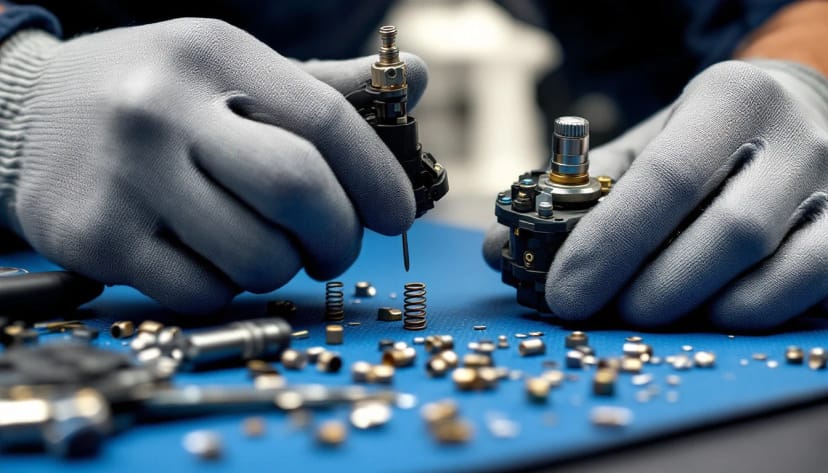
The work: the technician removes the lock cylinder from the steering column, then either rebuilds it with fresh wafers and springs or installs a replacement cylinder. On most vehicles the new cylinder is keyed to match your existing key, so you don't walk away carrying two different keys for one car. As of September 2026, this ignition repair runs $150-$400 depending on the vehicle, the cylinder design, and whether the replacement has to be re-keyed to your current key. A mobile automotive locksmith performs the majority of these jobs on-site in 30-90 minutes — no tow, no dealer appointment.
The ignition repair service page covers the cylinder and switch work in detail, and if the steering-column lock mechanism itself is the fault — not just the cylinder — the steering column lock repair service addresses that specific assembly.
When the key turns but the car still won't start
There's an important branch that isn't an ignition problem at all: the key turns physically, but the engine won't crank or start. That points at the electronic security system rather than the mechanical lock. Common culprits are a weak smart-fob battery, a failed antenna ring around the ignition, an immobilizer fault, or an anti-theft lockout left over from a previous failed programming attempt.
Per the Associated Locksmiths of America credentialing standards and the NASTF Vehicle Security Professional program, diagnosing this correctly requires a scan tool that reads the immobilizer's status — which is exactly why a credentialed automotive locksmith scans before touching anything. Replacing a cylinder to fix an electronic no-start is a wasted repair. If your symptom is "turns but won't start," the fix is in the fob, antenna, or immobilizer — potentially a lost or damaged fob replacement in the $180-$450 band — not the mechanical ignition.
The cost of getting the diagnosis wrong
The reason to diagnose in order — free fixes, then key, then cylinder, then electronics — is that each step up the ladder costs more, and paying for the wrong one is pure waste. Four numbers frame the stakes: the steering-lock fix is $0; a worn-key re-cut is $120-$200; an ignition cylinder repair is $150-$400; and an electronic no-start tied to a fob can run $180-$450. A driver who jumps straight to "replace the ignition" when the real problem was a bound steering lock has spent hundreds of dollars solving nothing.
Per AAA's Your Driving Costs research, unscheduled vehicle repairs are already one of the least predictable line items in ownership; a misdiagnosed ignition adds avoidable cost on top of that. And per the Insurance Institute for Highway Safety, the vehicle is central enough to daily life that the downtime from a wrong repair — a car sitting undriveable while the actual problem goes unaddressed — carries its own cost. Ordered diagnosis is how you avoid both.
Credentials — who should touch your ignition
Ignition work involves your vehicle's security assembly, so the operator's credentials matter. In Texas, locksmith companies and technicians are licensed by the Texas Department of Public Safety Private Security Bureau — not a general trade board and not a general trade board. Ask for the DPS license number; a legitimate operator provides it on request.
Beyond the state license, two credentials mark a serious automotive locksmith. The ALOA Master Automotive Locksmith standard governs training and certification, and the NASTF Vehicle Security Professional registry is the sanctioned channel for pulling manufacturer security data on modern vehicles. A NASTF-registered mobile operator can re-key a replacement ignition cylinder to your existing key and reprogram immobilizer components the same way a dealer can — on your schedule and without a tow.
Field-operator perspective
Half the "my key won't turn" calls we get are solved on the phone before we even dispatch — the car's parked with the wheels cranked against a curb, and once they rock the wheel the key turns. I'd rather tell someone the free fix than drive out for nothing. When it is real, the honest split is worn key versus worn cylinder, and you can tell them apart in about a minute: if the spare turns and the daily doesn't, it's the key, and that's the cheap one. The mistake that costs people money is forcing it and snapping the blade off inside the lock.
— ALOA Master Automotive Locksmith (MAL), NASTF VSP-registered, DFW metroplex (anonymized)
A real-world example
Operator: Anonymized 2013 Ford Escape owner, key won't turn, parked on a sloped Fort Worth driveway
Before:
- Owner's key stopped turning one morning; the vehicle was parked nose-down on an inclined driveway with the front wheels slightly turned.
- Owner assumed the ignition had failed and was bracing for a costly repair.
- Before forcing anything, they called a mobile operator for advice.
What changed: The technician walked the free checks over the phone — rock the steering wheel side to side while applying light turning pressure. On the second attempt the steering-column lock released and the key turned normally. The technician also flagged that the owner had been "jiggling" the key for weeks, a sign of a worn key, and suggested a fresh transponder cut as preventive maintenance in the $120-$200 band.
Outcome:
- No-turn resolved on the phone at no cost.
- Owner scheduled a fresh key on their own timeline to prevent recurring wear and a future cylinder repair.
- No tow, no unnecessary ignition replacement.
Net: The owner nearly paid for an ignition cylinder replacement ($150-$400) to solve a problem that was actually a free steering-lock bind — with a worn key as the only real underlying issue. Ordered diagnosis saved the difference between a $0 fix plus an optional $120-$200 preventive key and a needless several-hundred-dollar repair.
The bottom line
When your car key won't turn in the ignition in Fort Worth, work the ladder in order. Rock the steering wheel and confirm Park first — it's free and it fixes most cases. Try your spare; if it turns, you have a worn key ($120-$200), not an ignition problem. Only if the cylinder is genuinely worn or seized do you reach a true ignition repair ($150-$400). And if the key turns but the car won't start, that's an electronic issue, not a mechanical one. Above all, don't force the key — a snapped blade is the one move that makes everything more expensive.
As of September 2026, a mobile locksmith diagnoses which of these you're facing before any work starts, and fixes the real one on-site. Call Fort Worth Car Keys at 817-842-1256, text the same number, or email contact@fortworthcarkeys.com. We come to you.
September 2026 field notes — the current mix of no-turn calls
Updated for September 2026. The price bands on this page are unchanged; what follows is what these calls have actually turned out to be over the past few weeks, because the ordering is consistently different from what callers expect.
The free fixes still resolve the largest share. Wheel pressure against the steering lock and a shifter sitting a hair out of park remain, together, the single biggest category. Nobody likes hearing that after making a call, but it is genuinely where most of these end, and it costs nothing to check before a van is dispatched.
Worn keys are the next biggest, and the gap is widening. A meaningful number of the vehicles we see now are twelve to twenty years old with one original key that has been in daily use for the whole time. A blade worn below tolerance behaves exactly like a dying cylinder: it goes in, it will not turn, and it feels mechanical. The distinguishing test is free — try the other key. If a spare turns and the daily driver does not, the cylinder is fine. This is the difference between cutting a key to code and replacing a cylinder, and the cheaper outcome is only available to somebody who checked first.
Heavy keyrings are an underrated cause of the expensive version. The mass hanging off an ignition while you drive wears both the cylinder and the switch behind it. We see this most on work trucks, where a single ring carries vehicle keys, padlock keys, gate keys and a fob — truck key replacement cost covers the fleet side of that, including why a dedicated vehicle key pays for itself.
Where it is not the cylinder at all. If the key turns normally through every position with correct feel and something electrical fails to happen, the part behind the cylinder is the suspect rather than the cylinder itself, and the repair-versus-replace economics of that are in ignition switch repair versus replacement cost. Make-specific wear patterns are worth a look if they match your car, and Chevrolet Impala ignition repair is a good example of a platform with a well-known cylinder history.
If the key turns and the engine will not run, the ignition hardware has already done its job and you are on the immobilizer branch instead: key turns but nothing happens walks that from cheapest cause to most expensive, and if only one of your keys misbehaves, one key works and the other does not is the closer match. If the key has already snapped off in the cylinder, stop and read key stuck in the ignition before reaching for pliers.
Frequently Asked Questions
Why won't my car key turn in the ignition?
The most common cause is a steering-column lock binding against the ignition cylinder — usually because a wheel is parked against a curb or the front tires are turned. Wiggle the steering wheel left and right while gently turning the key and it often frees instantly at no cost. Other causes are a worn key, a worn or dirty ignition cylinder, the shifter not fully in Park, or a seized cylinder. Diagnose in that order before paying for a repair.
How do I fix a key that won't turn for free?
Apply light turning pressure on the key while rocking the steering wheel firmly side to side — the steering lock releases and the key turns. Also confirm the transmission is fully in Park (jiggle the shifter), and if you have a spare key, try it. These cost nothing and resolve a large share of no-turn calls. If none work, the problem is likely the key or the cylinder and needs a technician.
Is it the key or the ignition cylinder?
If a spare key turns but the original doesn't, the problem is a worn key — cheap to fix. If every key feels loose, sticky, or has to be jiggled in all vehicles you try, the cylinder is worn. If the key won't insert fully or the cylinder won't move even with a fresh key and free steering, the cylinder is likely seized. A locksmith confirms which with a quick inspection before quoting.
How much does ignition repair cost in Fort Worth?
As of September 2026, ignition repair — including worn or seized cylinder replacement and switch work — runs $150-$400 depending on the vehicle and whether the new cylinder must be keyed to match your existing key. A worn key that just needs re-cutting is cheaper and falls under key work: a fresh transponder key is $120-$200. A mobile locksmith diagnoses which you need before any work starts.
Can a locksmith fix an ignition on-site in Fort Worth?
Yes. A mobile automotive locksmith repairs most ignition cylinders in your driveway or wherever the vehicle sits — no tow required. The technician removes the lock cylinder, replaces or rebuilds it, and keys the new cylinder to your existing key so you don't end up carrying two different keys. Most ignition jobs finish on-site in 30-90 minutes.
Is it safe to force a key that won't turn?
No. Forcing the key risks snapping the blade off inside the cylinder, which turns a free or inexpensive fix into a more involved extraction and possible cylinder replacement. If gentle pressure plus steering-wheel rocking doesn't work, stop and diagnose. A broken key in the ignition is a harder, costlier problem than the one you started with.
My key turns but the car won't start — is that the ignition?
Not necessarily. If the key physically turns but the engine won't crank or start, the issue may be the immobilizer or transponder rather than the mechanical ignition — a weak fob battery, a failed antenna ring, or an anti-theft lockout. That is a different diagnosis from a key that won't turn at all. A technician scans the vehicle to separate a mechanical no-turn from an electronic no-start.
References & external sources
- NHTSA — Anti-Theft Systems & FMVSS 114 — Federal guidance on the ignition-lock and immobilizer security assembly and why it isn't built to absorb force.
- Federal Trade Commission — Hiring a Locksmith — Consumer guidance on flat-rate quotes and reputable operators who walk free steps first.
- Associated Locksmiths of America (ALOA) — Trade association governing locksmith certifications including the Master Automotive Locksmith credential.
- NASTF Vehicle Security Professional Registry — National Automotive Service Task Force channel for OEM security data used in re-keying and immobilizer work.
- AAA — Your Driving Costs — Research on the unpredictability and cost of unscheduled vehicle repairs.
- Insurance Institute for Highway Safety — Vehicle Choice — Data on the central role of the personal vehicle and the cost of downtime.