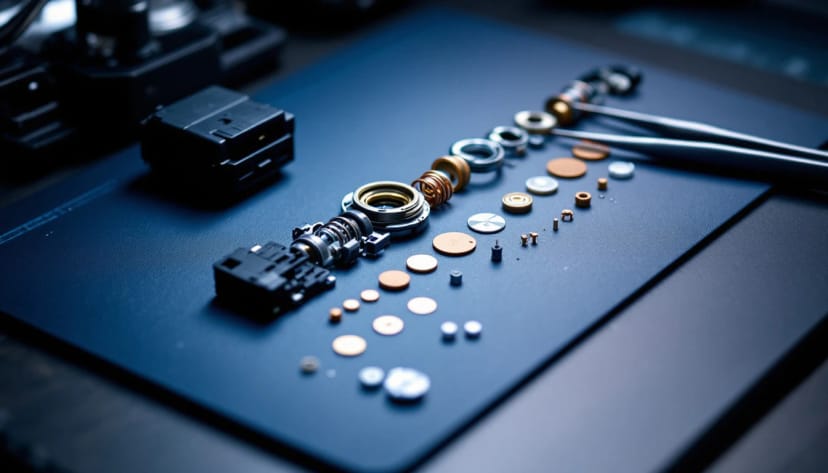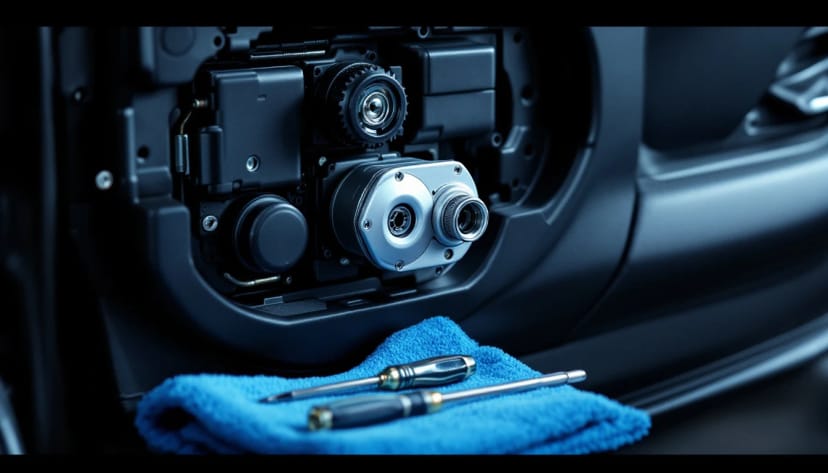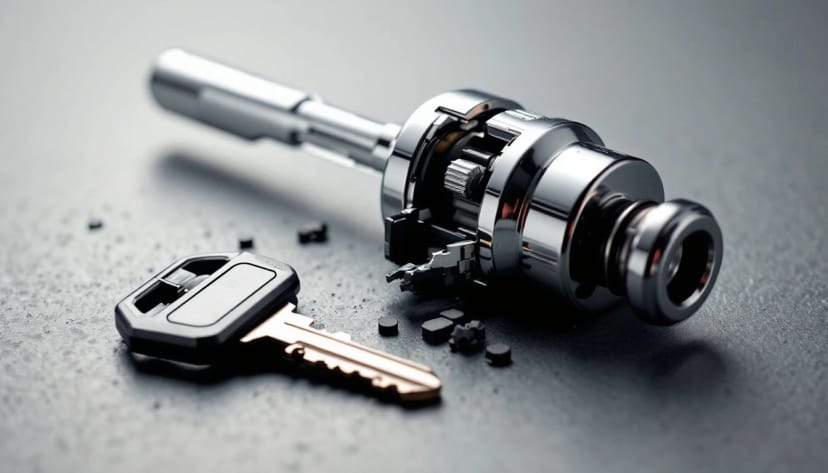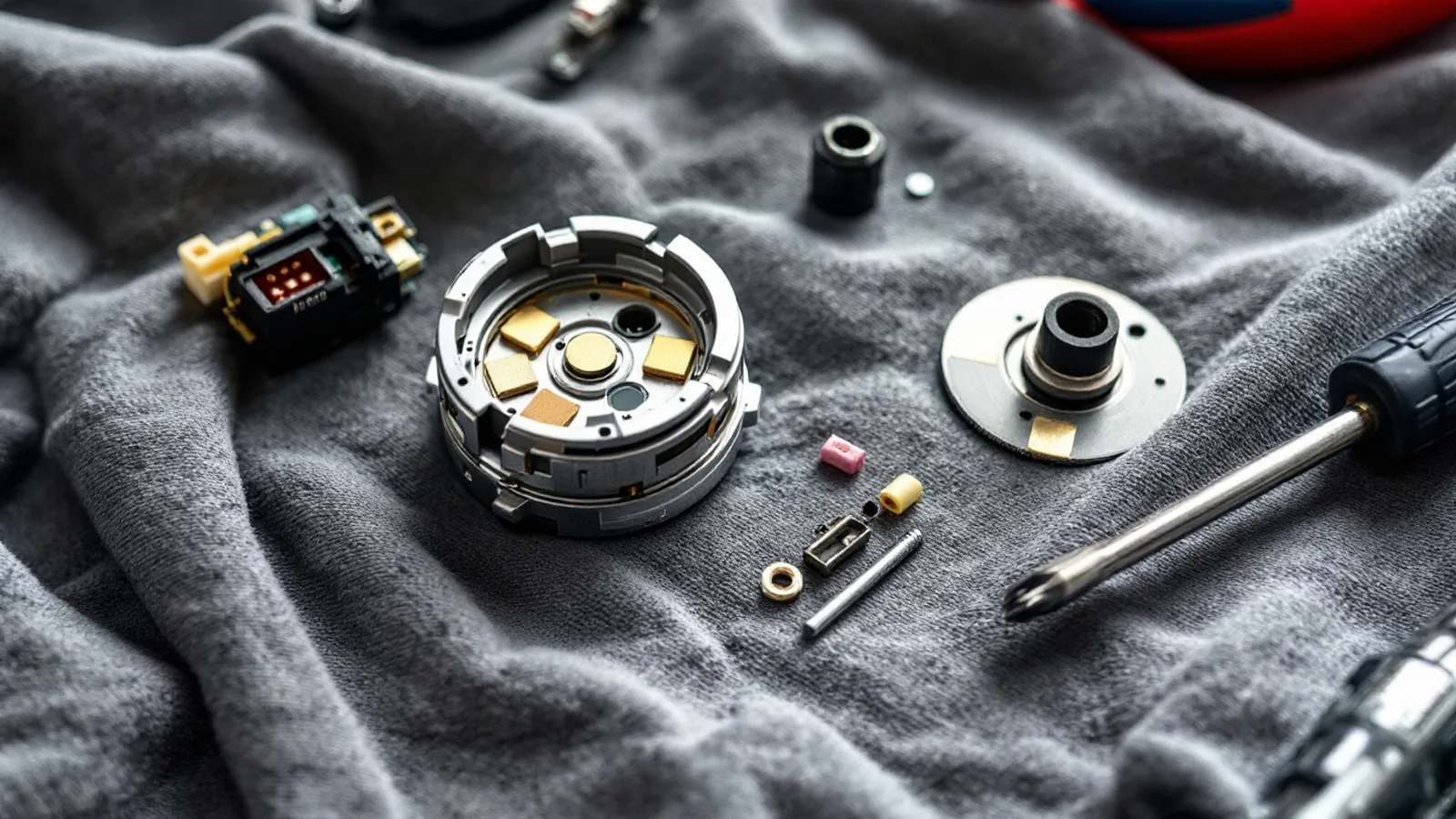
A failing ignition produces two complaints that sound identical on the phone and come from two entirely different parts. Guess wrong and you buy a part that was never broken. Here is how to narrow it down before anyone spends your money. Call or text 817-842-1256 if you would rather have it diagnosed properly.
The Short Answer
If the key will not go in, will not turn, or spins loosely with no crisp stops, the fault is almost certainly the mechanical lock cylinder. If the key turns normally through every position with correct feel but one position does nothing — no dash lights, no crank, dead accessories — the fault is almost certainly the electrical switch behind it. As of September 2026, either repair runs $150 to $400 in Fort Worth.
The Two Parts People Confuse
The lock cylinder (mechanical)
This is the part you interact with. Inside it is a stack of spring-loaded wafers that only line up for a correctly cut blade, allowing the cylinder to rotate. It wears out the way any moving mechanical part wears out: thousands of insertions, a heavy keyring hanging off it, grit carried in on the blade, and Texas summers cooking the lubricant out of it.
Cylinder symptoms are things you can feel in your hand. The key goes in partway and stops. It goes in fully but will not rotate. It rotates but feels vague, with no defined click between positions. It rotates and then will not come back out. All of those are mechanical complaints, and every one of them is felt rather than observed on the dashboard.
The ignition switch (electrical)
Behind the cylinder, coupled to it by a rod or a plastic actuator, sits the switch. As the cylinder rotates it turns the switch through its positions — lock, accessory, run, start — and the switch routes power accordingly. It is a set of electrical contacts, and it fails the way contacts fail: they burn, wear thin, corrode, or lose tension until they no longer connect reliably.
Switch symptoms show up as electrical behavior while the key feels completely normal. The key reaches run and the dash stays dark. The key reaches start and nothing happens, with no click from the starter. The radio works in accessory but dies at run. The car stalls while driving and the instrument cluster blinks just before. The battery is flat every morning because a circuit never fully shut off.
Two parts, two failure languages: feel for the cylinder, power for the switch.
Symptom by Symptom
| What you are experiencing | Most likely part | Why |
|---|---|---|
| Key will not insert fully | Lock cylinder (or wrong / worn key) | Wafers obstructed, debris, or a blade that no longer matches |
| Key inserts but will not rotate at all | Lock cylinder, steering column lock, or shifter interlock | Rotation is being blocked mechanically, not electrically |
| Key rotates loosely with no detents | Lock cylinder | Internal wear; the cylinder is no longer indexing positions |
| Key turns, dash stays completely dark at run | Ignition switch | Cylinder is working; the run circuit is not being fed |
| Key turns to start, total silence, no click | Ignition switch, interlock, starter circuit or battery | Start signal is not reaching the starter |
| Radio works in accessory, everything dies at run | Ignition switch | One contact bank has failed while another still works |
| Car stalls while driving, cluster flickers first | Ignition switch | Contacts losing connection under vibration |
| Battery flat overnight, no obvious draw | Ignition switch | A circuit is staying live after shutdown |
| Key will not come back out of the ignition | Lock cylinder or shifter interlock | Retention mechanism or park-position linkage |
| Key turns, engine cranks, will not run, security light on | Neither — immobilizer or chip | Mechanical and electrical ignition are both fine |
That last row matters. A security-light complaint is a different investigation entirely, and our guide to the anti-theft light flashing and the car not starting covers it.
The Five-Minute Driveway Diagnostic
Do these in order. Each step eliminates something cheap before you get to something expensive.
Step 1 — try your other key
Do this first, always. A blade worn smooth over a decade is the single most common cause of a key that will not turn, and it presents exactly like a dying cylinder. If the spare turns and the daily key does not, the cylinder is fine and you need a key cut to the original code, not a repair. This step alone resolves a meaningful share of the "my ignition is broken" calls we take. Our walkthrough of a car key that will not turn in the ignition goes deeper on the worn-blade side.
Step 2 — unload the steering column lock
If the front wheels were turned against a curb when you parked, the column lock is under load and the key physically cannot rotate. Grip the wheel, apply firm pressure left and right, and try the key at the same time. If it frees up, nothing was broken. If the wheel itself will not move at all, the column lock is a candidate in its own right — see steering column lock repair.
Step 3 — work the shifter
Put the shifter firmly in park, then move it to neutral and back, then try the key. Many vehicles will not release the ignition unless the park switch is satisfied, and a shifter sitting a millimeter out of detent produces a no-turn or a no-crank that has nothing to do with the ignition.
Step 4 — read the positions
Turn the key slowly and pay attention to the feel. You should sense distinct stops: accessory, then run, then spring-loaded start. Vague, gritty, or continuous rotation with no stops points at cylinder wear. Crisp, normal stops point away from the cylinder and toward the switch.
Step 5 — watch the dashboard at run
Hold the key at run, short of start, and look at the cluster. Warning lights should illuminate. A dark dash with a normal-feeling key is a strong switch indicator. A dash that illuminates and then drops out as you push toward start suggests a switch losing contact under load — or a weak battery, which is why the next step exists.
Step 6 — rule out the battery
A battery too weak to crank can produce silence, a single click, or a dash that collapses at start. Headlights that visibly dim when you turn the key, or a car that jump-starts and then behaves normally, point at power rather than the ignition. Do this before condemning any part.
Step 7 — note whether the fault is consistent
Write down what happens each time over a day. A fault that appears cold and clears warm, or appears only over rough pavement, is characteristic of electrical contacts. A fault that gets steadily worse and never improves is characteristic of mechanical wear. An intermittent electrical fault that causes stalling is the one to stop driving on.
What Each Repair Costs in Fort Worth
As of September 2026, ignition cylinder and switch work both fall in the $150 to $400 band mobile, inclusive of diagnosis, part and on-site labor. Where you land inside it comes down to three things: which part actually failed, how much steering column disassembly your platform requires, and whether replacing a cylinder also means cutting keys to the new cylinder.
If the diagnosis turns up something adjacent — a worn key rather than a failed part, or an immobilizer fault — the scope changes and so does the number. A replacement key alone runs $120 to $200 for a transponder with a working key present. The full picture across every service sits in our automotive locksmith price list, and the repair-versus-replace trade-off specifically is in ignition switch repair versus replacement cost.
This is the part of the job where a diagnosis is genuinely worth paying for. A $150 to $400 band is wide precisely because the same complaint has several causes, and the cheapest outcome — a new key instead of a new cylinder — is only available to someone who checked first.
The Impostors
Four things get misdiagnosed as ignition failures often enough to be worth naming.
A worn key. Covered above, and it deserves repeating because it is both the most common and the cheapest.
The steering column lock. On many vehicles this is a separate mechanism from the ignition, and on some modern platforms it is an electronically actuated unit that can fail closed. When it does, the key or button behaves normally and the wheel simply will not release.
The shifter interlock. A park-position switch that has drifted out of adjustment produces a no-crank that feels electrical and is mechanical.
The immobilizer. If the engine cranks strongly and then dies within a second or two, or a security light is lit or flashing, the ignition hardware has already done its job. That is a chip or immobilizer conversation — key turns but nothing happens walks through that branch, and vehicles using a lock-cylinder sensor rather than a chip in the key behave differently again, as our Chevrolet Impala ignition repair notes explain.
Why Getting This Right Saves Real Money
The failure mode we see most often is not a misdiagnosis by a technician — it is a part ordered from a description. Someone reads that a no-crank means a bad ignition switch, buys a switch, fits it, and still has a no-crank, because the actual fault was a park switch or a tired battery. The switch is now installed, unreturnable, and irrelevant.
The reverse happens too. A cylinder gets replaced because the key would not turn, when the key itself was worn past tolerance. The new cylinder works, which appears to confirm the theory, but a correctly cut key would have worked in the old one for a fraction of the cost.
Either way the cure is sequence: test, then buy. The trade bodies that certify this work — ALOA on the locksmith side, and the documented service-data channels administered by NASTF for security components — both organize their training around diagnosis before parts for exactly this reason. The Bureau of Labor Statistics occupational data is a reminder of how specialised this trade is: it is a small field, and the diagnostic experience is most of what you are hiring.
"Nine out of ten ignitions I am called to fix are one of three things, and one of those three is a key somebody should have replaced two years ago. The expensive mistake is never the repair — it is buying the part before the test." — an ALOA-credentialed Master Automotive Locksmith working the DFW metro
When to Stop and Call Someone
Stop and call if any of these apply. The car has stalled while driving, which is a safety matter rather than a convenience one. The key will not come out and the steering is locked. The key has snapped in the cylinder — do not attempt extraction with pliers, since pushing the broken piece deeper turns a straightforward job into a cylinder replacement. Or the diagnostic above has not produced a clear answer, which is a legitimate outcome and the reason diagnosis is a line item.
Two safety notes worth stating plainly. Ignition and column work sits next to airbag components on many vehicles, and the NHTSA's guidance on vehicle safety systems is worth respecting before pulling a column shroud in a driveway. And the electrical architecture around start circuits is standardized engineering territory documented by bodies like SAE International rather than something to improvise on.
What Not to Do
Do not spray general-purpose lubricant into the cylinder. Household penetrating oils attract dust, and the resulting paste accelerates wear — a cylinder that felt slightly stiff becomes seized.
Do not force the key. A blade under torque in a worn cylinder is how keys break, and a broken blade converts a repair into an extraction plus a repair. If it has already broken, key stuck in the ignition covers the next step.
Do not keep a heavy keyring on the ignition. The mass hanging off the cylinder while you drive is a genuine contributor to premature wear in both parts.
Do not ignore an intermittent stall. Both AAA roadside research and vehicle-safety analysis from the Insurance Institute for Highway Safety consistently show that unexpected loss of power in traffic is a disproportionate risk factor. An ignition switch that drops out once will do it again.
And if a quote feels wrong, ask what the diagnosis found before agreeing to a part. Consumer protection guidance from the Federal Trade Commission is clear that the price you are told should be the price you pay — a repair quote should name the part and the reason. Our own ignition repair page sets out the process, and if the key spins with no resistance at all, ignition key spins freely is the closest match to that specific symptom.
Frequently Asked Questions
What is the difference between the ignition switch and the ignition lock cylinder?
The lock cylinder is the mechanical part your key goes into — a set of wafers or tumblers that only rotate for the correct blade. The ignition switch is the electrical part behind it, which rotates with the cylinder and sends power to accessories, the run circuit and the starter. A cylinder failure is mechanical: the key will not go in, will not turn, or turns with no resistance. A switch failure is electrical: the key turns normally but something does not receive power.
How can I tell which one failed without taking it apart?
Work from the key motion. If the key will not rotate at all, or rotates loosely with no crisp detents, suspect the cylinder. If the key rotates normally through every position with correct feel but a position produces no result — no dash lights at run, no crank at start, radio dead in accessory — suspect the switch. Also try your spare key first, because a worn blade mimics a failing cylinder and costs far less to fix.
What does ignition repair cost in Fort Worth?
As of September 2026, ignition cylinder or switch work runs $150 to $400 mobile, covering diagnosis, the part and on-site labor. Where the difference lands inside that band depends on which part failed, how much column disassembly the platform needs, and whether the repair also requires a new key cut to the replacement cylinder. If an immobilizer or column-lock fault turns up alongside it, that is quoted separately once the cause is confirmed.
Can a bad ignition switch drain my battery or stall the car?
Yes to both, and that pattern is a useful clue. A worn switch can fail to fully break contact, leaving a circuit live after shutdown and pulling the battery down overnight. It can also lose contact intermittently while driving, which causes a stall with no warning and often a dash that flickers just beforehand. A stall traced to the ignition switch is a safety issue rather than an inconvenience and should be addressed rather than worked around.
My key turns fine but the car does not crank. Is that the switch?
It is one of several candidates, and the switch is not the most common. Check the easy ones first: the shifter fully in park or neutral, the brake pedal on a push-button vehicle, and battery condition. Then the neutral safety or clutch interlock switch. Then the starter relay. The ignition switch belongs on that list but sits behind those, which is exactly why a diagnosis is worth paying for before a part is ordered.
Will I need a new key if the lock cylinder is replaced?
Often yes. A replacement cylinder normally arrives with its own wafer configuration, so either the cylinder is re-keyed to your existing blade or new keys are cut to the cylinder. Both are routine, but they change the scope of the visit, so ask which approach is planned when you get the quote. On vehicles with a transponder immobilizer the chip side is unaffected by a cylinder change unless the key itself is being replaced.
Is this something a mobile locksmith can do, or does it need a shop?
Most ignition cylinder and switch work on mainstream vehicles is mobile work, done at the vehicle in 45 minutes to two hours depending on how much column disassembly is involved. Some platforms with airbag components or heavily integrated column locks are genuinely better on a lift, and an honest operator will tell you that rather than start and stop. Call or text 817-842-1256 with your year, make and model and we will tell you which category yours falls into.
References
- NHTSA — Anti-Theft and Vehicle Safety Systems
- NASTF — Service information and security data channels
- ALOA — Associated Locksmiths of America
- SAE International
- AAA Newsroom — roadside and reliability research
- Insurance Institute for Highway Safety
- Bureau of Labor Statistics — Occupational Outlook Handbook
- FTC — Advertising and Marketing Guidance
Not sure which part failed? Call or text 817-842-1256. Tell us what the key does — whether it turns, how it feels, and what the dashboard does at run — and we can usually narrow it down on the phone before we drive out. Mobile across Fort Worth and the surrounding cities, Mon-Sun 8AM to 8PM.
Reviewed against the ALOA Master Automotive Locksmith (MAL) standard. Prices are Fort Worth mobile service ranges current as of September 2026 and are confirmed per vehicle before dispatch.