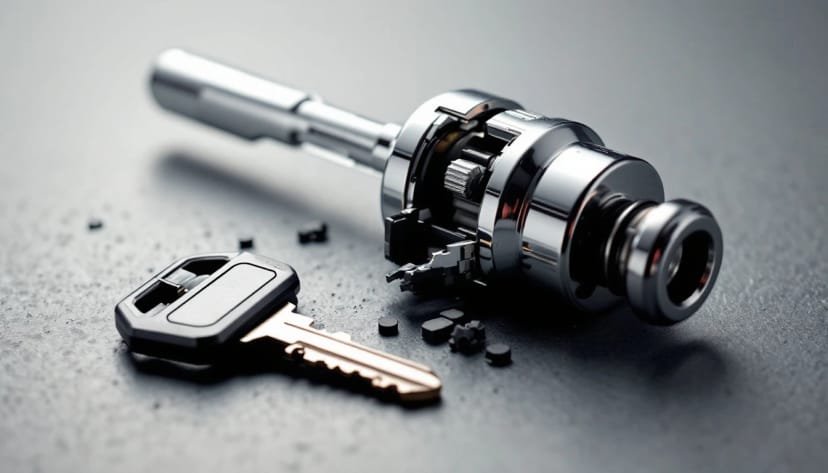
The key goes in, the key turns, the engine cranks — and nothing happens. Or it fires for a moment and dies. Glance at the dash and the little security light is flashing. Then you look at the key and notice the plastic head has split, and it feels lighter than it used to. There is a good chance the part your car is looking for is sitting on your floor mat. Call or text 817-842-1256 with a photo of the key if you need help today.
The Short Answer
As of September 2026, a car key whose plastic head has cracked can lose its transponder chip, which makes the car crank but not start and usually sets the security light flashing. If you find the chip intact, it can be pressed back in as a temporary fix, and a permanent rebuild into a new head needs no programming. If the chip is lost, the answer is a new transponder key: $120 to $200 in Fort Worth when another working key exists, or $180 to $450 if it was your only key.
What the Chip Is, and Why It Can Go Missing
Since the late 1990s almost every car key has carried a transponder, a tiny passive chip with no battery. When you turn the key, a coil around the ignition lock energizes the chip, the chip answers with its code, and the immobilizer decides whether to allow the engine to run. The NHTSA's anti-theft systems guidance explains why this became standard: it makes starting a car without an authorized key far harder, and the Insurance Institute for Highway Safety has tracked how theft patterns changed once immobilizers spread.
The mechanics of how the chip is held are where this problem comes from. On many keys, particularly those from roughly the late 1990s through the 2000s, the transponder is a small glass capsule — about the size of a grain of rice — or a small carbon or ceramic wedge, sitting in a cavity inside the plastic head. On some keys it is molded in solidly. On others it is held only by the two halves of the head or by a snap-in cap. When that plastic cracks, splits along its seam or loses its cap, the chip can simply fall out.
Nothing about this is dramatic. The chip weighs almost nothing and makes no sound when it drops. The blade, which is what turns the lock, is completely unaffected. So the owner experiences a car that suddenly refuses to start with a key that looks and works perfectly normal — except for a small crack most people never notice.
What Each Symptom Looks Like
| What you see | What it usually means | What to do |
|---|---|---|
| Key turns, engine cranks but never starts | Immobilizer does not detect a trusted chip | Inspect the key head; try a spare |
| Engine starts for 1 to 2 seconds, then dies | Chip missing or unrecognized on a system that allows a brief start | Same checks; look for the chip |
| Security or anti-theft light flashes rapidly | Key not recognized by the immobilizer | Strong sign the key, not the car, is at fault |
| Spare key starts the car normally | Problem is in the daily key | Rebuild or replace the daily key |
| Spare key also fails | Problem may be in the car, not the key | See the diagnostic links below |
| Key head flexes, rattles or has a visible gap | Head cracked; chip may be loose or gone | Open carefully over a clean surface |
Pricing for each outcome is covered further down, and every figure matches our automotive locksmith price list.
How your car behaves depends on the manufacturer. Some immobilizers stop the starter from engaging at all; others let the engine fire and then cut fuel. The security indicator varies too — a flashing key, a padlock, a car with a key through it. If your security light is doing something unusual, our explainer on the anti-theft light blinking when the car is off or won't start covers what each pattern typically means.
How to Confirm It in Five Minutes
- Inspect the head. Look for a crack, a split along the seam where two halves join, or a missing end cap. Squeeze it gently; a head that flexes or clicks has probably separated inside.
- Try a spare key. If a second key starts the car, the car is fine and the problem is your daily key. If you only have one key, skip to step 4.
- Watch the security light. Turn the key to on without cranking. A light that flashes rapidly or stays on where it normally goes out points to a key the immobilizer cannot read.
- Look for the chip. Check the floor mat, the footwell, the gap beside the seat, the cup holder, the pocket or bag where you keep your keys, and the ignition area. You are looking for a small glass cylinder or a small dark wedge.
- Open the head carefully, over a clean light-colored surface, if it separates easily. The chip may still be inside, just dislodged from its position.
If a spare key also fails, the fault is more likely in the vehicle — the antenna ring around the ignition, the immobilizer module or wiring. Our guide to one key working and the other not helps separate a key problem from a car problem, and our no key detected and immobilizer page covers the vehicle side.
You Found the Chip: The Cheap Outcome
This is the best-case version, and it is common. The chip that fell out is the same chip your car already trusts. Nothing about it has been erased or reset by falling out, so it does not need to be programmed again.
The temporary fix. Press the chip back into its cavity in the correct orientation, close the head, and wrap it firmly with electrical tape. On many vehicles the car starts immediately. Treat this as a way to get home or to work, not a repair; the next time the key is dropped or flexed, the chip is likely to move again.
The permanent fix. We rebuild the key into a new head or shell, transfer your original chip into it, and cut a fresh blade to your vehicle's key code. Because the chip is unchanged, the car recognizes the rebuilt key with no programming at all. We quote that from a photo, and it costs less than a full chip key because the programming step disappears.
One caution: glass capsule chips can crack if stepped on or crushed. A cracked chip may work intermittently or not at all. If the chip looks damaged, tell us, and we will test it before building a key around it.
You Cannot Find the Chip: A New Transponder Key
If the chip is gone, the answer is a new transponder key cut to your key code and registered to the immobilizer. As of September 2026:
- Another working key exists: $120 to $200. The immobilizer already trusts a key, and we add one more.
- The cracked key was your only key: $180 to $450 as an all-keys-lost job on most domestic and Asian vehicles, $350 to $800 on European platforms. Ownership has to be verified first — registration or title in your name with matching photo ID.
- An extra key during the same visit: about $65. If you are down to one key, this is the cheapest moment to fix that.
One thing to know about the lost chip: on many systems a new key is simply added to the immobilizer's memory, which means the old chip remains authorized. If you are worried someone else might have it, ask us to erase and rebuild the key list so only the keys in your hand will start the car. The full cost picture for this job is in chip key replacement cost, and transponder key programming explains the visit.
Why Keys Crack in the First Place
The plastic heads on older transponder keys were never designed for twenty years of service, and many of these vehicles are well past that. The common causes:
- Heavy key rings. A large bundle of keys hanging from the ignition levers against the head every time the car hits a bump.
- Heat. Texas summers bake keys left on dashboards and in cup holders, and heat cycling makes older plastics brittle.
- Drops on hard surfaces. Parking lots and driveways are unforgiving.
- Being used as a tool. Prying open boxes or packages with the key flexes the joint between blade and head.
- Age. Plastics used in older key heads degrade with ultraviolet exposure and time.
A single broken plastic head is annoying. The expensive version is when that key was the only one. The broader case for a spare is in is a spare car key worth it, and duplicate car key explains why a hardware-store copy of a transponder key is not the same thing.
What Not to Do
- Do not keep cranking. Repeated cranking on a car that will not recognize the key drains the battery and, on some systems, triggers a timed lockout before the car will accept even a good key.
- Do not glue the chip in blind. Adhesive that surrounds or displaces the chip can stop it reading reliably. Seat the chip first, then secure the head.
- Do not buy a random key online. A replacement key must match your chip generation and blade profile, and it still has to be cut and programmed. The Federal Trade Commission and ALOA both warn about offers that look far cheaper than the market and are not what they seem.
- Do not force a split key into the ignition. A separating head can let the blade twist or break inside the lock. If that has already happened, see broken car key extraction.
"We find the chip on the floor mat more often than you would think. When the customer hands it to us, the job gets smaller and cheaper, because the car already trusts that chip. We just need a new home for it." — an ALOA-credentialed Master Automotive Locksmith working the DFW metro
When It Is Not the Key
If the key head is intact, a spare also fails, and the security light still flashes, the fault is probably in the car. A failed antenna ring around the ignition, an immobilizer module fault, or a low battery voltage condition after a battery change can all produce the same no-start. Our guides to the security light staying on after a new key and module programming cover those. Standards for how these systems communicate are published by bodies such as SAE International, and a good technician will test the key, the antenna and the module before replacing anything.
Quick Checklist Before You Call
Have these ready and the call takes two minutes: year, make and model; whether any other key starts the car; a photo of the cracked key; whether you found the chip; and where the car is parked. That is enough for us to tell you whether it is a rebuild, a new key or a vehicle-side problem, and quote it before anyone drives out.
Frequently Asked Questions
Can a car key chip really fall out?
Yes. On many keys from the late 1990s through the 2000s, the transponder is a small glass capsule or a carbon wedge that sits loose in a cavity inside the plastic head, held in only by the head itself. When the plastic cracks or splits along its seam, the chip can drop out without any sound. The blade still turns the ignition normally, which is why owners do not suspect the key at first.
What does a car do when the key chip is missing?
It depends on the manufacturer. Some vehicles crank the engine but it never catches. Others start for a second or two and then shut off. Most light or flash the security or anti-theft indicator on the dash. What they have in common is that the key turns the ignition normally, because the blade is fine; the immobilizer simply cannot find a chip it trusts.
I found the chip. Can I just put it back in?
Often, yes, as a temporary fix. The chip is the same chip the car already trusts, so pressing it back into the cavity and holding the head closed with tape can get the car started immediately. It is not a lasting repair: the next crack or drop loses it again. The permanent fix is a new key head or shell with the original chip transferred into it, which usually needs no programming at all.
How much does it cost to fix a key whose chip fell out?
As of September 2026, if you still have the original chip and it is intact, we can usually rebuild the key into a new head and cut a fresh blade to your key code without programming, quoted from a photo at less than a full chip key. If the chip is lost, it is a new transponder key: $120 to $200 when another working key exists, or $180 to $450 as an all-keys-lost job when it was your only key.
How do I know the chip is the problem and not the ignition?
Three quick checks. Look at the key head for a crack, a gap along the seam or a head that flexes when squeezed. Try a spare key if you have one: if the spare starts the car, the problem is in your key, not the car. And watch the security light: rapid flashing when you turn the key to on is the classic sign of a key the immobilizer does not recognize.
Can I glue a cracked key head back together?
You can, and it can hold for a while, but be careful. Glue that gets into the chip cavity can shift or damage the chip, and some adhesives do not bond well to the plastics used in key heads, so the repair lets go in the heat of a parked car. If you glue it, make sure the chip is seated first, then get a proper replacement head soon, and treat the glued key as a stopgap.
Can you fix this at my location in Fort Worth?
Yes. We rebuild keys with a transferred chip, cut new blades to your key code, and program new transponder keys at the vehicle. If your only key has lost its chip and the car will not start, it cannot be driven anywhere, which is exactly the situation mobile service is for. Call or text 817-842-1256 with your year, make and model and a photo of the key.
References
- NHTSA — Anti-Theft Systems
- Insurance Institute for Highway Safety
- SAE International
- ALOA — Associated Locksmiths of America
- FTC — Advertising and Marketing Guidance
- NASTF — Secure Data Release framework
- AAA Newsroom
Key cracked and the car won't start? Call or text 817-842-1256 with your year, make, model and a photo of the key. We rebuild, cut and program keys on site across Fort Worth and the surrounding cities, Mon-Sun 8AM to 8PM.
Reviewed against the ALOA Master Automotive Locksmith (MAL) standard. Prices are Fort Worth mobile service ranges current as of September 2026 and are confirmed per vehicle before dispatch.