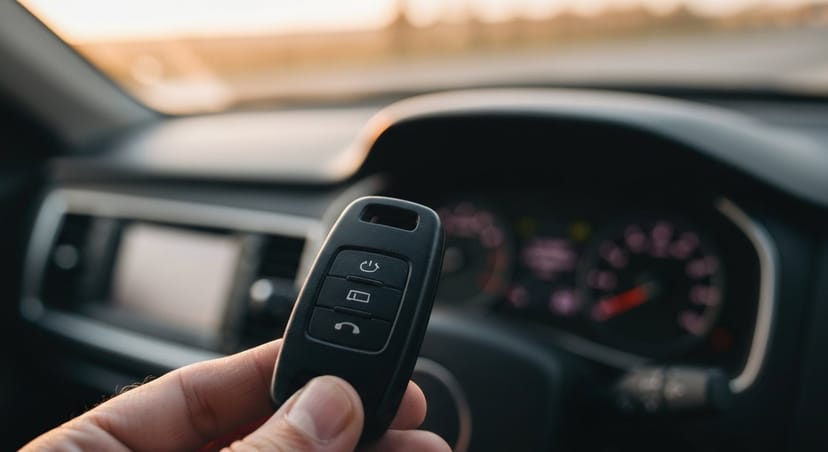
Getting a car key cut sounds like a single task with a single price. It is really two tasks sharing one visit. One is mechanical: shaping a metal blade so it turns your locks. The other is electronic: getting the car to accept the chip that rides inside the key. The first is quick and the second is where most of the cost sits. Call or text 817-842-1256 with the year, make and model and we will tell you which of the two your car needs.
The Short Answer
As of October 2026, a chipped car key cut and programmed at your location in Fort Worth runs $120 to $200. A proximity fob, including its cut emergency blade, runs $220 to $500, and European keys run $350 to $800. Cutting is included in each band, not added on top. A second matching key in the same visit is about $65. A cut-only key with no programming will not start most cars built after the late 1990s.
Why There Is No Single Cutting Price
A hardware store can copy a house key in a minute because a house key is only a shape. A car key stopped being only a shape roughly a generation ago. The National Highway Traffic Safety Administration describes the engine immobilizer as a system that prevents the engine from running unless the correct coded key is present, and nearly every vehicle on a Fort Worth road today has one.
So the honest answer to the cutting question depends on what the cut is for:
- If the blade is the whole key, as on a vehicle from before the transponder era, the cut is the job.
- If the blade carries a chip, the cut is the first third of the job and programming is the rest.
- If the blade is the emergency insert in a proximity fob, the cut is a small part of supplying and pairing the fob.
That is why we quote by key type rather than by cut. The bands below already include the blank, the cutting, the programming and the trip.
Cost by Blade and Key Type
| Key and blade type | Typical vehicles | What the cut involves | Starts the car cut-only? | Fort Worth price, cut and programmed |
|---|---|---|---|---|
| Edge-cut blade with transponder chip | Most 1998-2015 domestic and Asian models, many work trucks | Notches cut on one or both edges, to code or by duplication | No | $120-$200 |
| Laser-cut (sidewinder) blade with chip | Many 2005-and-newer Honda, Toyota, Ford, GM, Hyundai and Kia models | Wavy groove milled into the face on a high-security machine | No | $120-$200 |
| Flip key or remote-head key | Keyed trims of 2010-2020 sedans and SUVs | Blade cut, then chip and remote both paired | No | $120-$200 |
| Proximity fob with emergency insert | Push-button-start vehicles | Insert cut for the driver door; fob paired to the car | Not applicable, the fob starts it | $220-$500 |
| European high-security key or fob | BMW, Mercedes-Benz, Audi, Volkswagen, Porsche, Land Rover | Precision track cut plus brand-specific pairing | No | $350-$800 |
| Second matching key, same visit | Any of the above | Same cut repeated while the machine and code are set up | Programmed with the first | About $65 |
Two things stand out. First, the edge-cut and laser-cut rows share a band. A laser-cut blank costs more and the machine is more specialized, but once a chip has to be programmed the difference disappears inside the range. Second, the last row is the bargain. The expensive parts of a key visit are the setup, the code and the connection to the car. Once those are done, a duplicate is mostly a blank and a few minutes.
For the wider price list, see our guide to how much is a locksmith for a car and the pricing guide.
What Changes the Price
1. Whether a working key exists
With a working key present, a new one is added alongside it. With none, the car's immobilizer has to be accessed from scratch after ownership is verified, and that moves the job into the lost-key band of $180 to $450. Cutting is the same either way. The electronics are not. We compare the two paths in bought a used car with one key.
2. Whether the cut comes from a code or from a lock
When a key code is available, the machine cuts the factory pattern directly. When it is not, the cuts are decoded from a door cylinder or the ignition, which takes longer. Access to key codes and security data for independent shops is handled through the vehicle security professional registry operated by the National Automotive Service Task Force, which exists so that credentialed locksmiths can obtain this information after confirming who owns the car.
3. The condition of the original
A crisp original can be duplicated. A worn one should not be. Wear rounds off the peaks and widens the valleys, and a tracer faithfully copies every bit of it. We see the result weekly: a brand-new key from a kiosk that sticks in exactly the way the old key did. If your key has to be wiggled, read our note on the key that won't turn in the ignition before paying to copy the problem.
4. The brand
European makes use tighter tolerances, encrypted chips and brand-specific procedures. That is the whole reason for a separate $350 to $800 band. Our European car locksmith page explains what is different about them.
5. How many keys you make at once
One key is a full visit. Two keys is a full visit plus about $65. Nobody regrets the second one.
Edge-Cut, Laser-Cut and the Rest
Edge-cut
The traditional key. The blade is thin, and the pattern is a row of notches along the edge. Most are double-sided so the key works either way up. Edge-cut keys are forgiving to cut and quick to duplicate, which is why they survived so long on trucks and economy cars.
Laser-cut, also called sidewinder
Despite the name, no laser is involved. The blade is thicker and rectangular, and a small rotary cutter mills a curving groove along the center of one or both faces. The lock reads the depth and position of that groove. These keys resist picking and casual duplication better, and they cannot be made on the simple duplicator at a big-box store. We compare the two in laser-cut versus transponder keys, which also clears up the common confusion between the cut style and the chip.
Emergency inserts
Every proximity fob contains a small metal key for the day the electronics fail. On a new fob it arrives blank. It is cut to the same code as the driver door, and it should be tested in the actual door, because the keyhole is often hidden under a cap on the handle and many owners have never used it.
Tibbe and other specialty profiles
A handful of vehicles, including certain older Ford and Jaguar models, use a Tibbe key with angled cuts on a round shaft. A few others use dimple or internal-track profiles. They need their own cutters and are quoted individually within the appropriate band.
Why a Cut-Only Key Usually Does Not Start the Car
This is the single most common surprise. Someone has a key cut for a small fee, it opens the door, it turns in the ignition, the starter spins, and the engine dies or never catches. Nothing is wrong with the cut.
The door lock is a mechanical device and only cares about shape. The engine computer also wants a radio answer from a transponder in the key head. No answer, no fuel or spark. Research by the Insurance Institute for Highway Safety and its affiliated Highway Loss Data Institute found that immobilizers were standard on 96 percent of 2015 to 2019 models from other manufacturers at a time when they were standard on only 26 percent of Hyundai and Kia models, and that the vehicles without them suffered sharply higher theft claims. That gap is the best evidence there is that the chip, not the cut, is what stops a car being driven away.
So when a cut-only key fails to start the car, the system is working. The remedy is programming, described on our transponder key programming page. If a security light is flashing after the attempt, see anti-theft light flashing and the car won't start.
There are legitimate uses for a cut-only key:
- A pre-transponder vehicle. Many models from before the late 1990s, and a few later base trucks, have no chip at all. Our reference on the Colorado key covers a truck whose first generation used a plain metal key.
- A door-only key. A flat metal key kept in a wallet to recover from a lockout. It will not start the car and is not meant to.
- A test cut. Before programming an expensive fob, a locksmith may cut a plain blank to confirm the code is right.
Where the Cutting Happens
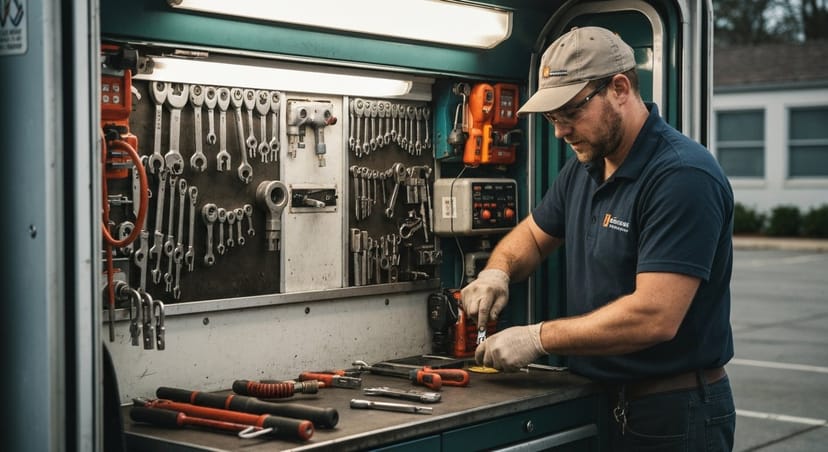
We cut on site. The van carries a code-cutting machine for edge-cut blades and a high-security machine for laser-cut blades, along with the programming equipment. That matters for cost in one specific way: you are not paying for a tow. A car with no working key cannot be driven to a counter, and the American Automobile Association has long reported that lockouts and lost keys are among the most frequent reasons its members call for roadside help, numbering in the millions each year. Bringing the machine to the car removes the tow from the bill entirely.
The cutting itself takes minutes. A typical visit for one chipped key is 20 to 40 minutes door to door, most of it programming and testing. We test every key in the driver door, the ignition or start button, and the trunk or liftgate before we call it finished.
Dealership, Kiosk or Mobile Locksmith
A kiosk or hardware counter is fine for a house key and for a plain metal car key. Some kiosks can clone certain older chips. They cannot program a key into the car, cannot cut to code from a VIN, and cannot help if no key exists to copy.
A dealership can do all of it, typically by ordering a key cut to code and scheduling the car into the service lane for programming. The car has to be there, which for a no-key car means a tow, and dealership pricing for the same key is commonly higher than a mobile locksmith's.
A mobile locksmith cuts and programs at the car. The Federal Trade Commission explains that under federal warranty law a manufacturer generally cannot void your warranty simply because someone other than the dealer performed a service or supplied a part, so an independent key does not put your coverage at risk. We lay out the trade-offs in mobile locksmith versus dealership.
Four Numbers Worth Knowing
- 96 percent versus 26 percent. The share of 2015 to 2019 models with standard immobilizers from other makers versus Hyundai and Kia, per the Highway Loss Data Institute. It is why a cut alone is not a key.
- Around $12,000. AAA's Your Driving Costs research, published through the AAA newsroom, has put the average annual cost of owning and operating a new vehicle near that figure. A spare key is a rounding error against it.
- More than one million. The approximate number of vehicles reported stolen in the United States in a recent year, according to NHTSA's vehicle theft prevention material. Coded keys exist because of that number.
- About $65. What the second key costs when it is made in the same visit as the first.
What the Trade Says
"People think I charge for cutting. I charge for the key working. The cut takes me four minutes. Making sure the car agrees with it, in the door, in the ignition and after it has sat locked for a minute, is the job." — an ALOA-credentialed Master Automotive Locksmith working the DFW metro
How to Get an Accurate Quote
Have these ready when you call:
- Year, make and model. The tenth character of the VIN is the model year if you are unsure.
- Turn key or start button. This decides between the chipped-key band and the proximity band.
- How many keys work right now. One, none, or one that is failing.
- Where the car is. We come to homes, workplaces and parking lots across the area.
- Whether you want a second key. Say so up front and it is priced into the same visit.
If every key is gone, bring registration or title in your name and a matching photo ID. Proof of ownership is required before a key is cut for a car that has none, and no reputable locksmith will skip it. In Texas, locksmith companies are licensed by the Texas Department of Public Safety through its Private Security Program, and ALOA Security Professionals Association maintains the trade's automotive credentials. Ask for the license number; a legitimate company will give it without hesitation.
Mistakes That Cost Money
- Copying a worn key. You pay for a new key with an old problem. Cut to code instead.
- Buying a blank online and assuming any counter will cut it. Many counters refuse customer-supplied blanks, and a fob bought with the wrong frequency cannot be paired at any price. See aftermarket key fob won't program.
- Paying for a cut-only key on a chipped car. It opens the door. That is all.
- Waiting until the last key is lost. Adding a key is the $120 to $200 job. Replacing the only key is the $180 to $450 job. Our guide on duplicate car keys makes the case in detail.
- Forgetting the emergency blade. A fob without a cut insert leaves you locked out the day a battery dies.
Service Area
We cut and program car keys throughout Fort Worth and nearby cities including Arlington, Hurst, Bedford, Keller, North Richland Hills, Saginaw and Benbrook. See the service areas page for the full list, and the car key cutting page for the service itself. For a spare, start at spare car key.
Frequently Asked Questions
How much does it cost to get a car key cut in Fort Worth?
As of October 2026, a chipped key cut and programmed on site runs $120 to $200, and a proximity fob with its emergency blade cut runs $220 to $500. European keys run $350 to $800. The cut itself is included in each of those figures rather than billed as a separate line. A second matching key made during the same visit is about $65.
Can I just get a car key cut without programming?
You can, and on most vehicles built since the late 1990s the result opens the doors and turns the ignition but does not keep the engine running, because the car is waiting for a chip it never hears. A cut-only key makes sense for a pre-transponder vehicle, for a door-only emergency key, or for the hidden blade inside a proximity fob. For anything else, cutting and programming are one job.
What is the difference between a laser-cut key and a regular key?
A regular edge-cut key has notches along one or both edges of the blade. A laser-cut key, also called a sidewinder or high-security key, has a wavy groove milled into the flat face of a thicker blade. Laser-cut keys need a different machine and a more expensive blank, but for pricing purposes both fall in the same band once a chip is involved.
Can a locksmith cut a car key from the VIN?
Often, yes. The key code that describes the cuts can be retrieved through credentialed channels for many vehicles once ownership is verified, and the key is then cut to that code rather than copied from a worn original. Where a code is not available, the cuts can be read from a door or ignition lock. Either way you will be asked for registration or title and a matching photo ID first.
Why does my newly cut key open the door but not start the car?
Because the metal is right and the chip is missing, blank or not yet registered. The door lock is purely mechanical, so a correct cut opens it. The engine also needs the transponder in the key head to answer the immobilizer with a code the car already knows. Until the key is programmed, the car treats it as a stranger with a well-shaped piece of metal.
Is it better to copy my existing key or cut a new one to code?
If your key is worn, cut to code. A copy reproduces the wear, and a copy of a copy reproduces more of it, until the new key sticks in the cylinder just like the old one. Cutting to the factory code gives you the key the car was built with. If your existing key is crisp and works smoothly in every lock, a careful duplicate is fine.
Does the emergency blade inside a key fob need to be cut?
Yes. A replacement proximity fob arrives with an uncut metal insert. It has to be cut to your vehicle before it will open the driver door, and that is the only way into the car when the fob battery or the car battery is dead. It is included when we supply and program a fob, and it is worth testing in the door before we leave.
References
- NHTSA — Anti-Theft Systems
- NHTSA — Vehicle Theft Prevention
- Insurance Institute for Highway Safety
- National Automotive Service Task Force (NASTF)
- FTC — Businessperson's Guide to Federal Warranty Law
- American Automobile Association
- AAA Newsroom — Your Driving Costs
- ALOA Security Professionals Association
Need a car key cut and programmed? Call or text 817-842-1256 with the year, make, model and how many keys still work. We cut on site across Fort Worth and the surrounding cities, Mon-Sun 8AM to 8PM.
Reviewed against the ALOA Master Automotive Locksmith (MAL) standard. Prices are Fort Worth mobile service ranges current as of October 2026 and are confirmed per vehicle before dispatch.