Repair Car Lock in Fort Worth TX: Mobile Key Cutting & Programming
When your car door lock fails, breaks, or your key won't turn, you need professional repair car lock service fast. Call or text (817) 842-1256 for mobile automotive locksmith service anywhere in Fort Worth, Texas. Fortworthcarkeys provides on-site car lock repair, replacement, and key programming for all vehicle makes and models — traditional keys, transponder chips, remote-head keys, key fobs, and push-to-start smart keys. Our technicians arrive equipped to diagnose lock cylinder damage, frozen tumblers, broken key extraction, and electronic key system failures right at your location, helping you avoid towing costs and dealership wait times. Whether you're locked out in downtown Fort Worth, Sundance Square, or the Stockyards, we bring the shop to you.
Quick Answer: How Do You Repair a Car Lock in Fort Worth?
Professional repair car lock service begins with diagnosing whether the issue is mechanical (broken cylinder, worn tumblers, frozen lock) or electronic (faulty actuator, immobilizer failure, key programming error). A licensed automotive locksmith will inspect the lock assembly, test your existing key, and determine if the lock can be re-keyed, lubricated, or requires full replacement. For electronic locks and transponder systems, the technician uses OEM-level diagnostic tools to read fault codes and reprogram or replace the key credential.
The repair process typically takes 30 to 90 minutes depending on the vehicle's security system complexity. Most 2015-and-newer vehicles use encrypted key systems that require specialized programming equipment synced to the vehicle's immobilizer and body control module. According to the National Automotive Service Task Force, automotive service professionals must maintain credentialed access to OEM security data to lawfully perform these services — the same channel dealership technicians use.
Fortworthcarkeys completes the majority of car lock repairs and key replacements on-site the same day, eliminating the need to schedule a dealership appointment or leave your car overnight. Service runs seven days a week, 8AM to 8PM, across the Fort Worth metro area.
Car Lock Repair & Key Replacement Pricing
As of August 2026, the ranges below are what Fort Worth drivers pay for mobile lock and key work. Final pricing depends on vehicle year, make, model, key availability, and your location within the service area. Ranges only — anyone quoting a single flat number before seeing your VIN is guessing.
| Service Type | Price Range |
|---|---|
| Traditional metal key cutting | $10–$50 |
| Transponder chip key (cut + program) | $120–$250 |
| Remote-head key / key fob | $180–$400 |
| Push-to-start smart key | $250–$650+ |
| Luxury / European key systems | Quote required |
| All keys lost (no working key) | Quote required |
Lock cylinder replacement for driver or passenger doors typically adds $80 to $200 in parts and labor, depending on whether the vehicle uses a traditional wafer tumbler or an electronic integrated system. Broken key extraction from the lock or ignition runs $50 to $120 when the key snaps inside the cylinder.
Two notes on how those ranges behave in practice. First, a cylinder replacement is driven by labour rather than the part — door cylinders on common domestic and Asian platforms are inexpensive, and the time is in the trim removal and re-keying. Second, broken key extraction on its own sits at the bottom of its range when the cylinder survives the extraction, which it usually does.
For a full cross-brand cost picture, see our guide on car key replacement cost in Fort Worth TX and the broader how much does a locksmith cost in Fort Worth breakdown.
Key Types We Replace & Program in Fort Worth
Traditional Metal Keys
Older vehicles manufactured before 1995 typically use simple metal keys with no electronic components. These can be duplicated by cutting a new blank to match the original bitting pattern or by decoding the lock cylinder directly. Replacement takes 10 to 20 minutes.
Transponder Chip Keys
Introduced in the mid-1990s, transponder keys contain a radio-frequency identification chip that must be registered to the vehicle's immobilizer. The key blade is cut mechanically, then the credential is programmed to the car's control unit. Vehicles from 1998 to 2010 commonly use this technology across Ford, GM, Honda, Toyota, and Nissan models. If you are not sure which of the two you are holding, our transponder key vs key fob guide sorts it out in a couple of minutes.
Remote-Head Keys and Key Fobs
These combine a transponder chip, metal blade, and remote lock and unlock buttons in a single unit. Programming requires registering both the immobilizer credential and the remote frequency to the vehicle's receiver module. Common on 2005-and-newer Honda, Toyota, Hyundai, Kia, and many domestic models.
Push-to-Start Smart Keys
Also called proximity keys or smart fobs, these systems allow keyless entry and engine start when the fob is inside the vehicle. They use encrypted rolling credentials and often require dealer-level or credentialed aftermarket tooling that communicates directly with the car's body control and security modules. Most vehicles from 2010 onward offer or require this technology.
If you're experiencing issues with your push-button ignition, read our diagnostic guide on push-button start not working in Fort Worth.
High-Security and Laser-Cut Keys
European brands and many newer domestic models use sidewinder or laser-cut keys with milled tracks on both faces of the blade. These require precision milling equipment and often integrate multiple security layers including rolling credentials and encrypted handshake protocols.
Common problems we see in Fort Worth
Lock complaints arrive in a small number of recognisable shapes. Knowing which one you have tells you most of what the visit will cost.
The key turns roughly, then stops turning at all
This is ordinary wear, and it is the most common call of the group. Wafers inside the cylinder round off over a decade of use while the blade itself wears in the opposite direction, and the two failures compound. The tell is that the fault appeared gradually — a jiggle that worked, then needed two jiggles, then stopped working. Ordinary wear is repairable: the wafers are replaced, the cylinder is re-keyed to your existing key, and nothing electronic is touched.
The blade snapped off in the cylinder
A key does not break without warning; it bends first, usually for months. Extraction is straightforward with the right tools and rarely damages the cylinder. The important part is what happens next. The replacement must be cut from the vehicle key code rather than traced from the surviving half, because tracing a worn original just reproduces the defect that broke the first key.
The lock is fine but the door will not unlock electrically
This is the actuator, not the cylinder, and it is worth separating early because the two failures feel identical from the driver's seat. If the mechanical key opens the door but the fob and the interior switch do not, the cylinder is healthy and the fault is downstream. If the fob works on other doors but not one, that door's actuator is the suspect.
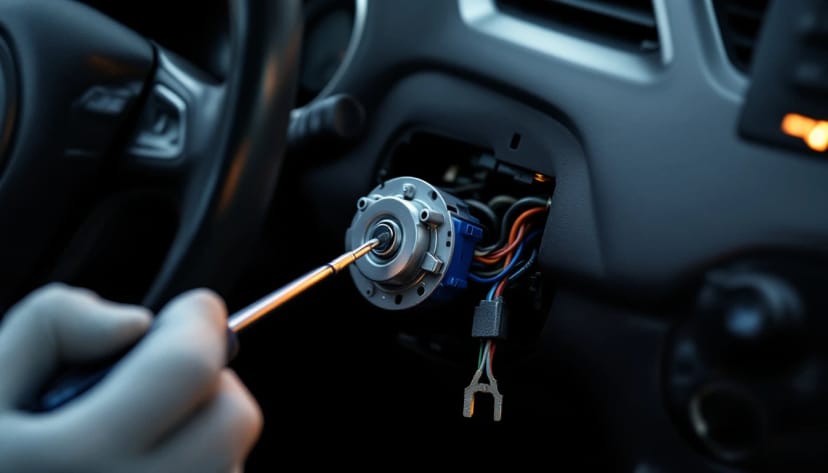
Ignition cylinder wear that reads as an electrical fault
An ignition that needs the wheel rocked to turn, or that turns but does not crank, is frequently mechanical rather than electronic. Fort Worth heat is unkind to ignition assemblies, and a cylinder that binds in August often behaved perfectly in February. Diagnosis before parts, every time.
Anti-theft light on and the engine will not start
Here the lock is innocent. The vehicle is refusing a credential it does not recognise, which points at the key, the antenna ring, or the module — not the cylinder. Our guide on the anti-theft light flashing and the car not starting walks the diagnostic order. NHTSA guidance on anti-theft systems describes why immobilizers are designed to fail closed like this, and IIHS vehicle theft research documents the theft-rate reduction that made the design worth the inconvenience.
Lock repair versus lock replacement — how the call is made
Owners often ask for a replacement when a repair would serve them better, and occasionally the reverse. The decision rests on three observations a technician makes in the first few minutes on site.
The first is whether the failure is mechanical wear or damage. A door lock or ignition cylinder that has simply worn — wafers rounded off after years of use, a key that has to be jiggled, a cylinder that turns roughly — is usually repairable. The wafers can be replaced and the cylinder re-keyed to your existing key, which means you keep one key for everything and you do not touch the immobilizer at all. Damage is different. A cylinder that has been punched, drilled, or forced during a theft attempt has usually lost the tolerances that make repair viable, and replacement becomes the honest recommendation.
The second is whether the vehicle's key coding is still intact. If the repair path would leave you with a cylinder that accepts a different blade than your programmed key, the job quietly turns into a key job as well, and the cost calculus changes. A good operator raises this before starting rather than after. Re-keying the new cylinder to your existing key is almost always cheaper than programming new keys to match a new cylinder, and it is the outcome to ask for by name.
The third is parts availability for the platform. On common domestic and Asian vehicles, cylinders and lock service kits are readily available and either path is open. On older or lower-volume platforms, a replacement cylinder may be discontinued, which makes repair the only route and raises the value of an operator who can actually rebuild one rather than only swap parts. This is the situation where the difference between a general locksmith and a credentialed automotive specialist shows up most clearly in your bill.
The repair-or-replace conversation is the one where customers get overcharged most often, and it is not usually deliberate. It is that swapping a cylinder is quicker to quote than rebuilding one. If the wafers are worn and the housing is straight, a rebuild and a re-key gives the owner exactly what they wanted and keeps their existing programmed key alive. That is the cheaper job and it is also the better job, and it takes about ten minutes on site to know which one you are looking at.
— a NASTF-registered Fort Worth automotive locksmith, ALOA Master Automotive Locksmith (MAL) credential, DFW metroplex (anonymized)
When to Call a Locksmith vs the Dealership for Car Lock Repair
Choosing between a mobile locksmith and the dealership depends on urgency, location, cost, and vehicle complexity.
Choose a mobile locksmith when:
- You need immediate, on-site service at your home, office, or roadside location
- Your vehicle is outside dealership service hours or you cannot wait days for an appointment
- You want competitive pricing without markup on key blanks and programming labour
- The vehicle is a common domestic or Asian brand from model years 2000 to 2024
- You have proof of ownership and valid identification readily available
Consider the dealership when:
- The vehicle is still under warranty and you want service documented in the manufacturer system
- You have lost all keys to a rare or exotic model with proprietary security that few independents service
- You prefer OEM parts exclusively and are willing to wait for ordering and scheduling
- The vehicle has active theft-deterrent features that require factory-level authorization
Mobile service is usually faster and cheaper on the whole-cost view because we come to your location and remove the tow entirely. For a detailed comparison, see mobile locksmith Fort Worth vs dealership. If you have lost all your keys and have no spare, our guide on lost car keys with no spare walks through the all-keys-lost process step by step.
Honest boundaries — what we will tell you to take to the dealer
An operator who says yes to everything is telling you something about how they work. There are jobs where the honest answer is that the dealer is the right call, and they are worth naming.
Mercedes-Benz platforms running the FBS4-era security architecture, Volkswagen Audi Group vehicles with Component Protection, and the newest push-button platforms across several premium brands all place part or all of the key authorization behind manufacturer online systems. Independent coverage on those platforms changes by model year and by tool vendor, which is exactly why a credible quote begins with a request for your VIN rather than a flat price. We will tell you before dispatch if your vehicle sits on the wrong side of that line.
The same honesty applies to a lock that is not really the problem. If the diagnosis points at a body control module, a wiring fault in the door harness, or a battery that cannot hold voltage through a programming session, that is a different trade's job or a different repair, and saying so early is cheaper for you than discovering it after the trim is off. A marginal 12V battery in particular produces convincing false immobilizer faults, and load-testing it costs nothing.
How the on-site visit works in Fort Worth
We are mobile-only. There is no shop to drive to, which matters most on the jobs where the vehicle cannot be driven at all.
The call starts with four questions: year, make, model, and whether any working key exists. VIN if you can read it through the windshield on the driver's side. That is enough to load the right tooling and bring the right blank rather than discovering a mismatch in your driveway. You get a band before dispatch, not after.
On arrival, ownership is verified first — title or current registration plus a government-issued photo ID in a matching name — and that verification is recorded on the invoice. The FTC's consumer guidance on hiring a locksmith treats identity verification as the baseline expectation, and it is the clearest single signal separating a credentialed operator from a problem. Nobody legitimate skips it.
Then the diagnosis: test the existing key, inspect the cylinder, load-test the battery, and scan for module faults if anything electronic is in question. Only after that does anyone reach for a part. A parking space with room to open the doors fully and shade in Texas summer is worth arranging in advance, because programming sessions can run an hour with the tool connected and the vehicle's voltage needs to stay stable throughout.
We cover Fort Worth and Tarrant County: Arlington, North Richland Hills, Hurst, Euless, Bedford, Keller, Grapevine, Benbrook, White Settlement, Saginaw, Lake Worth, and River Oaks. Arrival time depends on technician availability, traffic, and your exact location. Call or text (817) 842-1256 to confirm availability and get an estimated arrival window for your specific address.
For emergency lockout and after-hours service, visit our 24/7 emergency locksmith Fort Worth page.
What We Need From You: ID, Proof of Ownership & Vehicle Info
Texas locksmith companies and technicians are licensed through the Texas Department of Public Safety Private Security Program and must follow state licensing and vehicle-ownership verification requirements. Reputable automotive locksmiths should be able to show business identification, insurance, and proof of authorization before performing vehicle key work.
Before we begin any repair car lock or key replacement service, you must provide:
- Valid government-issued photo ID that matches the vehicle registration
- Proof of ownership: vehicle title, current registration card, or insurance declaration showing your name and the VIN
- Vehicle identification number (VIN) located on the dashboard near the windshield or on the driver door jamb
- Year, make, and model of the vehicle
- Physical location of the vehicle (street address, parking lot, or cross streets)
- Working key status: whether you have any working keys or have lost all keys
We verify ownership to prevent unauthorized key duplication and to meet the automotive security standards set out by the Associated Locksmiths of America. This protects both vehicle owners and service providers from theft and fraud, and on an all-keys-lost job it is not optional.
If you have lost your car keys and are not sure what information you need, read I lost my car keys — what do I do for a complete checklist.
Why Choose Fortworthcarkeys for Car Lock Repair
Mobile On-Site Service
We bring professional equipment, key blanks, and programming tools directly to your location — home, work, a shopping centre, or the roadside. No tow, no borrowed ride to a shop.
Experienced Technicians
Our team has serviced thousands of vehicles across Fort Worth and stays current with immobilizer technologies, encrypted key programming, and OEM security procedures for domestic, Asian, and European vehicles. The Bureau of Labor Statistics occupational profile for locksmiths describes a trade whose entry standard has moved decisively toward electronics, and that is exactly what the last decade of vehicle security has demanded.
Transparent Pricing
You receive a band before any work begins. We explain what the vehicle requires and why, and the number quoted on the phone is the number on the invoice. FTC business guidance sets the baseline that a quoted range should mean something when the bill arrives.
Fast Turnaround
Most traditional and transponder key services are completed in under an hour. Smart key and proximity fob programming for newer vehicles typically finishes within 90 minutes.
Local Fort Worth Operation
We are based in Fort Worth, serve Tarrant County, and know the local traffic, the common platforms, and the parking realities of the neighbourhoods we work in. AAA driving-cost research puts annual ownership cost above $12,000 for the average new vehicle, which is a useful frame for why a day of downtime and a tow is rarely the cheap option.
For more on choosing a trusted local provider, read our article on the best automotive locksmith in Fort Worth.
References
- NASTF Vehicle Security Professional Registry — Credentialed access to OEM immobilizer and security data.
- Associated Locksmiths of America (ALOA) — Certification standards for automotive locksmith work.
- NHTSA — Anti-Theft Systems — Federal guidance on immobilizer and anti-theft equipment.
- IIHS — Vehicle Theft — Research on theft rates and immobilizer effectiveness.
- FTC Consumer Advice — Hiring a Locksmith — Verifying a locksmith before authorizing service.
- FTC — Business Guidance — Federal guidance on pricing and advertising disclosure.
- AAA — Your Driving Costs — Vehicle ownership and downtime cost research.
- Bureau of Labor Statistics — Installation, Maintenance and Repair Occupations — Occupational profile and skill trends.
Frequently Asked Questions
Can you repair a car lock that won't turn?
Often yes. Frozen wafers, worn tumblers, and grit packed into the cylinder can usually be cleaned, lubricated, and re-keyed on site without replacing the whole assembly. The judgement call is whether the cylinder has worn or been damaged. Wear is repairable. A cylinder that has been punched, drilled, or forced during a theft attempt has normally lost the tolerances that make a rebuild reliable, and replacement becomes the honest recommendation.
How long does it take to program a new transponder key?
Once the blade is cut and the technician has access to the immobilizer, transponder programming usually runs 15 to 30 minutes. Proximity and push-to-start systems take longer because the credential has to be accepted by more than one module. All-keys-lost work on any platform adds time, because ownership verification and security-data access happen before a single line of programming does.
Do I need to reprogram my car if I replace the lock cylinder?
It depends on whether the new cylinder can be re-keyed to your existing key. If it can, nothing electronic changes and your programmed keys keep working exactly as they did. If the replacement cylinder accepts a different blade, the job quietly becomes a key job as well, and new keys have to be registered to the immobilizer. Ask for the cylinder to be re-keyed to your existing key by name, because it is almost always the cheaper outcome.
What if I lost all my car keys and have no spare?
That is an all-keys-lost job, and it starts with paperwork rather than tools. You will need the vehicle title or a current registration together with a government-issued photo ID in a matching name. After ownership is verified, the key code is derived, a blade is cut, and new credentials are registered to the immobilizer. Expect it to take longer and cost more than adding a spare while a working key still exists.
Can you fix a broken key stuck in the lock?
Yes. Broken blades are extracted from door cylinders and ignitions with purpose-made extraction tools, and in most cases the cylinder itself is undamaged once the fragment is out. A key that snapped is usually a key that had been bending for months, so the replacement is cut fresh from the code rather than traced from the broken half. Tracing a worn original just reproduces the fault.
Do you service luxury and European car locks?
Yes, with an honest boundary. Conventional European lock and key work is routine for a credentialed operator. Newer platforms with module-level authorization, Mercedes FBS4-era systems, and Volkswagen Audi Group Component Protection cars are a different class of job, and on some model years the dealer genuinely is the right call. Any operator who quotes those flat over the phone without asking for your VIN is guessing.
Is mobile locksmith service more expensive than going to a shop?
Usually the opposite, once the whole cost of the alternative is counted. Mobile service removes the tow, the ride to and from the dealership, and the days the vehicle sits in a service queue. The work is performed in your driveway or parking space at the same bands quoted over the phone. As of August 2026 the published ranges are what Fort Worth drivers actually pay, and the number quoted before dispatch is the number on the invoice.
Get Professional Car Lock Repair in Fort Worth Today
When your car lock is broken, your key won't turn, or you need a fast replacement, the technicians at Fortworthcarkeys deliver reliable on-site repair car lock service throughout Fort Worth and Tarrant County. We arrive equipped to handle traditional metal keys, transponder chips, remote fobs, and push-to-start smart keys for most makes and models, and we say so plainly when a platform belongs at the dealer instead.
Call or text 817-842-1256 now for immediate assistance, a band before dispatch, and automotive locksmith service you can hold to the quote. Seven days a week, 8AM to 8PM, anywhere in the Fort Worth metro. More: car locksmith Fort Worth, ignition repair, car key cutting, and emergency car locksmith.
Written by the Fortworthcarkeys Automotive Locksmith Team. Reviewed by a licensed locksmith technician.