TL;DR — emergency locksmith expectations
A real 24/7 mobile automotive locksmith in Fort Worth, after-hours: (1) answers the phone with a human, not a call-routing tree, (2) commits to a flat-rate price range before dispatch — typically with a $25-$75 after-hours surcharge versus daytime rates, (3) gives a realistic ETA window (usually 30-75 minutes overnight depending on zone), (4) verifies ownership when they arrive.
What's NOT realistic: "5-minute response anywhere in DFW at 3 AM" or "$19 emergency lockout, no extra fees." Per the Better Business Bureau locksmith scam advisory, emergency-hours bait-and-switch is the highest-frequency scam in the locksmith trade — the operator quotes $19, arrives, then charges $385 for "after-hours service fee, drilling, high-security cylinder, trip charge."
The protective move: get the flat-rate range in writing (text message is fine) before authorizing dispatch.
What counts as a "true" emergency
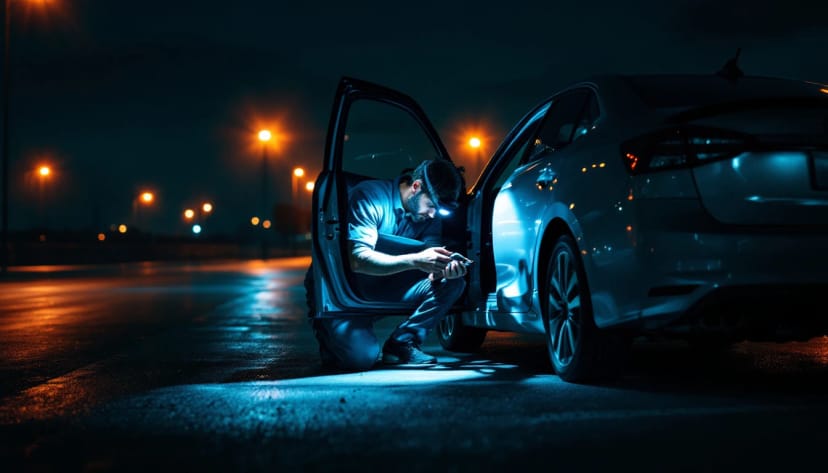
Operationally, the trade defines emergency lockouts as situations where (a) the customer cannot access their vehicle, (b) the vehicle is in a location that exposes the customer to safety, weather, or schedule risk, and (c) the situation cannot wait for standard business hours.
The clearest emergencies:
- Locked out at night in an unfamiliar location.
- Child or pet locked inside a vehicle (call 911 first; locksmith second).
- Locked out in extreme weather (Texas heat above 100°F, or freezing rain).
- Stranded with no working key at an airport, hospital, or out-of-town location.
- Locked out at a workplace where being absent creates immediate professional consequences.
What's typically NOT an emergency, despite feeling like one:
- Lost keys at home with the car safely parked — can wait until morning at standard rates ($120-$250 saved).
- Lost keys on a Saturday for a Monday-morning need.
- Spare-key adds where you still have a working key.
Per BrightLocal's Local Consumer Review Survey 2024, customers who book emergency-rate work for non-emergencies are the most likely to report dissatisfaction afterward — primarily because they paid emergency premium for what could have been daytime work.
Realistic Fort Worth response windows by zone
A single mobile van can cover meaningful geography in 30-60 minutes of drive time. Realistic windows from a dispatch operating in Tarrant County:
- Downtown Fort Worth, Cultural District, TCU area, Stockyards: 20-40 minutes daytime, 25-50 minutes overnight.
- Westover Hills, Ridglea, Benbrook, Crestwood: 25-45 minutes daytime, 35-60 minutes overnight.
- North side, Saginaw, Lake Worth: 30-50 minutes daytime, 40-65 minutes overnight.
- Arlington (entertainment district, AT&T Stadium, Cooper corridor): 30-55 minutes daytime, 40-70 minutes overnight.
- NRH, Hurst, Bedford, Keller: 30-50 minutes daytime, 40-65 minutes overnight.
- Grapevine, Euless: 35-60 minutes daytime, 45-75 minutes overnight.
Operators advertising "10-minute response anywhere" are running call-center dispatch with sub-contractors — you get whoever bites first, not necessarily who's closest. That model is associated with higher rates of bait-and-switch pricing per the FTC's consumer protection guidance on hiring a locksmith.
Emergency job types at a glance
Not every 2 AM call is the same job. The table below maps the four calls that actually come in after dark to what they cost and how long they take on-site.
| Emergency call type | Typical Fort Worth range | On-site time | Tow required? |
|---|---|---|---|
| Car lockout (keys visible inside) | $75-$200 | 15-35 min | No |
| Lost transponder key, no spare | $120-$200 | 40-75 min | No |
| Lost smart/proximity fob, no spare | $180-$450 | 60-120 min | No |
| Ignition will not turn / key stuck | $150-$400 | 45-120 min | Rarely |
The "tow required" column is the one worth reading twice. A credentialed mobile operator resolves all four of these at the roadside, which is precisely why an after-hours mobile call is usually cheaper than the dealer route even before the dealer's parts markup enters the picture.
After-hours pricing — what's legitimate
A legitimate after-hours upcharge exists. Operators have real cost: technician overtime, lower per-call density at night, and higher liability exposure for late-hours work. Reasonable Fort Worth 2026 ranges:
- Standard daytime lockout: $75-$150
- After-hours lockout (10pm-6am): $100-$200 (typically a $25-$75 surcharge)
- Standard daytime transponder key: $120-$250
- After-hours transponder key: $150-$320
- Standard daytime smart fob: $220-$500
- After-hours smart fob: $270-$580
- Holiday surcharge: additional $25-$50 on top of after-hours rate
What's NOT legitimate: $19 "starting at" rates that balloon to $300+ on arrival. Per BBB scam research, this pattern is the single highest-frequency consumer complaint in the trade. Real cost math: a single after-hours service call has $80-$160 in baseline cost (per AAA commercial driving cost data plus technician overtime) before any margin — the $19 advertised rate cannot cover it.
How to call at 2 AM and not get scammed
The 60-second pre-dispatch check works at 2 AM the same way it works at 2 PM:
- Ask for the Texas DPS license number and pause to acknowledge it. Honest operators give it without hesitation; scam operators stumble.
- Ask for the flat-rate price range for your specific job — be specific ("I'm locked out of a 2019 Toyota Camry, fob is visible on the driver's seat"). Get a range before dispatch.
- Ask whether the operator is on the NASTF VSP registry if your situation involves programming (not just a lockout).
- Confirm the dispatcher is local — if the phone gets answered by a national call-routing tree, you're talking to a referral broker, not the locksmith.
- Get the quote in writing — ask the operator to text you the price range. Honest operators do this without resistance.
Time investment: about 3 minutes. Savings against the average bait-and-switch event: typically $100-$300 per call.
Locked out with a child or pet in the car
Per Fort Worth Police Department and Tarrant County emergency-services guidance, when a child or pet is locked in a vehicle, the first call is 911 — not the locksmith. Police and fire respond faster than any mobile locksmith and have authority to break a window without owner authorization when life is at risk.
Locksmith timeline for emergency response is 20-60 minutes minimum. Heat exposure thresholds for children and pets in a closed vehicle in Texas summer are reached in 10-15 minutes. The 911 call is the right first move.
After the immediate safety event is resolved, a locksmith can repair the entry mechanism, replace any damaged components, and program any new keys as needed.
Insurance + roadside assistance options at night
Several common roadside-assistance programs cover lockout service after hours, sometimes at no out-of-pocket cost:
- AAA membership: covers lockout service nationally; the catch is response time can be 60-90 minutes after hours.
- Auto manufacturer roadside (BMW Assist, OnStar, Mercedes-Benz Roadside): typically included on newer vehicles for 3-5 years; covers lockout dispatch.
- Insurance roadside-assistance riders: many Texas auto policies include a small roadside add-on. Check your declarations page.
Per Texas Department of Insurance consumer guidance on auto coverage, comprehensive auto policies sometimes include key replacement under specific endorsements — the deductible structure usually makes this only worthwhile for the most expensive scenarios.
If you have one of these and your situation is genuinely safety-driven (overnight, unfamiliar location, weather), use them first. The trade-off is response speed: a private mobile operator typically beats roadside dispatch by 20-40 minutes after hours.
When the dealership is genuinely the right call
Rare, but real. Cases where dealer-only is correct even at night:
- The vehicle is a recent-model Mercedes EQS / EQE, or 2022+ AMG GT — see Mercedes-specific guidance for FBS4 platforms.
- An open recall or TSB touches the immobilizer system on your specific chassis.
- The vehicle is a low-volume luxury where independent tooling genuinely doesn't exist (Bentley, Rolls-Royce, some Aston Martin).
These cases involve a tow + waiting until the dealer opens the next morning, with the cost premium per J.D. Power's Customer Service Index data. For everything else, mobile is faster and cheaper after hours.
After-the-job paperwork (the same at 3 AM as at 3 PM)
Before the technician leaves: written invoice with company license number, services performed, parts installed, total paid, and warranty terms (industry standard: 90 days on labor, 1 year on hardware). After-hours service should be on the invoice if charged.
If the technician asks for cash-only payment after charging more than the quoted range, refuse the additional amount and call the operator's office to dispute. Per the Better Business Bureau locksmith scam advisory, cash-only pressure at the end of an after-hours job is the textbook bait-and-switch closing move — credentialed operators take card payments and issue digital invoices regardless of the hour.
Common after-hours problems we see
Night calls skew toward a narrow set of situations, and knowing which one you are in shortens the conversation considerably.
Keys locked in a running car
More common than people expect, especially on push-button vehicles left idling for air conditioning. It is a lockout, not a key job, and it is one of the fastest calls we run — non-destructive entry, no programming, no key generated.
The fob that died in a parking garage at midnight
A proximity fob with a failing battery degrades rather than dying cleanly, and it usually gives up somewhere inconvenient. Before assuming the worst, try the backup start method in your owner's manual — most vehicles let you hold the fob against a marked spot on the column, cupholder or start button. That single trick gets a lot of people home without a call.
The only key lost at the end of a shift
The genuinely expensive version: no working key, a car in a workplace lot, and a driver who needs to be somewhere in the morning. This is an all-keys-lost job, it takes longer than a lockout, and ownership paperwork has to be sorted before any credential is generated — which is harder at 2 AM if the title is at home.
A key snapped off in the ignition
Extraction is its own job. Do not attempt it with pliers or glue; a broken blade driven deeper into the cylinder turns a straightforward extraction into a cylinder replacement in the $150–$400 range.
A car that will not start and is blamed on the key
Sometimes the key is fine. A flat 12-volt battery, a failed starter or an immobilizer fault all present as "my key stopped working." A technician who diagnoses before selling hardware saves you the cost of a key that was never the problem.
Honest boundaries
Not every job can be finished at 3 AM. Lockouts and most mass-market key work are genuinely round-the-clock. Some encrypted platforms need manufacturer-side authorization that is not reachable at every hour, and bench work on a removed module is not a roadside procedure. When your job is one of those, the honest answer at night is a safe interim plan and a first-thing-in-the-morning slot, not a promise that cannot be kept.
The newest platforms still need verification. Recent model years, Mercedes FBS4, Volkswagen Audi Group Component Protection cars and Tesla's account-based pairing sit outside universal independent capability. As of August 2026 that remains true regardless of what time you call, and a technician confirms your exact setup from the VIN rather than quoting blind.
Ownership verification does not get waived because it is late. Title or current registration against a government-issued photo ID in a matching name, recorded on the invoice, before any credential is generated. The FTC's consumer guidance on hiring a locksmith sets that expectation, and an operator willing to skip it at night is exactly the operator you called to avoid.
Emergency pricing should be disclosed on the phone. A surcharge that only appears on the invoice is not a surcharge, it is a bait-and-switch.
How the after-hours visit works in Fort Worth
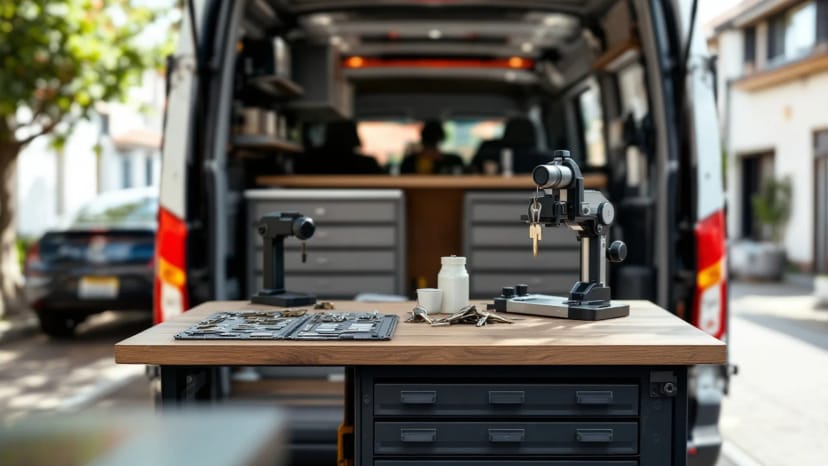
Our normal hours are 8AM to 8PM, seven days a week, and we take genuine emergency automotive calls outside that window when a technician is available. Everything happens where the car is — driveway, roadside, workplace lot, garage.
The call should be short and factual: where you are, what you drive, whether anyone is locked in the vehicle, and how many working keys exist. A person trapped inside — particularly a child or a pet in Texas heat — changes the priority immediately, and in that situation you should be calling 911 first and us second.
You get a flat-rate range including any after-hours component before dispatch. On arrival the technician verifies ownership, checks the 12-volt battery and the simple failure modes, then does the work and function-tests everything before writing an itemized invoice with the VIN on it.
Coverage runs across Fort Worth and out to Arlington, Bedford, Hurst, Keller and North Richland Hills. See also 24-hour car locksmith and emergency car locksmith, and for the underlying numbers, car key replacement cost in Fort Worth TX.
Talk to a technician
Call 817-842-1256. Tell us where you are, what you drive, and whether anyone is locked inside — you will get a flat-rate range including any after-hours component before a technician is dispatched.
Field-operator perspective
3 AM calls are where the scam industry makes its money. Customer is tired, stressed, in a parking lot, doesn't want to argue. The honest operator looks the same on the phone as the scam operator at 3 AM — except for one thing: the honest one will text you a written quote in 30 seconds. Just ask. If they say "we can't do that," they're going to mark you up by 300% when they arrive.
— a NASTF-registered Fort Worth automotive locksmith, ALOA Master Automotive Locksmith (MAL) credential, DFW metroplex (anonymized)
A real-world example
Operator: Anonymized 2020 Honda Pilot owner, AT&T Stadium parking lot post-game lockout at 11:48 PM
Before:
- Customer locked keys in the vehicle in section J of the AT&T Stadium lot after a Cowboys game; visible on the driver's seat through the window.
- First call (paid-ad operator): "starts at $25" — refused to commit to a range, dispatched without flat-rate confirmation.
- Customer canceled the first dispatch after that operator estimated 75 minutes ETA + "$169 after-hours surcharge" added verbally.
What changed: Customer called a second NASTF-registered local operator. Pre-dispatch flat-rate quote texted in 90 seconds: $135-$165 covering after-hours lockout, ETA 35-50 minutes. Technician arrived in 42 minutes, verified ownership (TX DL + insurance card), opened the vehicle in 4 minutes using non-destructive entry tools.
Outcome:
- Final invoice: $145 (within quoted range). Card payment, digital receipt.
- Customer was driving home 6 minutes after technician arrived.
- 90-day warranty issued in writing on any potential lock damage.
- Total time from first call to driving away: 52 minutes (after 2 separate dispatch attempts).
Net: The second-operator route saved roughly $40-$120 vs the first operator's expected final bill, with no quality difference. The more important learning: getting the flat-rate range in writing on the phone is what prevents the worst version of the after-hours bait-and-switch. Per BBB scam data, this is the single highest-frequency consumer protection event in the trade.
Frequently Asked Questions
How much should after-hours locksmith service cost in Fort Worth?
Reasonable 2026 ranges: lockout $100-$200 after hours ($75-$150 daytime); transponder key $150-$320 after hours ($120-$250 daytime); smart proximity fob $270-$580 after hours ($220-$500 daytime). The legitimate after-hours surcharge is $25-$75 on top of daytime rates. Operators quoting $19-$29 "starting at" are advertising bait rates that mark up after dispatch — get a flat-rate range in writing before authorizing.
How fast should an emergency locksmith arrive in Fort Worth at night?
Realistic overnight windows by zone: Fort Worth proper 25-50 minutes; Arlington / NRH / Hurst / Bedford / Keller 40-70 minutes; outer suburbs (Grapevine, Euless, Benbrook outer) 45-75 minutes. Operators advertising 5-15 minute response are running call-center dispatch — you get sub-contractors of variable quality. A 30-50 minute window from a credentialed local operator is faster in real terms than a "10-minute" call-center promise.
What do I do if a child is locked in the car?
Call 911 first. Police and fire respond faster than any mobile locksmith and have authority to break a window when life safety is at risk. In Texas summer heat, the safe-exposure window for a child in a closed vehicle is roughly 10-15 minutes. Locksmith dispatch will typically take 20-60 minutes — the math doesn't support waiting. After 911 has resolved the safety event, a locksmith can repair entry mechanisms and replace any damaged components.
Does my insurance cover emergency lockout calls?
Sometimes. Many Texas auto policies include a small roadside-assistance rider that covers lockouts. Per Texas Department of Insurance consumer guidance, comprehensive coverage can also cover key replacement under specific endorsements — but the deductible structure usually makes filing only worthwhile for the most expensive scenarios. Ask your agent before authorizing work; rate-increase exposure at next renewal can eat the savings on smaller claims.
Why are some locksmiths so cheap on advertising but so expensive on arrival?
It's the classic bait-and-switch documented by both the FTC and the Better Business Bureau. The $19 "starting at" rate is a marketing hook — the operator knows it cannot cover their actual cost ($80-$160 baseline per call) and intends to mark up after arrival when the customer is stressed and feels they have no choice. The fix is to refuse dispatch until you have a flat-rate range in writing covering all expected charges.
How do I tell a real local operator from a call-center?
A few quick signals. (1) Phone is answered by a human, not a routing menu. (2) The dispatcher can name landmarks in your zip code without looking them up. (3) The dispatcher can quote a flat-rate range for your job class within 60 seconds. (4) The technician has business cards with the same phone number and license that matched the call. (5) The invoice issues from the same business name as the phone tree. Call centers fail at least one of these consistently.
References & external sources
- Better Business Bureau — Locksmith Scam Advisory — BBB consumer protection guidance on locksmith bait-and-switch operators.
- FTC Consumer Advice — Hiring a Locksmith — Federal Trade Commission guidance on verifying locksmith legitimacy before service.
- NASTF Vehicle Security Professional (VSP) Registry — National Automotive Service Task Force registry for credentialed access to OEM security data.
- Texas Department of Public Safety — Private Security Licensing — Texas locksmith company + individual licensing requirements.
- BrightLocal — Local Consumer Review Survey 2024 — Annual research on how consumers find + evaluate local service businesses.
- AAA — Your Driving Costs 2024 — Annual ownership cost study including unscheduled maintenance projections.
- J.D. Power — Customer Service Index — Annual study of dealership service department satisfaction and cost.
- Texas Department of Insurance — Auto Insurance Coverage Types — TDI consumer guide to comprehensive coverage and key-replacement claims.