Transponder Key — The Short Definition
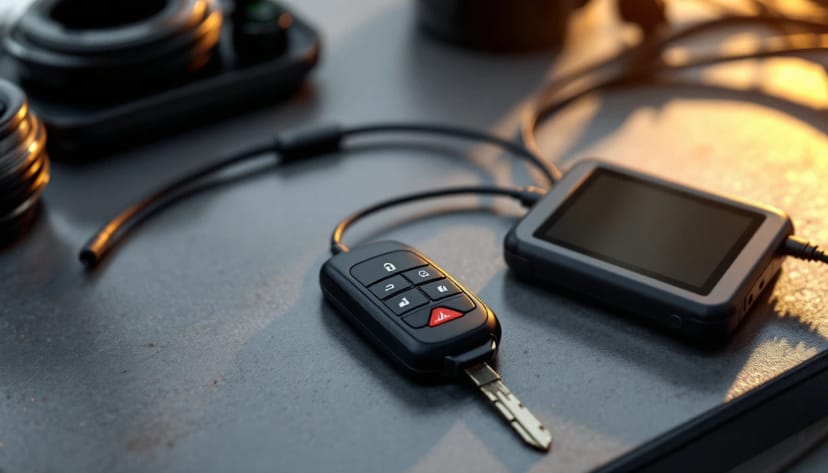
A transponder key is a metal key blade with an embedded RFID chip (the "transponder") inside the plastic head. The chip is passive — no battery — and only communicates with your car when the key is inserted into the ignition cylinder. When you turn the key, the immobilizer sends out a low-frequency radio signal that powers and reads the chip, authenticates, and authorizes the engine to start. If the chip is missing, wrong, or damaged, the engine won't crank or will crank but not start. Per the NHTSA's anti-theft system guidance and FMVSS 114, this architecture exists specifically to prevent unauthorized key generation.
Key Fob — The Short Definition
A key fob (also called a remote or remote-entry fob) is a battery-powered device with buttons that sends a radio signal to your car — typically at 315 MHz or 433 MHz in North America. You press a button to lock, unlock, open the trunk, or trigger the panic alarm. The fob is active — it needs a battery (typically CR2032 or CR2025) and transmits only when you press a button.
Smart / Proximity Fob — The Modern Hybrid
A smart key or proximity fob combines both technologies. It has batteries and buttons like a regular fob, but it also continuously listens for a low-frequency signal from antennas built into your car's doors and cabin. When the fob is near the car, the car's computer authenticates it automatically — no button press needed. This is what enables keyless entry (touch the door handle) and push-button start.
How to Tell Which You Have
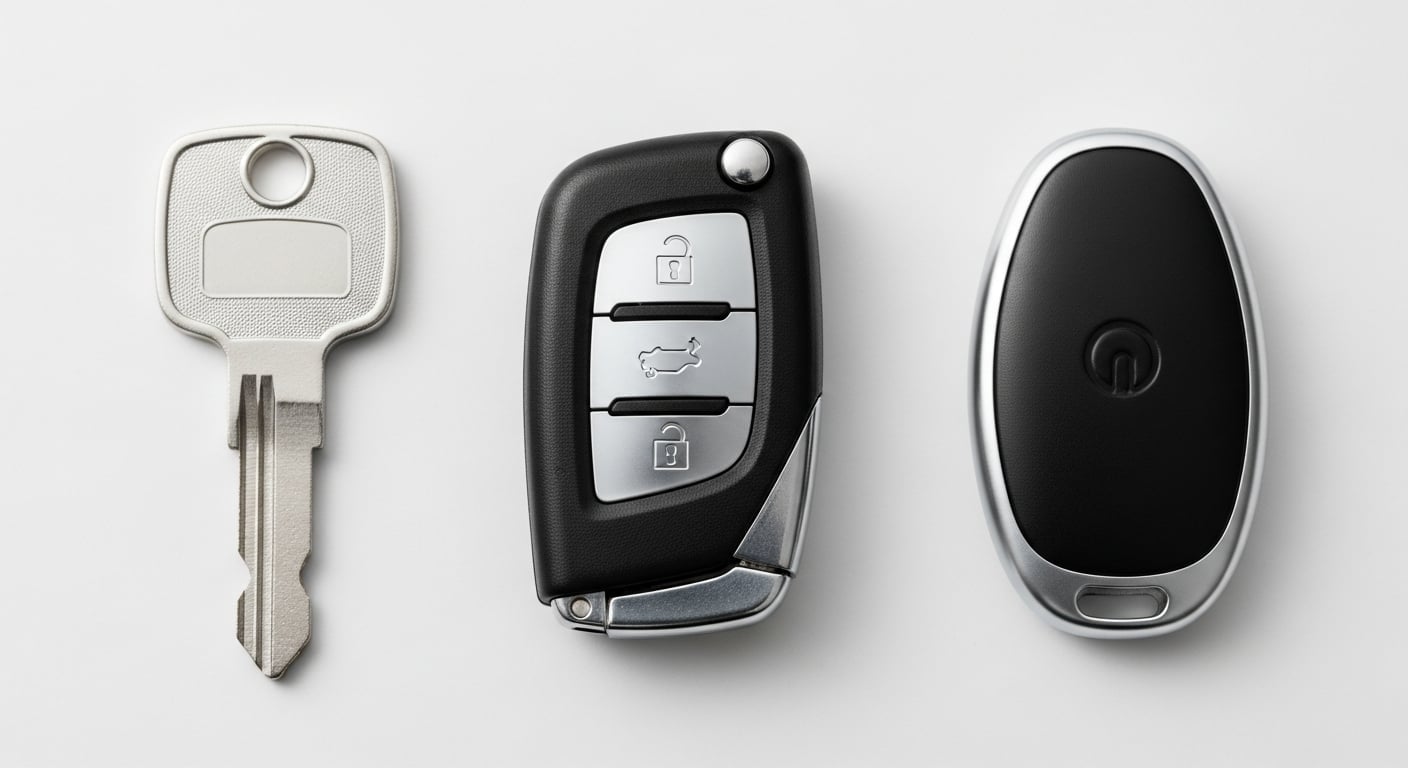
- Traditional transponder (no buttons): just a metal key. You insert it into the ignition to start the car. 2) Remote head / flip key: a metal key with a fob attached at the top. You use the blade to unlock mechanically, press buttons for remote, then insert to start. 3) Smart / proximity fob: no visible metal blade (just a plastic "shell" with buttons), used for push-button start. Often has a hidden emergency blade inside the case for battery-dead situations.
Why the Distinction Matters for Cost
As of August 2026, basic transponder keys run $120–$180 to replace and program. Remote head and flip keys run $175–$275. Smart and proximity fobs run $220–$500. European luxury smart fobs (BMW, Mercedes, Audi) run $350–$800. The more the key does, the more hardware inside, and the more sophisticated the programming — so more cost. Per J.D. Power's Customer Service Index data, dealer-side equivalents typically run 1.7-2.4× these mobile rates. For the full cross-service picture, see our breakdown of car key replacement cost in Fort Worth TX.
Can I Use One Type in Place of Another?
No. Each vehicle's security system is designed for one specific key architecture. A vehicle with a proximity smart key cannot be downgraded to a regular transponder (the ignition cylinder doesn't exist or is dummy). A vehicle with a traditional transponder cannot be upgraded to proximity without major aftermarket module installation ($800+ and often breaks warranty).
The cryptography behind each generation
Older transponders used fixed-code RFID (Philips ID33 / ID40, late 1990s through early 2000s) — readable with simple tooling. Mid-generation rolling-code (Texas Instruments DST40, 2005-2014) added cryptographic challenge-response. Modern encrypted chips (TI DST80 / Toyota 8A, Megamos AES, Hitag3) use AES-128 or proprietary encryption — programming requires either NASTF Vehicle Security Professional registry data access or specialized aftermarket tooling certified through the Associated Locksmiths of America. The cryptography evolution is driven by each generation's resistance to theft, per BLS Occupational Employment data on the locksmith trade's tooling evolution.
Side-by-Side: Transponder vs Fob vs Smart Key
The three terms get used interchangeably, but they're distinct technologies with different hardware, different failure modes, and different replacement costs. Here's the clean comparison.
| Feature | Transponder key | Remote / key fob | Smart / proximity fob |
|---|---|---|---|
| Physical blade | Yes (cut metal) | Yes (often flip/RHK) | Hidden emergency blade only |
| Battery | No (passive chip) | Yes (CR2032/CR2025) | Yes |
| Starts car by | Inserting + turning | Insert + turn | Push-button (fob nearby) |
| Locks/unlocks remotely | No | Yes (buttons) | Yes (buttons + walk-up) |
| Talks to car | Only in the ignition | Only when you press a button | Continuously, wirelessly |
| Typical replacement | $120–$200 | $175–$275 | $220–$500 ($350–$800 EU) |
The rule of thumb: the more the key does, the more hardware is inside it and the more sophisticated the programming — so the more it costs to replace.
How to Identify Yours in 30 Seconds
- Traditional transponder: just a metal key, no buttons. You insert it to start. The plastic head is noticeably thick because the chip lives inside it.
- Remote head / flip key: a metal blade with lock/unlock buttons built into the head (or a blade that springs out of a fob body). You still insert it to start.
- Smart / proximity fob: a button pod with no visible working blade — you start the car with a push-button while the fob is in your pocket. There's usually a hidden emergency blade tucked inside the case for dead-battery situations.
If you're unsure, any locksmith can scan the key with a chip reader in under a minute and tell you exactly what generation it is.
Replacement Cost by Type
Cost follows capability. As of August 2026, basic transponder keys run $120–$200 to replace and program. Remote head and flip keys run $175–$275. Smart/proximity fobs run $220–$500, and European luxury smart fobs (BMW, Mercedes, Audi, Porsche, Jaguar, Land Rover) run $350–$800 because of both the hardware and the OEM-grade tooling their platforms demand. Adding a second matching fob while the technician is already on site is normally about $65 on mass-market platforms. Per J.D. Power's Customer Service Index analysis, dealer-side equivalents typically run 1.7–2.4× these mobile rates before any tow is added.
Battery, Water, and Wear — What Fails and What It Costs
Each type fails differently. A transponder key has no battery, so it rarely dies electronically — but its chip can be damaged by a trip through the washing machine, and worn blades eventually stop turning a tired ignition. A remote fob most often just needs a $5 coin-cell battery before you assume it's broken; only after a fresh battery fails to help is programming or hardware the issue. A smart fob can suffer a dead battery (use the hidden blade and the backstop start method in your manual), water intrusion, or button-pad wear. Diagnosing which of these you have is exactly what avoids buying a $400 fob when a $5 battery would have done — a distinction a good operator makes before selling you anything.
The Immobilizer: Why a Non-Chip Key Won't Start Your Car
Since the late 1990s, virtually every car sold in the U.S. has an electronic immobilizer: when you try to start the engine, the car looks for the correct chip signature and refuses to run the fuel/ignition if it doesn't get it. That's why a hardware-store key cut to fit your door will turn the lock but not start the engine on any post-1997 vehicle — the blade is right, but the chip is missing. This architecture is the direct reason vehicle theft-by-hotwiring collapsed after immobilizers became standard; the Insurance Institute for Highway Safety / HLDI has documented the large, durable drop in theft-loss rates that followed widespread immobilizer adoption. It's also, per the NHTSA anti-theft framework, why generating a key without proof of ownership is deliberately hard.
Cloning vs Programming — Not the Same Thing
Two different operations get lumped together. Cloning copies an existing working key's chip identity onto a new blank — fast and cheap, but only possible when you have a functioning key to copy and the chip generation supports it (older fixed-code and some rolling-code chips). Programming writes a brand-new identity into the car's immobilizer memory — required for all-keys-lost, for adding a fob the car has never seen, and for any modern encrypted platform where cloning is impossible. Cloning is why a spare made from a working key can be cheaper than a from-scratch key; programming is why an all-keys-lost job costs more.
Security Tradeoffs by Generation
The chip generations exist because each one answered the previous one's vulnerability. Early fixed-code transponders (Philips ID33/ID40, late 1990s–early 2000s) were simple and are trivially copyable today. Rolling-code chips (Texas Instruments DST40, roughly 2005–2014) added a cryptographic challenge-response. Modern encrypted chips (DST80/Toyota 8A, Megamos AES, Hitag3) use AES-128 or proprietary encryption and require either credentialed OEM security-data access through the NASTF VSP registry or specialized tooling certified through the Associated Locksmiths of America. The practical takeaway: the newer and more encrypted your key, the more it costs to replace — but also the harder it is to steal, which is the whole point.
Which One Do You Actually Need?
Here's the part most people actually care about: you don't get to choose. Your vehicle's security system was engineered for one specific key architecture, and that's the one you need. A car built around a proximity smart key can't be "downgraded" to a cheaper transponder — there's often no real ignition cylinder to turn, just a push-button. A car built around a traditional transponder can't be casually "upgraded" to proximity without adding aftermarket modules (an $800+ job that can break warranty and introduce reliability quirks). So the practical question isn't which type is better — it's which type does my car use, and then how do I replace it for a fair price. Identify your type using the 30-second check above, match it to the cost table, and you know what a fair quote looks like before you ever pick up the phone.
Upgrading, Downgrading, and Adding Convenience
A few real options do exist, with honest tradeoffs. Adding a remote to a plain transponder car (aftermarket keyless entry) is common and reasonable — but it's a separate accessory system, not a change to the key that starts the car. Retrofitting push-button start onto an older vehicle is technically possible but rarely worth it: the module and labor cost usually exceeds the convenience, and it can complicate future key work. Adding a spare of your existing type is almost always the smart money — a second correct key programmed now (from ~$65 on mass-market platforms up to a few hundred on European ones) is a fraction of a future all-keys-lost event. If a shop pushes an expensive "upgrade" when you only asked for a replacement, treat it the way the Better Business Bureau's locksmith advisory suggests: as an upsell to question, not an instruction to follow. The right move is almost always to replace what you have, in the type your car was built for, and add a spare while the technician is already there.
A Buyer's Checklist for a Correct Replacement
Whether you're replacing a transponder key, a remote, or a smart fob, five checks make sure you get the right part programmed at a fair price. One: confirm the type. Have the operator verify whether your car uses a transponder, a remote-head/flip key, or a proximity fob — this alone sets the correct cost tier. Two: confirm the frequency and chip generation. North American fobs run at 315 MHz or 433 MHz, and the transponder generation (fixed-code, DST40 rolling-code, or DST80/Megamos AES) must match your vehicle; a mismatch is the most common reason a bought-online fob won't work. Three: OEM vs aftermarket. Ask which is being quoted and why — quality aftermarket is fine for most mass-market cars, while some European and proximity systems want OEM-equivalent hardware. Four: cut method. Laser (sidewinder) blades and edge-cut blades need different equipment; confirm the operator has it for your car. Five: the all-in quote. One number covering hardware, cutting, programming, and testing — texted to you, with a license number you can check on the TX DPS Private Security lookup. Run that checklist and you'll never overpay for the wrong key.
The Bottom Line
"Transponder key" and "key fob" aren't interchangeable — they're different technologies, and a "smart key" is the modern hybrid of both. A transponder is a passive chip that only talks to the car in the ignition; a fob is a battery-powered remote with buttons; a smart key does both and enables push-button start. Which one you have is fixed by your vehicle, and it determines what a fair replacement costs — from about $120 for a basic transponder up to $800 for a European luxury smart fob. Identify your type, match it to the cost tier, insist on the correct frequency and chip generation, and get one all-inclusive quote from a licensed operator. Do that, and you'll pay for exactly the key your car needs — nothing more.
August 2026 review — the failure that proves the distinction
Reviewed 23 August 2026; the replacement bands above are unchanged from the July review.
The clearest real-world illustration of why transponder and remote are separate systems came out of a Fort Worth driveway this month. The owner had replaced the car battery himself, and afterwards the remote still locked and unlocked the doors perfectly — so he was certain the key was fine and started shopping for a starter. It cranked, fired, and died in about two seconds, every attempt.
The remote was fine. It was never the point. The remote is a one-way radio in the plastic shell; the transponder is a separate challenge-and-response circuit that the car interrogates at the ignition, and that side had lost sync with the vehicle when power was interrupted. A diagnostic re-learn fixed it in under an hour with no new hardware at all. Had he bought the starter, the car still would not have run.
That is the practical payoff of understanding which part of your key does what: "my remote works so my key is good" is one of the most expensive wrong conclusions in this trade. The full diagnosis is in car won't start after a battery replacement or jump start. If you want the same distinction applied across one model line year by year, Ford Escape key replacement 2001 to 2026 walks all four generations from bladed transponder to proximity fob. And for what each type costs across the whole service menu, see car key replacement cost in Fort Worth TX.
Field-operator perspective
The two questions that filter the trade are: what tool do you use for my chassis, and what's your flat-rate range for this job. Honest operators answer both in under 60 seconds. The scam operators stall on both. Every customer who calls us armed with those two questions saves themselves $150-$400 on average — that's the entire trick.
— a NASTF-registered Fort Worth automotive locksmith, ALOA Master Automotive Locksmith (MAL) credential, DFW metroplex (anonymized)
Common problems we see by key type
The type of key you carry predicts the failure you will eventually have. These are the ones that fill a Fort Worth week.
The washed transponder key
A plain transponder key has no battery and no screen, so owners treat it as indestructible — right up until it goes through a wash and dry cycle in a jeans pocket. The blade survives. The chip, potted in the plastic head, often does not. The symptom is unmistakable: the door still unlocks mechanically and the engine cranks, but it either refuses to fire or fires and dies within a second or two as the immobilizer cuts fuel. That is not a fuel-pump problem and it is not a starter problem, and diagnosing it as one is how people end up paying a shop to chase a fault that is actually a dead chip.
The flip key that will not stay out
Flip and remote-head keys hide a small spring and a hinge pin inside the fob body, and both are consumables. When the spring tires, the blade stops snapping into the extended position and starts flopping. Owners tend to live with it for months, which is a mistake, because the same hinge failure eventually lets the blade sit at a slight angle in the ignition and accelerate wear on the cylinder wafers — turning a key problem into an ignition problem that costs $150–$400 instead.
The proximity fob that works from six inches away
A smart fob with a fading battery does not die cleanly. It degrades: it stops working from across the parking lot, then from a few feet, then only when held directly against the start button — which is exactly the backup procedure most manufacturers build in, and the reason a lot of people never realise the battery is the issue. Heat accelerates it, so this failure clusters in a Texas August. Replace the cell before you replace anything else.
The one-key used car
The most expensive problem on this list is not a fault at all. A car bought secondhand with a single key is a car one bad afternoon away from a full all-keys-lost job, and on every platform the gap between adding a spare now and recovering from nothing later is large. Our guide to what happens when you have lost car keys with no spare walks the recovery path in detail; the short version is that the cheapest moment to make a second key is always today.
The "programmed to your VIN" online fob
Listings promising a fob pre-programmed to your vehicle are selling something that is not technically possible for anything that starts the engine. Registration happens at the car. What arrives is a fob with the right shape, sometimes the wrong frequency, usually an uncut blade, and occasionally a chip generation your immobilizer will not talk to at all. It is the single most common reason a customer ends up paying twice.
Honest boundaries
There are limits worth stating plainly, because the operators who do not state them are the ones you should worry about.
Newest platforms need verification, not promises. Vehicles from roughly the last two or three model years, along with Mercedes FBS4, Volkswagen Audi Group Component Protection cars, and Tesla's account-based key pairing, sit behind manufacturer-side authorization that independent tooling does not universally reach. On those, an honest answer starts with your VIN and ends with a technician confirming your exact setup — not with a flat price quoted over the phone.
A key cannot fix an ignition. If the cylinder is worn, the wafers are damaged, or the steering-column lock has failed, a brand-new correctly cut key will still not turn. That is mechanical repair in the $150–$400 range and it is a different job.
Some fobs genuinely are dealer-only. A handful of low-volume trims and very recent hardware revisions have no aftermarket equivalent yet. When that is true, saying so is the service.
No key work without proof of ownership. On any all-keys-lost job we verify the vehicle title or current registration against a government-issued photo ID in a matching name, and record it on the invoice, before any credential is generated. That is not paperwork theatre — immobilizer access is powerful, and the FTC's consumer guidance on hiring a locksmith treats identity verification as a baseline expectation.
How the on-site visit works in Fort Worth
We are mobile-only, which suits this work: a car that will not start is a car that is not driving to anyone. Hours are 8AM to 8PM, seven days a week, across Fort Worth and Tarrant County.
The call comes first, and it should be short and specific. We ask for the year, make and model, whether you have a working key, and which of the three key types you carry. That last answer alone determines the hardware on the van, so a thirty-second identification on the phone is what makes a single-visit fix possible.
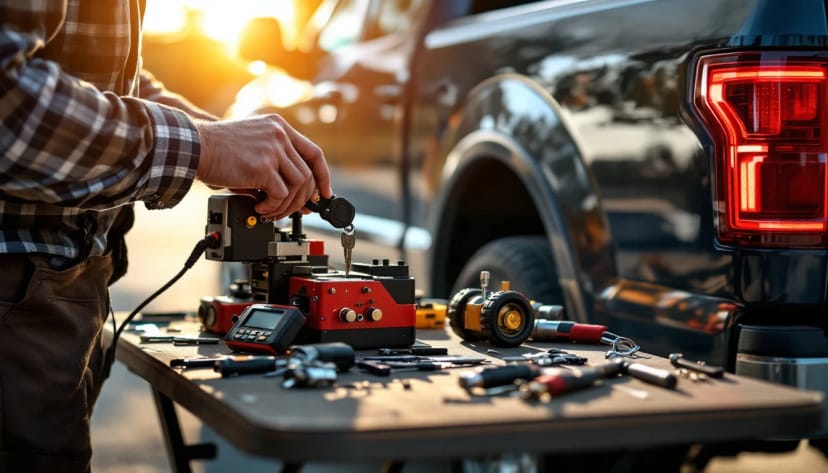
On arrival, the technician verifies ownership, then confirms the key type by scanning what you have or by reading the vehicle's configuration when you have nothing. A 12-volt battery check comes next, because a marginal battery produces convincing false immobilizer faults and it is a cheap thing to rule out before anything else. Blades are cut from your key code rather than copied where possible, which produces a cleaner key than duplicating an already-worn original. Then the credential is written, and every function on every key is tested before the invoice: start, lock, unlock, trunk, panic, and the mechanical blade in the driver's door.
Coverage runs across Fort Worth and out to Arlington, Bedford, Hurst, Keller and North Richland Hills. If you are not sure which type of key you have, call and describe it — that is a normal call, not an inconvenient one.
Talk to a technician
Call 817-842-1256 and describe the key in your hand. We can identify the type, the likely chip generation, and a flat-rate range before anyone is dispatched, seven days a week from 8AM to 8PM across Fort Worth and Tarrant County.
Frequently Asked Questions
What's the difference between a transponder key and a key fob?
A transponder key is a metal key with an RFID chip embedded in the head — no buttons, no battery — that communicates with the immobilizer only when inserted into the ignition. A key fob is a separate battery-powered remote with buttons for lock/unlock/trunk. A smart key combines both: it has buttons AND continuously communicates with the car for keyless entry and push-button start.
Does my key need a chip?
Almost certainly yes, if your vehicle is 1997 or newer. Vehicle manufacturers added immobilizer systems that require a transponder chip starting in 1996–1998 for most brands. Cutting a no-chip key will unlock the door but won't start the engine on any post-1997 vehicle.
How can I tell if my key has a transponder chip?
Three ways: (1) check the key itself — transponder keys have a thicker plastic head than chip-less keys; (2) check the vehicle model year — 1997+ almost always has a chip; (3) ask a locksmith to scan your key with a chip reader, which takes under a minute.
What does each key type cost to replace in Fort Worth?
As of August 2026, a basic transponder key runs $120–$200 replaced and programmed, a remote head or flip key runs $175–$275, and a smart or proximity fob runs $220–$500. European luxury smart fobs from BMW, Mercedes, Audi, Porsche, Jaguar and Land Rover sit in the $350–$800 band because of both the hardware and the credentialed tooling those platforms demand. Adding one more matching fob during the same visit is usually about $65.
Can I buy a key fob online and program it myself?
Sometimes, but far less often than the listings suggest. A remote-only fob on some older platforms can be paired with an on-board key dance, but anything that starts the engine needs the chip registered to your immobilizer at the vehicle, and most modern encrypted platforms will not accept an untooled pairing at all. The blade also has to be cut to your key code, which no seller can do without your vehicle. Confirm the frequency, chip generation and cut style with an operator before you buy anything.
My fob stopped working — is it dead or does it just need a battery?
Start with the battery, because a tired coin cell is the single most common cause and it costs almost nothing to rule out. If a fresh cell does not fix it, the next suspects are water intrusion, a worn button pad, or a cracked solder joint on the board from being dropped. Only after all of those are eliminated is re-programming or replacement the right call. A good operator checks in that order rather than selling you a fob first.
Does the type of key change how fast a locksmith can get me going?
Yes, substantially. A basic transponder with a working key present is usually a short visit, since the blade is cut from your key code and the chip is added to memory. A proximity fob takes longer because the pairing sequence involves more of the vehicle network, and an all-keys-lost job on any type is longer still because ownership verification and immobilizer access come first. Tell the operator your key type on the phone and the time estimate you get back will be far more accurate.
References & external sources
- NHTSA — Anti-Theft Systems & FMVSS 114 — Federal Motor Vehicle Safety Standard governing key-code and immobilizer disclosure.
- J.D. Power — Customer Service Index — Annual study of dealership service department satisfaction and cost.
- NASTF Vehicle Security Professional (VSP) Registry — National Automotive Service Task Force registry for credentialed access to OEM security data.
- Associated Locksmiths of America (ALOA) — Trade association governing locksmith certifications including the Master Automotive Locksmith (MAL) credential.
- U.S. Bureau of Labor Statistics — Occupational Employment and Wages, Locksmiths (49-9094) — BLS OEWS national wage + employment data for locksmith occupation.
- AAA — Your Driving Costs 2024 — Annual ownership cost study including unscheduled maintenance projections.
- Better Business Bureau — Locksmith Scam Advisory — BBB consumer protection guidance on locksmith bait-and-switch operators.
- Insurance Institute for Highway Safety (IIHS/HLDI) — Vehicle Theft — Research on immobilizer effectiveness and vehicle theft-loss trends.
Update, August 2026
Prices quoted here were re-checked in August 2026 against our published bands and are unchanged.
One addition worth making, because it is now the most common way this distinction costs people money. A generic fob bought online can pair with the remote side of a car, so the doors lock and unlock, and still fail completely on the security side, so the engine will not start. That is not a botched programming job. It is the clearest possible demonstration that the remote and the transponder are two separate systems, which is the whole subject of this article. The aftermarket fob programming guide covers what to do when it happens to you, and why stopping after the second failed attempt matters more than anything else.
The other place this distinction bites is on modules rather than keys. When a vehicle stops recognising a perfectly good key, the fault is often the component that reads it rather than the key itself. The Chrysler Pacifica RF hub guide is a worked example on one platform, and the Cadillac CT5, XT5 and XT6 reference shows how a proximity system behaves when everything is working correctly.