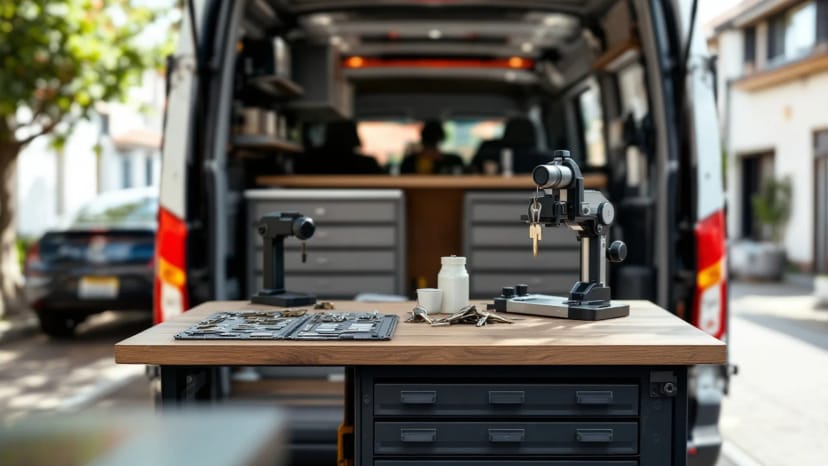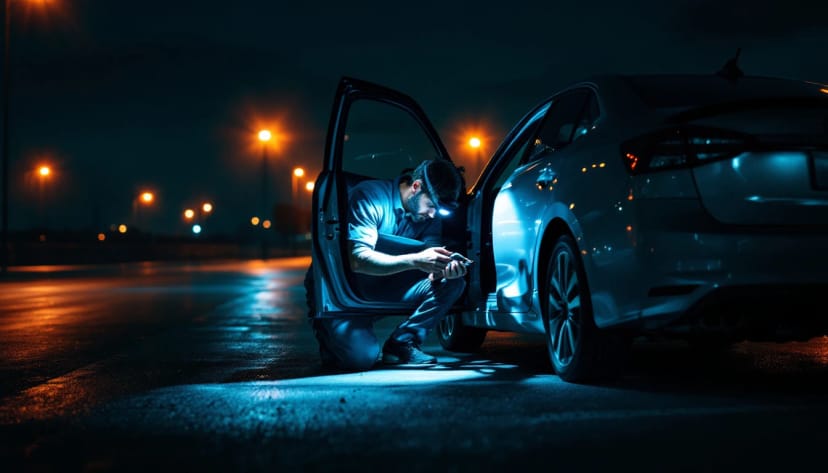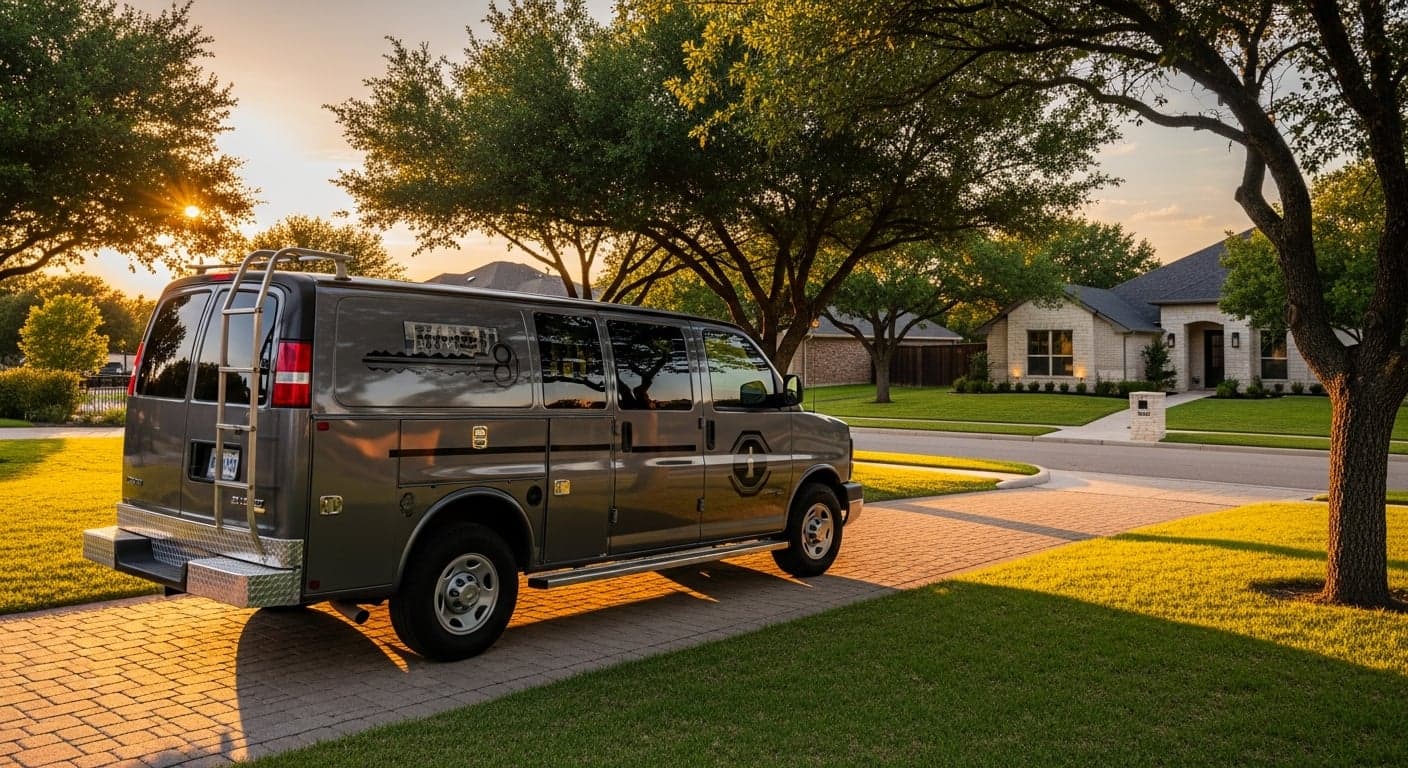
TL;DR — the 8-point picker, before you read the rest
If you're calling around right now, here's the short version. Any mobile automotive locksmith working on your vehicle in Fort Worth should be able to confirm, on a 60-second phone call: (1) Texas private-security license number (verifiable on the Texas DPS public lookup), (2) ALOA membership or Master Automotive Locksmith credential per the Associated Locksmiths of America standard, (3) NASTF Vehicle Security Professional registry status if they touch immobilizer data — the NASTF VSP program is the gatekeeping mechanism for OEM security-data access, (4) a flat-rate price range quoted before dispatch, in writing via SMS if you ask, (5) proof of commercial general liability + garage-keepers insurance, (6) a real local phone number that rings a dispatcher (not a national call-routing tree), (7) physical service area limited to mobile reach — they should not promise "10-minute response" from across the metro, and (8) ownership verification protocol (they'll ask for ID + title or registration before cutting a key).
If a locksmith fails any of those 8 checks, you're at elevated risk of bait-and-switch pricing. Per the Better Business Bureau locksmith scam advisory, the locksmith trade is one of the most consistently reported consumer-complaint categories in the local-services sector — and the FTC consumer guidance on hiring a locksmith lists pre-dispatch flat-rate quoting as the single most reliable scam filter.
Why "best" is a buyer-side decision, not a marketing claim
Every automotive locksmith in Fort Worth is going to claim to be "the best," "fastest," "most trusted," or "5-star rated." That language is essentially free to print. What it correlates to is operationally close to zero — many of the cheapest, lowest-credentialed operators run the largest paid-ads budgets, the most aggressive Google Business Profile review-generation schemes, and the loudest "best in Fort Worth" copy on their websites.
The buyer-side framework cuts through that. It's built around three pillars that are difficult or impossible to fake: licensing (regulated and publicly verifiable), credentials (ALOA / NASTF require continuing education + paid annual dues), and pricing discipline (flat-rate-before-dispatch is operationally hard to fake because it requires the operator to actually know their cost model).
Per BrightLocal's Local Consumer Review Survey 2024, 73% of consumers say they read reviews before choosing a local service provider, but only 27% say they verify license or credential status. The credential-verification gap is the leverage point: a locksmith with verifiable ALOA-MAL + NASTF-VSP status who lacks 500 Google reviews is almost always a better hire than the locksmith with 500 reviews and no credentials.
Pillar 1: Texas licensing — the floor, not the ceiling
Texas regulates locksmiths under the Texas Department of Public Safety Private Security program. Every individual technician operating in the trade is required to hold a current company license + individual registration. The license number is searchable on the DPS public lookup; if a Fort Worth locksmith can't give you the number on the phone, that's the first hard stop.
License compliance alone doesn't make a locksmith good — it just means they haven't been disqualified for cause. Plenty of licensed operators run bait-and-switch pricing within the letter of the law. But license absence is a near-certain indicator of an unregulated operator, and unregulated operators are the ones who quote $15 over the phone and charge $385 after they show up with a drill.
The license check takes 30 seconds. The technician's name + license number, cross-referenced against the DPS lookup, should produce a current active result. If it produces "expired," "revoked," or no record at all, hang up.
Pillar 2: ALOA + NASTF — the credentialed-operator signal
The Associated Locksmiths of America runs a credentialing program with three tiers: Registered Locksmith (RL), Certified Registered Locksmith (CRL), and Master Automotive Locksmith (MAL). The MAL credential requires demonstrated proficiency across automotive lock systems, transponder programming, and module-level diagnostics — and ongoing continuing education.
For any vehicle manufactured after roughly 2005, automotive locksmith work involves immobilizer + transponder programming, which in turn requires access to OEM security data through the NASTF Vehicle Security Professional registry. NASTF VSP membership is the legitimate path for an independent locksmith to retrieve VIN-keyed security data from manufacturers — without it, the only legal alternatives are (a) brute-force EEPROM programming on the bench, which is invasive and limited, or (b) the dealership.
A locksmith advertising "European luxury" or "all-keys-lost" service who is not on the NASTF VSP registry should raise a question. Either they're running the work outside the registry framework (which is a regulatory exposure), or they're sub-contracting to a registered operator (which means the front-of-house pricing is layered on top of someone else's labor cost).
Pillar 3: Pricing discipline — flat-rate-before-dispatch
The single most reliable indicator of operational maturity in a mobile automotive locksmith is whether they will quote a flat-rate price range, in writing, before dispatching a technician.
The reason: a real cost model has known inputs. For a 2019 Toyota Camry transponder key, the locksmith knows the key-blank cost, the transponder chip cost, the cutting time, the programming time, the truck overhead per call, and the desired margin. That math produces a number — typically a $20-40 range to cover variance — and a confident operator will commit to it.
An operator who refuses to quote, or who says "we'll see when we get there," is signaling one of two things: (a) they don't actually know their own cost model, or (b) they intend to mark up the price after arrival when the customer is least able to refuse. Per the Federal Trade Commission's published guidance on hiring a locksmith, this is the textbook bait-and-switch pattern.
As of August 2026, reasonable price ranges for Fort Worth:
- Lockout (no key cut): $75-$150
- Transponder key (basic, domestic/Asian, 2005-2015): $120-$250
- Smart proximity fob (push-button start, late-model): $220-$500
- European luxury (BMW, Mercedes, Audi, Porsche): $350-$900
- Jaguar / Land Rover / Range Rover: $500-$1,100
- Ignition cylinder repair: $150-$400
- All-keys-lost on encrypted platforms (BMW FEM, Mercedes FBS4, VW MQB): $450-$1,100
Per J.D. Power's annual Customer Service Index study, dealership-side equivalents typically run 1.6-2.4× the independent mobile rate, before towing — which itself runs $150-$300 per AAA's 2024 driving-costs analysis.
Credential quick-reference
Three credentials matter for automotive work, and each proves something different. Verify them in this order.
| Credential | What it actually proves | How to verify it in under a minute |
|---|---|---|
| Texas DPS Private Security license | The company is lawfully permitted to do locksmith work in Texas | Ask for the company licence number and check the Texas DPS Private Security Program record |
| ALOA membership | Voluntary trade-body standards and continuing education | Ask for the member name and confirm it at aloa.org |
| NASTF VSP registry | Vehicle-security-professional clearance for OEM key and immobilizer data | Ask for the VSP ID and confirm at nastf.org |
A company that hesitates on any of the three is telling you something. The licence is the legal floor; ALOA and NASTF are what separate an operator who can actually finish a modern immobilizer job from one who will cut a blade and leave.
Pillar 4: Response time + service area honesty
Fort Worth's metro footprint is roughly 350 square miles of city limits plus another 600+ square miles of contiguous served suburbs (Arlington, NRH, Hurst, Bedford, Keller, Grapevine, Benbrook). A single mobile locksmith van can realistically cover 15-25 miles in 30-45 minutes of drive time depending on traffic and time of day.
That means "10-minute response anywhere in Fort Worth" is not physically possible from a single dispatch point. Operators who advertise it are either (a) running multiple unmarked vans branded under one name (which is fine if disclosed), (b) sub-dispatching to whoever bites first (which is the classic call-center model and produces variable quality), or (c) lying.
A credentialed operator will give you a realistic ETA window — typically 20-45 minutes for Fort Worth proper, 25-60 minutes for outer suburbs — and update you if it changes. Per BLS Occupational Employment data, the locksmith workforce nationally is approximately 17,400 workers — and the DFW metroplex has roughly 200-300 licensed individuals across Tarrant + Dallas counties, which means there is real geographic coverage available but no single operator can cover everywhere at once.
Pillar 5: Ownership verification — the protection that protects you
When the technician arrives, before any key is cut or any programming begins, you should expect a brief ownership-verification step. The technician will ask for: government-issued photo ID, plus one of: vehicle title, current registration, or insurance card in your name. If the vehicle is in a spouse's or company's name, expect to provide additional documentation.
This is not the locksmith hassling you — it is the regulated, ALOA-recommended, NASTF-registry-compliant protocol that prevents your car from being broken into by someone with $200 and a fake story. Per the NHTSA's published guidance on anti-theft systems and Federal Motor Vehicle Safety Standard 114, the entire transponder/immobilizer architecture exists to prevent unauthorized key generation — and the ownership-verification step is what makes the system actually work.
A locksmith who skips the verification step is also the locksmith who will cut a key for the next person who shows up at your car with a story. That tradeoff cuts both directions; the verification is a feature, not friction.
Pillar 6: Insurance + bonding
Commercial general liability insurance on a mobile locksmith is industry-standard — typically $1M / $2M aggregate. Garage-keepers liability (covering damage to vehicles in custody) is a separate coverage line and is the one that actually matters if a technician scratches your paint reaching into a window or damages a module during programming.
Bonding is a third layer — usually $10,000-$25,000 — that protects the customer if the operator becomes unreachable or insolvent before a job is completed.
A credentialed mobile automotive locksmith should be able to email a certificate of insurance (COI) before dispatch if you ask. If the answer is "we're insured, don't worry about it," the question to follow up with is: "what's your carrier and policy number, and what does the COI list as the per-incident limit?" Operators with real coverage answer that without hesitation.
Pillar 7: Diagnosis before key-cutting
Many problems that look like "I need a new key" are actually something else: weak fob battery, immobilizer antenna ring failure, BCM/KVM/CAS/FEM module failure, ignition cylinder mechanical failure, or anti-theft lockout from a previous failed programming attempt. The right protocol is to plug a scan tool in and diagnose before cutting anything.
A good operator's call flow looks roughly like: (1) verify ownership, (2) scan vehicle for stored DTCs and immobilizer system status, (3) confirm root cause, (4) re-quote if the diagnosis points to module or ignition work rather than simple key replacement, (5) execute. Skipping step 2 — cutting a key first and "seeing if it works" — is how a $220 transponder-key job turns into $580 of unneeded work after the original problem (a $45 fob battery, say) was never resolved.
Pillar 8: After the job — paperwork and warranty
Before the technician leaves, you should receive: a written invoice with the locksmith company name, license number, services performed, parts installed (key blank model, transponder chip type), and total paid; a warranty statement (industry standard: 90 days on labor, 1 year on hardware); and confirmation that the second key — if programmed — is yours to keep regardless of what happens to the first.
Operators who hand-write a receipt on a notepad and leave are the operators you cannot find in 30 days when the new key fob stops working. Operators who issue a digital invoice with the license number printed on it are the operators who answer the phone when you call.
The DFW market — sizing the choice
Fort Worth has roughly 955,000 residents per the U.S. Census, with another ~3.2 million across the broader DFW metroplex. Vehicle ownership rates in Tarrant County run higher than the national average, and the metroplex skews toward longer commute distances — meaning a higher per-capita rate of lockouts, lost-key events, and ignition / module failures than denser metro markets.
For market sizing, BLS data shows the broader automotive service trade — Automotive Service Technicians and Mechanics (49-3023) — at approximately 691,000 workers nationally, of which a small fraction are credentialed automotive locksmiths. DFW's share of that workforce concentrates around 1,200-1,500 service technicians of all kinds in Tarrant County, with the locksmith specialty at roughly 200-300 individuals across the metroplex.
That market depth means you have real choice. You don't have to take the first call-center quote you get.
Field-operator perspective
The number that should matter on the phone is the flat-rate range, not the star rating. If a locksmith won't commit to a price band before dispatch, the call is over. We see customers in DFW pay $580 for what should have been a $220 job because they were stressed in a parking lot and never asked the pricing question — that's the entire scam. Ask the question.
— ALOA Master Automotive Locksmith (MAL), NASTF VSP-registered, 14 years experience, DFW metroplex (anonymized)
A real-world example
Operator: Anonymized 2021 BMW X3 owner, residential driveway in Westover Hills, all-keys-lost scenario
Before:
- Dealership quote for AKL programming: $1,420 + $260 tow = $1,680, with a 7-day wait for parts.
- First phone-quote from a paid-ad locksmith: $89 "starting at" — no commitment to a range.
- Customer had no working key and was leaving for a work trip in 36 hours.
What changed: Customer called a NASTF-VSP-registered mobile operator. Pre-dispatch flat-rate quote: $640-$780 covering BMW FEM all-keys-lost work, 2 keys programmed, 90-day labor warranty. Technician arrived in 38 minutes, verified ownership (TX DL + title), scanned the FEM module, confirmed no prior tamper attempts, executed programming in 78 minutes on-site.
Outcome:
- Final invoice: $710 (within the quoted range). No tow.
- Two working keys delivered. Spare stored in a magnetic case at the customer's home office.
- 90-day labor warranty + 1-year transponder hardware warranty issued in writing.
- Total time from initial call to working vehicle: 2 hours 14 minutes.
Net: Customer saved approximately $970 vs. the dealership path. More importantly, the work happened on a Tuesday evening on a private driveway with no tow involved — per AAA's 2024 driving costs analysis, tow + dealer wait + missed-work cost on this kind of event averages a further $400-$700 in indirect costs that don't show up on the locksmith invoice.
Frequently Asked Questions
How do I verify a Fort Worth locksmith's Texas license?
Ask for the company license number on the call, then look it up on the Texas DPS Private Security public lookup. The result should show active status, current expiration date, and the company name matching what the operator told you. If you can't find the record, do not authorize work.
What credentials matter for an automotive locksmith specifically?
For automotive work in 2026, the meaningful credentials are ALOA Master Automotive Locksmith (MAL) and NASTF Vehicle Security Professional (VSP) registry status. ALOA validates competency; NASTF provides the legitimate channel for OEM security-data access required for programming immobilizers on modern vehicles. Either credential alone is partial; both together is the gold standard.
Why won't some locksmiths quote a flat rate on the phone?
The honest answer for some jobs (complex AKL on rare European platforms) is that the labor variance is genuinely large. The dishonest pattern, much more common, is operators who use $19, $29, or $49 starting-quotes as bait, then mark up the price after arrival. The FTC explicitly cites this as the locksmith industry's most common scam pattern. A credentialed operator will quote a range — typically $20-50 wide — that they commit to before dispatch.
How fast should a real Fort Worth locksmith actually be able to arrive?
Realistic windows: Fort Worth proper (downtown, Cultural District, TCU area, west side): 20-40 minutes. Outer suburbs (Arlington, NRH, Hurst, Bedford, Keller, Grapevine, Benbrook): 25-60 minutes depending on time of day and traffic. Anything faster than 15 minutes from a single dispatch point is either a coincidence (a tech happened to be 5 minutes away) or a call-center sub-dispatch where you have no control over who actually shows up.
Is the dealership always more expensive?
For programming + key-replacement work on most makes, yes — typically 1.6-2.4× the independent mobile rate per J.D. Power's Customer Service Index data, before adding the tow cost. The exceptions: warranty-eligible recalls (key-related TSBs) and certain low-volume luxury platforms (Bentley, Rolls-Royce, some Aston Martin models) where the OEM tooling is genuinely not available outside dealer service.
Can I use insurance to cover lost car keys?
Possibly. Per the Texas Department of Insurance consumer guide, comprehensive auto coverage will sometimes cover key replacement under "miscellaneous personal effects" or specific endorsements. Deductibles often exceed the cost of the locksmith call, so it usually only makes sense for the most expensive AKL scenarios on European luxury vehicles. Ask your agent before authorizing work.
References & external sources
- Texas Department of Public Safety — Private Security Licensing — Texas locksmith company + individual licensing requirements.
- Associated Locksmiths of America (ALOA) — Trade association governing locksmith certifications including the Master Automotive Locksmith (MAL) credential.
- NASTF Vehicle Security Professional (VSP) Registry — National Automotive Service Task Force registry for credentialed access to OEM security data.
- Better Business Bureau — Locksmith Scam Advisory — BBB consumer protection guidance on locksmith bait-and-switch operators.
- FTC Consumer Advice — Hiring a Locksmith — Federal Trade Commission guidance on verifying locksmith legitimacy before service.
- BrightLocal — Local Consumer Review Survey 2024 — Annual research on how consumers find + evaluate local service businesses.
- J.D. Power — Customer Service Index — Annual study of dealership service department satisfaction and cost.
- U.S. Bureau of Labor Statistics — Occupational Employment and Wages, Locksmiths (49-9094) — BLS OEWS national wage + employment data for locksmith occupation.
- NHTSA — Anti-Theft Systems & FMVSS 114 — Federal Motor Vehicle Safety Standard governing key-code and immobilizer disclosure.
- AAA — Your Driving Costs 2024 — Annual ownership cost study including unscheduled maintenance projections.
- U.S. Census Bureau — Fort Worth, TX QuickFacts — Population, household, and commuting data for Fort Worth used for market sizing.
- BLS — Automotive Service Technicians and Mechanics (49-3023) — Workforce sizing data for the broader automotive service trade.
- Texas Department of Insurance — Auto Insurance Coverage Types — TDI consumer guide to comprehensive coverage and key-replacement claims.
Related Pages
- Car Key Replacement Cost Guide
- European Car Locksmith
- 24-Hour Emergency Locksmith
- BMW Key Programming
- Mercedes Key Replacement
- Contact Us for a Firm Quote
Ready when you are
Whether you need this handled today or you are planning ahead, the first step is the same: tell us the VIN and what the car is actually doing.
Call or text 817-842-1256, Mon-Sun 8AM-8PM. We come to you anywhere in Fort Worth and Tarrant County, and you will have a band and a realistic duration before work starts. More ways to reach us on the contact page.