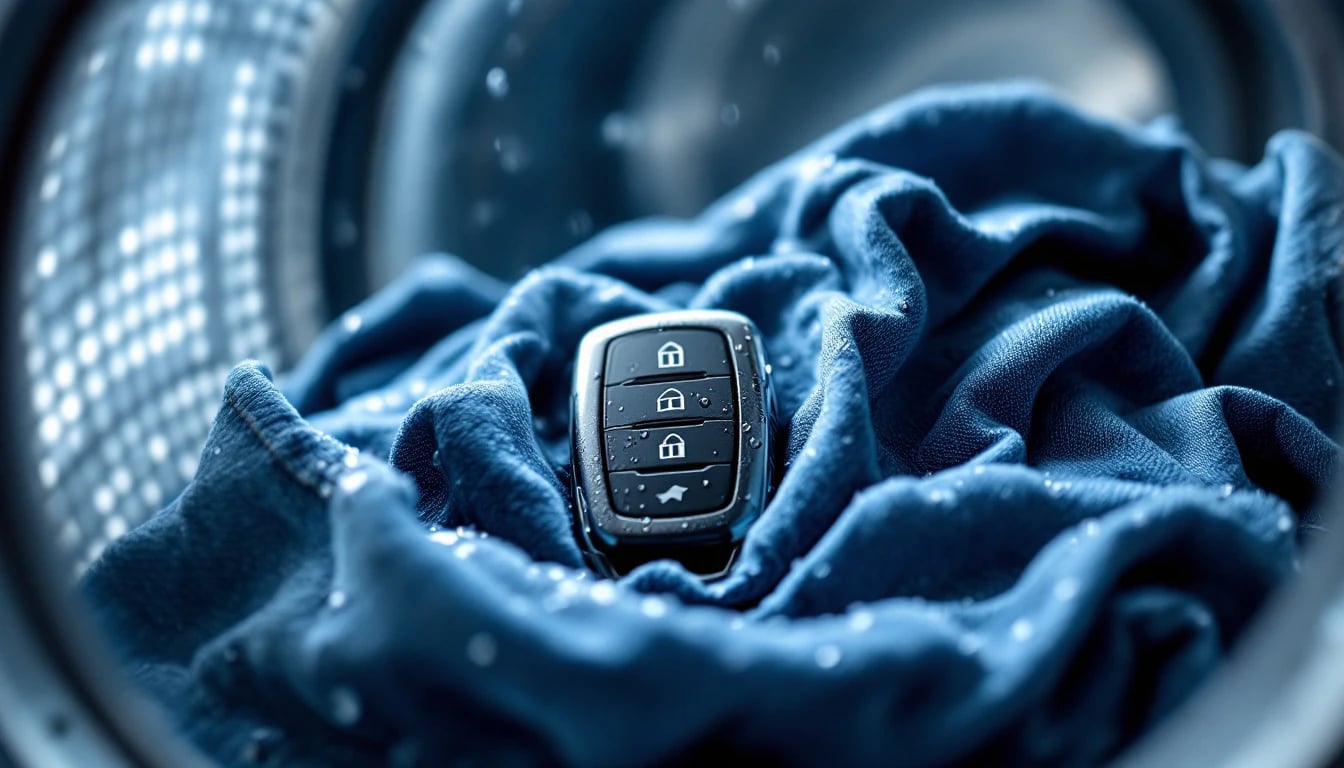
It is in the pocket of the jeans, and the jeans are in the washer. Or it went into the pool with you, or sat in a cup holder under an open sunroof during a North Texas downpour. A wet key fob is one of the most common ways people end up needing a replacement, and one of the most avoidable, because what you do in the first ten minutes changes the outcome. If it is the only fob you have and the car will not start, call or text 817-842-1256. Otherwise, start here.
The Short Answer
A wet key fob is often recoverable. Remove the battery immediately, do not press any buttons, open the case, rinse soap or salt off the board with distilled water or isopropyl alcohol, and dry everything for 24 to 48 hours before fitting a new battery. The chip that starts the engine usually survives even when the buttons do not. As of October 2026, replacement in Fort Worth runs $120 to $200 for a remote-head fob and $220 to $500 for a proximity fob.
What Water Actually Does to a Fob
It helps to know what you are fighting. Pure water on a circuit board with no power applied does very little harm. The damage comes from three things working together.
Electricity. A fob has a 3-volt lithium coin cell connected at all times. Water bridging two points on the board lets current flow where it should not, and that current drives a chemical reaction that dissolves metal. Every button press while the board is wet makes it worse.
Contamination. Wash water carries detergent. Pool water carries chlorine. Sea water carries salt. All of them are much more conductive than clean water, and all of them leave residue behind after the water has evaporated.
Time. Corrosion is not instant. A board with residue on it and a battery fitted keeps corroding for days, which is why so many fobs work after drying and then fail the following week.
That is the whole logic of the first-aid steps below: remove the electricity, remove the contamination, and only then remove the water.
The First Ten Minutes
Do these in order. The first one matters more than all the others combined.
- Take the battery out. Find the seam or the release for the emergency blade, open the case and remove the coin cell. If you cannot open it straight away, at least stop pressing buttons.
- Do not press anything. Do not test it. Do not "see if it still works". A button press on a wet board is the single most damaging thing you can do.
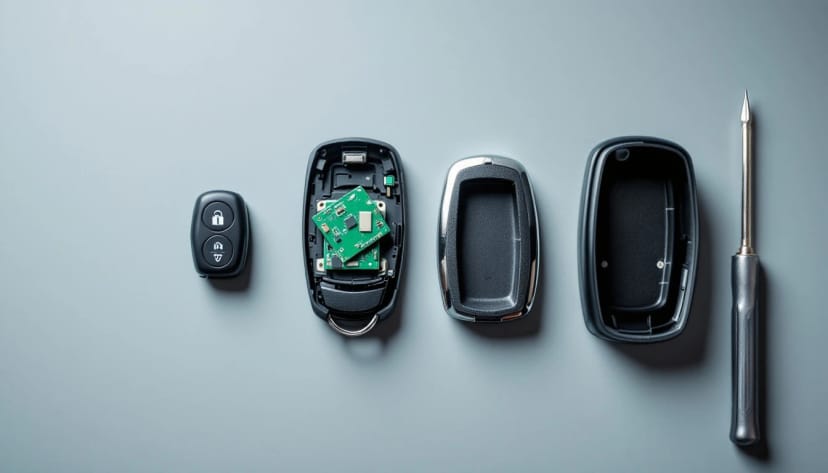
- Open the case fully. Separate the shell halves and lift out the circuit board and the rubber button pad. Note which way round everything sits; a phone photo helps.
- Rinse off contamination. If the fob has been through the wash, a pool or the sea, rinse the board gently with distilled water or, better, isopropyl alcohol of 90 percent or stronger. This feels wrong and is right: you are replacing dirty conductive liquid with clean liquid that evaporates without residue.
- Blot, do not rub. Use a lint-free cloth or paper towel. Rubbing can lift small surface-mounted parts.
- Dry in moving air for 24 to 48 hours. A fan in a dry room is ideal. Silica gel packets in a closed container help. Leave the parts separated.
- Fit a new battery, not the old one. A coin cell that has been wet may have shorted and partly discharged. Start fresh.
What not to do
- No hair dryer on high, no oven, no dashboard in the sun. Heat warps the case, softens the adhesive that holds the antenna and can damage the battery contacts. If a fob went through the dryer as well as the washer, the heat has usually done more harm than the water.
- No rice as the main plan. It does not draw moisture out of a closed case and it leaves dust in the contacts.
- No reassembling it damp because you need to get to work. That is how a recoverable fob becomes a corroded one.
How to Test What Survived
A fob has two jobs, and they can fail independently. Testing them separately tells you whether you have a small problem or a larger one.
Test one: will the car start?
The part that authorizes the engine is a transponder. The National Highway Traffic Safety Administration describes these immobilizer systems as the reason a car will not run without its own authorized key. On most vehicles the transponder is read at very short range and powered by the car, not by the fob battery, which is why it frequently survives water that kills everything else.
- Keyed ignition: insert the key and start the car normally.
- Push-button start: hold the fob directly against the start button and press, or place the fob in the marked backup slot or pocket. The owner's manual shows where it is.
If the engine starts, the chip is alive. You have a remote problem, not an immobilizer problem, and you are not stranded.
Test two: do the buttons work?
After a full dry-out and a new battery, stand next to the car and try lock and unlock. The remote side is a small radio transmitter operating under the rules the Federal Communications Commission sets for low-power devices, and it is the more delicate half of the fob.
- Buttons work at normal range: recovered. Keep an eye on it for the next two weeks.
- Buttons work only at very short range: the antenna or its solder joints are damaged, or the new battery is the wrong type.
- Some buttons work and others do not: the button contacts are contaminated or corroded.
- Nothing at all, but the car starts: the remote circuit has failed. This is repair or replacement, and it is not urgent.
- Nothing at all and the car will not start: the chip or the whole board is gone.
Test three: try the other fob
If you have a second fob, try it. If it works normally, the car is fine and the washed fob is the only casualty. If you suddenly find that one fob works and the other does not, our guide to one key works and the other doesn't covers the less obvious causes.
The Delayed Failure
This deserves its own section because it is the outcome people least expect. The fob dries. It works. Life goes on. Then a week or two later the range drops, a button stops responding, and eventually it dies.
Nothing new happened. Residue left on the board has been slowly attacking the copper traces and the battery contacts ever since the battery went back in. If you open the case at that point you will usually see green or white crust around the contacts.
Two consequences. First, clean the board properly on day one rather than only drying it. Second, if a fob has been wet and you have no spare, treat the working period afterwards as borrowed time and get a second fob made while the first still starts the car. That is the difference between about $65 added to a visit and a lost-fob call, as how much to replace a key fob lays out.
What Each Outcome Costs in Fort Worth (As of October 2026)
| What you found | What it needs | Mobile price | Urgency |
|---|---|---|---|
| Works normally after drying and a new battery | Nothing now; a spare is strongly advised | about $65 for a spare added to any visit | Low |
| Car starts, buttons dead or weak | Fob repair or a replacement fob | $120 to $200 remote-head or flip; $220 to $500 proximity | Low — you can still drive |
| Case swollen or cracked, electronics fine | New shell, electronics transferred | quoted from a photo, below the programming bands | Low |
| Car will not start, a second working fob exists | Replacement fob programmed alongside the good one | $120 to $200 or $220 to $500 by fob type | Medium |
| Car will not start, no other fob | Ownership check, immobilizer access, new fob | $180 to $450 mainstream vehicles | High |
| European vehicle, fob dead | Brand-specific replacement and programming | $350 to $800 | Medium to high |
Those bands match our car key replacement cost page. For where fob work sits against everything else we charge for, see how much is a locksmith for a car.
Repair or Replace?
A wet fob can be repaired when the damage is on the outside of the electronics: bent or corroded battery contacts, a swollen or split shell, a rubber button pad that has perished. In those cases the board the car trusts is unchanged, so there is nothing to reprogram. Shell and contact work is covered in broken key fob repair cost, and if the plastic head of a traditional key has split and the chip has fallen out, see key head cracked and the chip fell out.
Replacement is the reliable answer when the board itself has corroded, when a component has failed, or when the fob has started the delayed-failure pattern. A new fob is cut and programmed at the vehicle; our smart key fob replacement guide explains what pairing a proximity fob involves, and the keyless entry repair service covers faults on the car side.
One caution on buying a replacement yourself. Many proximity fobs lock to the first vehicle they are programmed to, so a used fob from another car may be unusable. Legitimate programming access is credentialed; the National Automotive Service Task Force operates the registry that vetted locksmiths use to obtain manufacturer security data. And if you are still under warranty, the Federal Trade Commission position on warranty claims is that an independent repair does not by itself void your coverage.
When to Call Instead of Waiting
Drying takes a day or two, and that is fine if you have another way to drive. Call sooner if:
- It was your only fob and the car will not start. Waiting 48 hours for a board to dry is not a plan if you need the car tomorrow.
- The fob went through the dryer. Heat damage is rarely recoverable.
- It was salt water or a pool. The odds are worse and the clock runs faster.
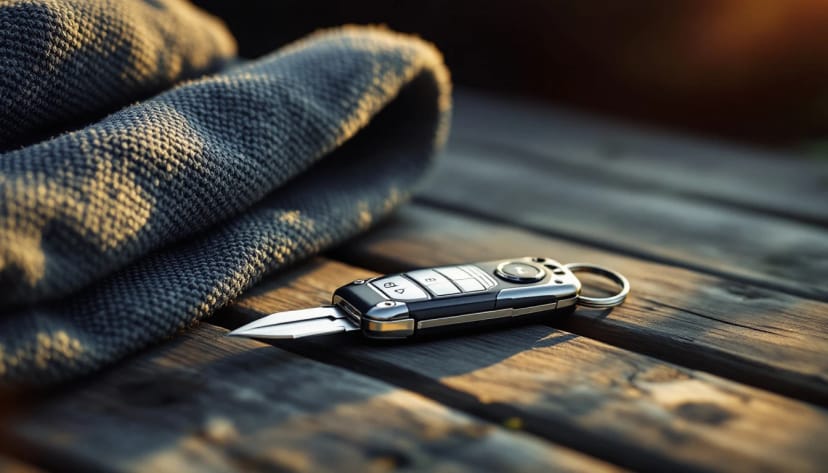
- You are locked out because the fob will not unlock the doors. AAA, which reports its roadside figures through the AAA newsroom, has said it responds to roughly four million lockout calls in a year, and a dead fob is a growing share of them. Every proximity fob contains a hidden mechanical blade for exactly this; slide the release and look for the keyhole under the driver door handle cap.
If no key works at all, proof of ownership is part of the job: registration or title in your name and matching photo ID. If the paperwork is inside the car, we open the car first.
Why Fobs Are Not Waterproof
People are often surprised that a part carried in a pocket every day is not sealed. Most fobs are splash-resistant at best. The case has seams, button openings and a battery door, and the industry standards for automotive electronics published by SAE International are written around the conditions inside a vehicle, not inside a washing machine drum for forty minutes with detergent.
Some newer fobs are better sealed than older ones, and a few manufacturers make sport or activity keys designed to get wet. Unless yours is one of those, assume it is not.
"The fobs that come back to life are almost always the ones where somebody pulled the battery in the first few minutes. The ones that do not are the ones that got pressed twenty times to see if they still worked. Water rarely kills a fob on its own. Water plus a live battery does." — an ALOA-credentialed Master Automotive Locksmith working the DFW metro
How to Make Sure This Never Strands You
- Have a second fob, and keep it somewhere dry at home. This single step turns a soaked fob from an emergency into an errand. Our spare car key service adds one in a single visit.
- Know where your backup start position is. Find the slot or the spot on the start button now, while nothing is wrong.
- Know where the hidden blade and the door keyhole are. Practice once in the driveway.
- Check pockets before the wash. Unglamorous, and it works.
- Replace the coin cell on a schedule. A fresh battery every two to three years removes the most common cause of fob trouble entirely; see key fob battery replacement.
When you do need a locksmith, ALOA recommends confirming you are dealing with a licensed, identifiable business. In Texas that licensing runs through the Texas Department of Public Safety Private Security Program. For the visit itself, see key fob programming.
Frequently Asked Questions
My key fob went through the washing machine. Is it ruined?
Not necessarily. Many fobs survive a wash if the battery is removed quickly and the board is dried properly before power is applied again. The damage is done by electricity flowing through water and detergent residue, not by the water alone. Take the battery out immediately, open the case, rinse off any soap with distilled water or isopropyl alcohol, and let it dry for 24 to 48 hours before testing.
Should I put a wet key fob in rice?
Rice does very little. It does not pull moisture out of a closed case, and it leaves starch dust in the button contacts. What works is opening the fob, removing the battery, blotting the board dry and leaving the parts in moving air for a day or two. Silica gel packets in a sealed container are a better drying aid than rice if you have them.
Will my car still start if the fob got wet?
Often yes, even when the buttons are dead. The part that lets the engine start is a transponder that is read at very close range and does not depend on the fob battery. On a keyed car, insert and turn the key as normal. On a push-button car, hold the fob directly against the start button or place it in the backup slot. If the car starts, the chip survived and only the remote side is damaged.
My fob worked after it dried, then stopped a week later. Why?
That is corrosion catching up. Water and detergent leave residue on the circuit board, and with a battery fitted that residue slowly eats the fine copper traces and the battery contacts. The fob works at first because the damage is not yet complete. This delayed failure is the most common outcome we see, and it is the reason to clean the board properly rather than just letting it dry.
How much does it cost to replace a water-damaged key fob in Fort Worth?
As of October 2026, if a working key or fob still exists, a replacement remote-head or flip fob runs $120 to $200 and a push-button proximity fob runs $220 to $500, cut and programmed on site. European fobs run $350 to $800. If the washed fob was the only one and nothing starts the car, mainstream vehicles run $180 to $450. A second fob made in the same visit is about $65.
Can a water-damaged fob be repaired instead of replaced?
Sometimes. If the board is clean and only the battery contacts or the case are damaged, a new shell and a contact repair can bring it back, because the electronics the car trusts have not changed. If the board itself has corroded or a component has failed, replacement is the reliable fix. Send a photo of the opened fob to 817-842-1256 and we will tell you honestly which one it looks like.
Is salt water or pool water worse than tap water?
Yes, considerably. Salt water and chlorinated pool water are far more conductive and far more corrosive than tap water, so damage starts faster and continues after the fob looks dry. If a fob has been in the sea or a pool, rinsing the opened board with distilled water or isopropyl alcohol straight away matters even more, and the chances of a lasting recovery are lower.
References
- NHTSA — Anti-Theft Systems
- Federal Communications Commission
- National Automotive Service Task Force (NASTF)
- FTC — Advertising and Marketing Guidance
- AAA Newsroom
- SAE International
- ALOA — Associated Locksmiths of America
Fob soaked and the car will not start? Call or text 817-842-1256 with your year, make and model and whether another key still works. We cut and program replacement fobs on site across Fort Worth and the surrounding cities, Mon-Sun 8AM to 8PM.
Reviewed against the ALOA Master Automotive Locksmith (MAL) standard. Prices are Fort Worth mobile service ranges current as of October 2026 and are confirmed per vehicle before dispatch.