TL;DR — what a smart fob job really costs
A "smart key fob" is the proximity / push-button-start fob that authenticates wirelessly when you walk up to your vehicle. Different from a transponder key (which must be inserted into the ignition), the smart fob negotiates with the vehicle's body control module or immobilizer over a short-range RF link.
Fort Worth 2026 pricing ranges for smart fob work:
- Spare smart fob add (1 working fob present, mass-market): $220-$400
- Spare smart fob add (luxury/European, 1 working): $300-$550
- All-keys-lost smart fob (mass-market): $350-$600
- All-keys-lost smart fob (luxury/European): $500-$1,100
- Smart fob battery replacement (CR2032 or CR2025): $5-$20 DIY, $25-$60 with locksmith
Per J.D. Power's Customer Service Index data, dealer-side equivalents typically run 1.7-2.4× independent mobile rates before adding tow cost. The math favors mobile for almost all smart-fob work.
How a smart fob actually works (mechanically)
Inside a smart fob: a low-frequency RF transceiver (typically 125 kHz LF for the wake-up signal), an ultra-high-frequency RF transmitter (typically 315 MHz or 433 MHz for the lock/unlock/start commands), an encryption-capable microcontroller, and a small battery (CR2032 or CR2025).
The negotiation: when you walk near the vehicle, the car broadcasts an LF wake-up. The fob receives it, the microcontroller computes a cryptographic response based on the rolling-code shared secret, and the fob transmits the response back. The vehicle verifies the response against its own copy of the secret, and if it matches, the doors unlock / engine starts.
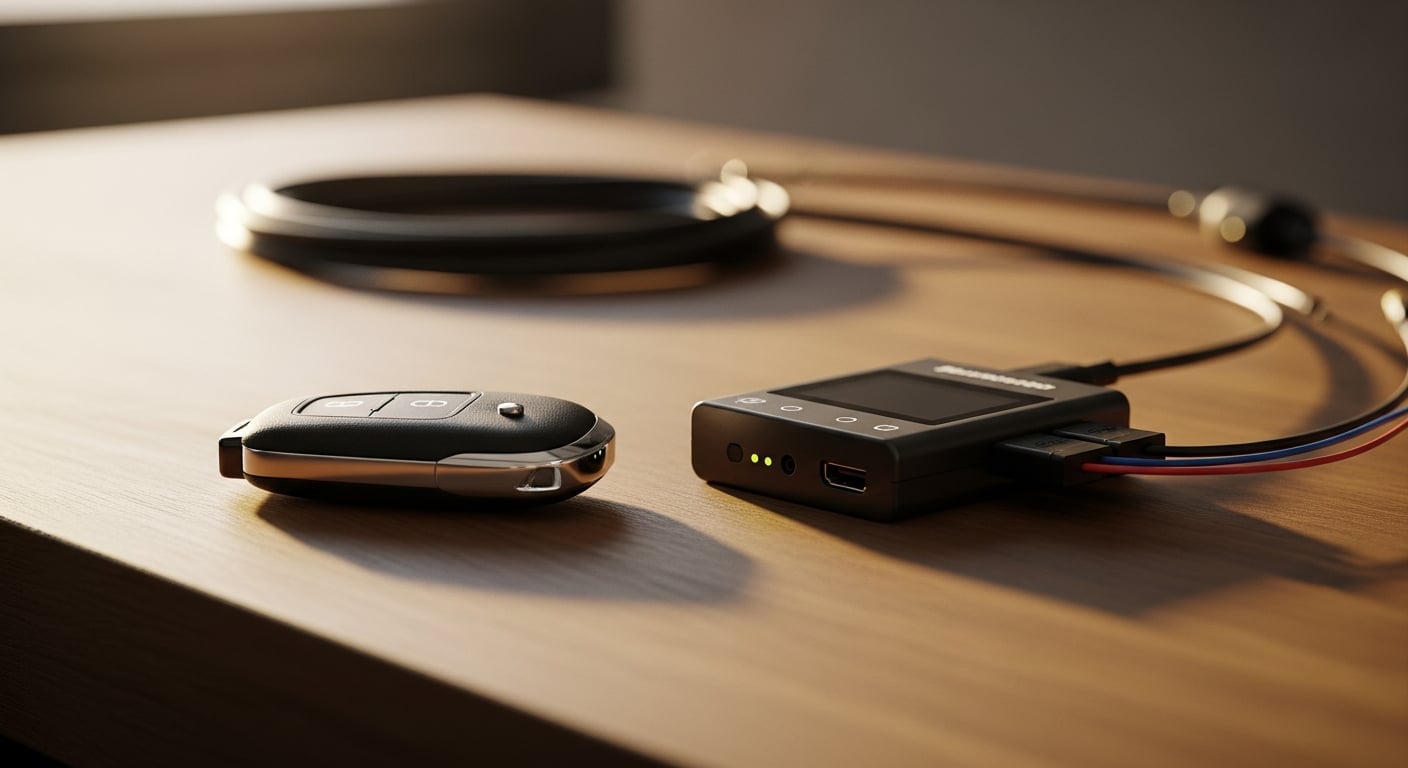
Why this matters for programming: when you replace a fob, the locksmith must write the new shared secret into both the fob (via OEM or aftermarket programmer) and the vehicle's authority module (BCM, CAS, FEM, EZS, etc.) so they negotiate correctly. This is fundamentally more complex than a transponder-only key — and the price reflects it.
Per the NHTSA's published guidance on anti-theft systems, the entire smart-fob architecture is governed by FMVSS standards and exists specifically to make unauthorized key generation cryptographically difficult.
Spare-fob add (1 working fob present)
When you still have a working fob and want a spare, the process is significantly simpler than all-keys-lost work. The technician can extract the existing pairing data from the working fob (or from the vehicle's authority module via OBD-II), program the new fob with the same shared secret, cut the emergency mechanical blade, and confirm both fobs work.
Typical on-site time for spare-fob adds: 30-75 minutes depending on platform. Mass-market vehicles (Toyota, Honda, Ford, GM): 30-50 minutes. Luxury (BMW, Mercedes, Audi): 45-90 minutes. Some platforms require the operator to "register" the new fob through a manufacturer-specific sequence (Toyota smart-key registration, BMW FEM/BDC update) that adds time.
Pricing in Fort Worth 2026:
- Toyota / Honda / Ford / GM mass-market: $220-$380
- Lexus / Acura / Infiniti / Cadillac: $280-$450
- BMW / Mercedes / Audi / VW: $300-$550
- Jaguar / Land Rover / Porsche: $400-$650
All-keys-lost smart fob programming
When you have no working smart fob, the job moves from "add a paired key" to "regenerate the shared secret with OEM data access." The locksmith needs:
- NASTF VSP registry access (for OEM-data-authorized makes) or platform-specific tooling that includes OEM data.
- Diagnostic equipment that can read the vehicle's authority module and write new pairing data.
- The correct fob hardware for your specific make / model / year.
Time on-site: 60-180 minutes depending on platform. Mass-market: 60-100 minutes. Luxury: 90-200 minutes. Some encrypted platforms (Toyota 8A, BMW FEM, Mercedes FBS4) run toward the upper end.
Pricing in Fort Worth 2026:
- Mass-market (Toyota 8A, Honda, Ford, GM): $350-$600
- Luxury Japanese (Lexus, Acura, Infiniti): $450-$750
- BMW (FEM/BDC era): $640-$1,100
- Mercedes (FBS3/FBS4): $550-$1,400
- Audi / VW (MQB platform): $550-$1,100
- Jaguar / Land Rover / Range Rover: $700-$1,300
Per the Associated Locksmiths of America Master Automotive Locksmith credential standards, AKL on encrypted smart-fob platforms is among the most technically demanding work in the trade — operators advertising "all smart keys $199" are advertising bait rates that will mark up significantly on arrival.
Smart fob scenarios and what they cost
Three scenarios cover essentially every smart-fob call. Identify yours before you dial.
| Scenario | What the technician has to do | Fort Worth range | On-site time |
|---|---|---|---|
| Spare fob add, one working fob present | Pair an additional fob to the existing session | $220-$500 | 30-70 min |
| All keys lost, mainstream make | Establish immobilizer access, then write new keys | $180-$450 | 60-120 min |
| All keys lost, European make | Module-level authorization, then write new keys | $350-$800 | 90-180 min |
| Second fob ordered during the same visit | Programmed inside the session already open | around $65 extra | Adds 10-20 min |
The last row is the whole argument for handling this before you lose your only key. The same fob that costs a few hundred dollars as an emergency all-keys-lost job costs a fraction of that when it is added to a visit that is already happening.
Aftermarket vs OEM fob hardware
For most platforms, you have a choice between OEM (manufacturer-produced) fob housings and aftermarket equivalents. Both work; the differences:
- OEM: matches your existing fob exactly. Manufacturer warranty. Higher cost ($50-$200 more per fob depending on make).
- Aftermarket: functionally equivalent for most makes. May have slightly different button feel or housing material. Locksmith-warrantied (typically 1 year). Lower cost.
For day-to-day mass-market work (Toyota, Honda, Ford, GM), aftermarket is fine and most operators use it as default. For luxury platforms where the customer values the OEM badge or expects to trade the vehicle into the dealer, OEM is worth the upcharge. Ask before booking which the operator uses by default and whether OEM is available.
Common smart fob failure modes
Many "I need a new fob" calls turn out to be something else. Most common diagnoses:
- Dead battery (CR2032 or CR2025): causes intermittent "key not detected" or "push button to start" failures. Replace before doing anything else. $5-$20 DIY.
- Worn fob buttons or housing damage: button rubber wears through, water gets into the circuit. Repair = housing replacement only, $40-$150 if internals are fine.
- Failed antenna ring inside the vehicle: the LF antenna near the steering column or in the door handle has a cold-solder joint. Repair = antenna replacement, $200-$500.
- BCM / authority-module fault: the module itself is failing. Repair = module replacement, $400-$1,500.
- Anti-theft lockout from previous failed programming: requires reset by a credentialed operator, $200-$400.
A credentialed operator scans before swapping fobs. The diagnostic step prevents the $500 fob purchase that doesn't fix the actual problem.
Mobile vs dealership economics
Per J.D. Power's Customer Service Index analysis, dealer-side smart-fob work typically runs 1.7-2.4× independent mobile pricing, before tow. The cost premium reflects (a) dealer service-writer overhead, (b) parts markup (typically 1.5-2.5× wholesale), and (c) the dealer's labor rate ($165-$240/hour in DFW).
When mobile is the right call (most situations):
- The vehicle is at home, work, or a parking lot — not at the dealer already.
- You have at least one working fob (spare-fob add).
- AKL on a platform where current independent tooling supports OEM-level access.
When dealer makes sense:
- Open recall or TSB on your specific chassis touches the immobilizer system.
- Specific FBS4 Mercedes platforms (EQS, EQE, AMG GT 2018+) where independent tooling is incomplete.
- Bundling with other warranty work already at the dealer.
Per BLS Occupational Employment data, the trade has grown specifically as the dealer cost premium has widened — mobile-side operations have absorbed the volume that dealerships have priced out of.
How to call about a smart fob replacement (the 60-second script)
When you call, share: year, make, model, trim (push-button start vs traditional ignition), and whether you have any working fob. The operator should respond with: a flat-rate price range, an ETA window, an estimate of on-site time, and a question about ownership documents.
A credentialed operator will:
- Quote the spare-add rate AND the AKL rate if there's ambiguity.
- Confirm whether your specific platform is independent-doable or dealer-only.
- Recommend programming two fobs in the same visit if you're doing AKL.
A scam operator will:
- Refuse to commit to a price ("we'll see when we get there").
- Quote $19-$29 "starting at" for any job.
- Promise unrealistic ETAs (5-10 minutes anywhere in DFW).
- Pressure you to authorize dispatch before quoting.
Per Better Business Bureau locksmith scam research, the flat-rate-before-dispatch ask is the single highest-leverage scam filter available.
Honest boundaries
Smart-fob work covers most of what rolls through Fort Worth, but there are real limits and an operator who does not name them is not being straight with you.
The newest platforms need your VIN, not a phone promise. Vehicles from roughly the last two or three model years, Mercedes on FBS4, Volkswagen Audi Group cars carrying Component Protection, and Tesla's account-based key pairing all sit behind manufacturer-side authorization that independent tooling does not reach on every configuration. As of August 2026 the honest answer on those begins with a VIN check and ends with a technician confirming your exact setup.
Maximum key count is a real constraint. Several proximity platforms cap the number of credentials the vehicle will hold. When a car is at its limit an existing key has to be deleted before a new one can be written, so bring every fob you own to the appointment.
A fob cannot fix a vehicle-side fault. If the receiver, an antenna, or the immobilizer module itself has failed, a brand-new correctly paired fob will behave exactly like the old one. That is diagnosis and module work, not a key sale, and it is the distinction that separates a technician from a parts-pusher.
Proof of ownership comes before any credential. On all-keys-lost smart-fob work we check the title or a current registration against a government-issued photo ID in a matching name and record the verification on the invoice. The FTC's consumer guidance on hiring a locksmith treats that as the baseline, and on a push-button-start vehicle the credential being generated is powerful enough to justify it.
How the on-site visit works in Fort Worth
We are mobile-only, 8AM to 8PM, seven days a week, across Fort Worth and Tarrant County — which matters on smart-fob jobs because a car with no recognised fob is a car that is not driving anywhere.
The call comes first. Year, make, model, and how many working fobs you still have: that last answer is the single biggest lever on both price and time, because adding a spare while one fob still works is a fundamentally easier job than a from-scratch recovery. You get a flat-rate range before anyone is dispatched.
On arrival the technician verifies ownership, then checks the simple things before the expensive ones — fob battery, 12-volt vehicle battery, and a scan of the vehicle network. A surprising share of "my fob died" calls end at one of those three. Where a new credential genuinely is needed, the emergency blade is cut from your key code, the fob is paired, and then everything gets tested: push-button start, walk-up unlock, lock, trunk, panic, remote start if equipped, and a walk-away check to confirm the car will not start once the fob is out of range.
Coverage runs across Fort Worth and out to Arlington, Bedford, Hurst, Keller and North Richland Hills. For the wider pricing picture see car key replacement cost in Fort Worth TX, and if you are down to zero working fobs, lost car keys with no spare walks through that recovery specifically.
Talk to a technician
Call 817-842-1256 with your year, make, model and how many working fobs you have left. You will get a flat-rate range before anyone is dispatched — 8AM to 8PM, seven days a week, anywhere in Fort Worth and Tarrant County.
Field-operator perspective
On smart fobs the question I always ask is whether you have one working. That changes the price by 2x in some cases. If you have one, we work with the data on it. If you don't, we have to read the vehicle's authority module and write new pairing data from scratch — that's a different job, different time, different tools. Honest operator quotes both scenarios on the phone.
— a NASTF-registered Fort Worth automotive locksmith, ALOA Master Automotive Locksmith (MAL) credential, DFW metroplex (anonymized)
A real-world example
Operator: Anonymized 2021 Lexus RX 350 owner, residential driveway in Grapevine, spare smart fob add
Before:
- Customer had one working smart fob; wanted a second after the existing fob got nearly lost on a recent trip.
- Lexus of Grapevine dealer quote: $485 + $35 keying labor = $520, 3-day wait for the new fob to arrive.
- Customer wanted same-day service to head off the next near-loss event.
What changed: Customer called a NASTF-registered mobile operator. Pre-dispatch flat-rate quote: $295-$345 for spare Lexus smart fob add, 60-90 minutes on-site, OEM-equivalent aftermarket fob with 1-year warranty. Technician arrived in 38 minutes, verified ownership, paired the new fob with the existing pairing data in 52 minutes.
Outcome:
- Final invoice: $315 (within quoted range).
- Both fobs tested and confirmed working (driver door, all locks, trunk, remote start, proximity walk-up).
- 1-year hardware warranty issued in writing.
- Customer time on-site: 1 hour 8 minutes total.
Net: Saved approximately $205 vs the dealer path, plus the 3-day wait. The bigger value: the spare fob now exists, eliminating the next $500+ AKL event if the working fob is lost. Per BrightLocal's local consumer survey data, customers who maintain spare keys / fobs report substantially fewer emergency-rate service events year-over-year.
Frequently Asked Questions
What's the difference between a smart key fob and a transponder key?
A transponder key is a mechanical key with an embedded RFID chip — it must be inserted into the ignition and authenticates only when keyed. A smart key fob is wireless — it authenticates via short-range RF when you walk up to the vehicle and lets you start the car via push-button without inserting anything. Smart fobs are more cryptographically complex, hence more expensive to replace. Most vehicles built after roughly 2015 use smart fobs as standard.
How much does a smart key fob cost in Fort Worth in 2026?
Spare-fob add (one working fob present): $220-$550 depending on make. All-keys-lost smart fob: $350-$1,400 depending on platform complexity. The biggest pricing variable is the cryptography generation — Toyota 8A, BMW FEM/BDC, and Mercedes FBS4 run higher than older systems. Operators quoting under $150 for any smart-fob work are advertising bait rates that will mark up significantly on arrival.
Can I program a smart key fob myself?
For most modern vehicles, no. The cryptography requires either OEM data access (through the NASTF VSP registry) or specialized aftermarket tooling that costs $1,500-$5,000 for the hardware plus annual licensing. Some pre-2015 vehicles have DIY pairing procedures published in the owner's manual, but the vast majority of post-2015 smart fobs require professional programming. Battery replacement, by contrast, is fully DIY for $5-$20.
My smart fob works when I touch the door but not from a distance — is it dying?
Most likely a weak battery. CR2032 / CR2025 batteries typically last 2-4 years in normal use; symptoms of weakness start with reduced range before the fob fails completely. Replace the battery (around $5 at any pharmacy) before assuming the fob itself has failed. If the new battery doesn't restore full range, the next suspects are the fob's internal antenna or the vehicle's receiver antenna ring — diagnose before replacing.
How long does smart key fob programming take on-site?
Spare-fob add with one working fob: 30-90 minutes depending on platform. All-keys-lost: 60-200 minutes depending on cryptography generation. Mass-market 2005-2015 platforms run on the shorter end; encrypted 2015+ platforms (BMW FEM, Mercedes FBS4, Toyota 8A) run on the longer end. Operators promising under 30 minutes for any AKL smart-fob work are usually over-promising.
Should I get OEM or aftermarket fob hardware?
For mass-market vehicles, aftermarket is functionally equivalent and saves $50-$200 per fob. For luxury vehicles you plan to trade in at the dealer, OEM may be worth the premium since dealers sometimes penalize aftermarket fobs at trade-in. For day-to-day use, both work the same. Ask the operator which is default and whether OEM is available on your platform before booking.
References & external sources
- NHTSA — Anti-Theft Systems & FMVSS 114 — Federal Motor Vehicle Safety Standard governing key-code and immobilizer disclosure.
- Associated Locksmiths of America (ALOA) — Trade association governing locksmith certifications including the Master Automotive Locksmith (MAL) credential.
- NASTF Vehicle Security Professional (VSP) Registry — National Automotive Service Task Force registry for credentialed access to OEM security data.
- J.D. Power — Customer Service Index — Annual study of dealership service department satisfaction and cost.
- U.S. Bureau of Labor Statistics — Occupational Employment and Wages, Locksmiths (49-9094) — BLS OEWS national wage + employment data for locksmith occupation.
- Better Business Bureau — Locksmith Scam Advisory — BBB consumer protection guidance on locksmith bait-and-switch operators.
- FTC Consumer Advice — Hiring a Locksmith — Federal Trade Commission guidance on verifying locksmith legitimacy before service.
- BrightLocal — Local Consumer Review Survey 2024 — Annual research on how consumers find + evaluate local service businesses.
Update, September 2026
Prices on this page were re-checked as of September 2026 and are unchanged: a spare proximity fob added with a working key present sits in the $220 to $500 band, an all-keys-lost fob runs $180 to $450 plus the $75 to $150 surcharge, and an extra fob added during the same visit is around $65 on top.
Two things worth adding from recent work.
First, a striking share of "my fob has failed" calls turn out to be a fob that is perfectly healthy. When one fob works and another does not, the working one proves the car, the locks and the immobiliser are all fine, which narrows the fault to the key itself and frequently to a battery or a lost credential rather than to hardware. The five-minute self-test is in one key works and the other does not, and it regularly saves the price of a fob.
Second, on some vehicles a fob that stops being recognised is not a fob problem at all but a radio module problem — the component the car uses to hear the key. Chrysler-family minivans are the clearest example in this market, and the pattern is documented in Chrysler Pacifica RF hub module programming. Replacing a working fob does not fix a module that cannot hear it.
If you are still unsure whether your vehicle carries a proximity fob or an older transponder key, the difference and what each one costs to replace are set out in transponder key versus key fob.