A down truck is a down day
For a contractor, landscaper, plumber, or delivery operation in Fort Worth, a truck that will not start is not an inconvenience — it is lost revenue. GMC and Chevrolet trucks — the Sierra, Yukon, Silverado, and their SUV siblings — are among the most common vehicles on DFW jobsites, and their keys are more complicated than the chunky remotes make them look. GM's theft-deterrent architecture, the move to proximity smart fobs with push-button start, and factory remote-start all mean a truck key is a programmed credential, not a blank you grind at a kiosk.
This guide covers GMC and Chevy truck key replacement the way a working owner needs it: what each key type costs as of July 2026, how the theft-deterrent system trips people up, why remote-start fobs are not a separate job, and how fleet key management keeps a whole yard of trucks from going dark over one lost fob.
GM's theft-deterrent systems, plain-English
Every GM truck built in the last quarter-century has an anti-theft system that refuses to start the engine without a valid key credential. This is federal policy, not a GM upsell: the National Highway Traffic Safety Administration documents that immobilizer-equipped vehicles carry measurably lower long-run theft rates, and the Insurance Institute for Highway Safety has tracked the same effect in its theft-loss reporting. Trucks are frequent theft targets, so GM's security matters — and it is exactly why a hardware-store key will not start your Sierra.
- PassLock and VATS (older trucks). Earlier GM trucks used PassLock — a resistor-and-sensor system in the ignition lock — and, on some models, VATS (Vehicle Anti-Theft System). These are simpler than modern transponders but have their own failure modes; a bad PassLock sensor causes a security-light no-start that mimics a key problem.
- Transponder plus body control module (mid-era). Later trucks moved to an RFID transponder chip in the key, authenticated by the body control module (BCM). Add or replace a key by writing the new chip identity into the BCM.
- Proximity smart fob (modern). Current Sierra, Yukon, and Silverado use proximity smart fobs with push-button start. The fob talks continuously to the truck, so you unlock by touching the handle and start with a button. Remote-start, where equipped, is a function of this same fob.
The consistent theme: the module — PassLock sensor, BCM, or the newer keyless controller — is the authority, not the key. A good operator diagnoses the module first and cuts a key only once it reads clean.
Truck key types and what they cost
Knowing your key type narrows the price before anyone drives out. As of July 2026, Fort Worth mobile-service bands are:
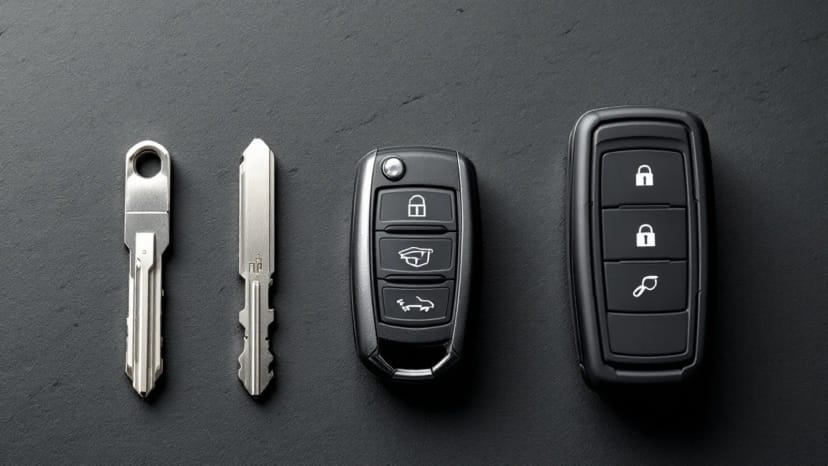
- Transponder blade key. Metal key with an RFID chip in the head. Older Silverado and Sierra work trucks. Transponder band, $120-$200 with programming.
- Remote-head key. A transponder blade with the remote buttons built into the head — lock, unlock, sometimes remote-start. Common on mid-era GM trucks. Programs as a transponder-plus-remote in roughly the $120-$200 range depending on model.
- Proximity smart fob. The modern flat fob with buttons, remote-start, and a hidden emergency blade, used for push-button-start trucks. Smart/proximity band, $220-$500, with all-keys-lost reaching the lost-fob band of $180-$450 for the programming session alone.
- Extra fob, same visit. Adding a second fob while the operator is already on-site is roughly $65 in hardware on top of the programming — the cheapest insurance you can buy for a work truck.
Model-by-model: Sierra, Silverado, Yukon and siblings
GMC Sierra / Chevy Silverado
The Sierra and its Silverado twin are the backbone of DFW work fleets. Older GMT800 and GMT900 trucks use transponder or remote-head keys and land in the $120-$200 band. The current T1-platform Sierra and Silverado (2019-present) use proximity smart fobs with push-button start and factory remote-start; these fall in the $220-$500 smart band. Because these trucks so often run as fleet units, a spare add for every truck is the standard recommendation — it is far cheaper than the all-keys-lost you will otherwise face when a fob goes down at a jobsite.
GMC Yukon / Chevy Tahoe / Suburban
The full-size SUV trio — Yukon, Tahoe, Suburban — share the truck platform's key architecture. Older units use transponder or remote-head keys; current models use proximity smart fobs in the $220-$500 band. These are frequently family-and-work dual-use vehicles, so owners often want two fobs programmed at once. The second fob at the same visit is roughly $65 hardware plus programming.
GMC Canyon / Chevy Colorado
The mid-size Canyon and Colorado follow the same pattern by era: transponder or remote-head on older trucks ($120-$200), proximity smart fob on newer ones ($220-$500). Nothing about the smaller footprint changes the programming path — it is the model year and key type that set the price.
Older work trucks (PassLock era)
Plenty of older GM work trucks are still earning their keep across Tarrant County. These PassLock-era trucks are inexpensive on the key side — transponder and remote-head work in the $120-$200 band — but the catch is diagnosis: a PassLock sensor fault produces a security-light no-start that looks exactly like a key failure. A credentialed operator scans before cutting so you are not paying for a key when the actual fault is the theft-deterrent sensor.
The one table: GM truck key work at a glance
Fort Worth mobile-service bands as of July 2026. These are ranges, not fixed quotes — your model, year, and whether a working key exists all move the number.
| GM truck / SUV era | Key type | System | Typical Fort Worth band |
|---|---|---|---|
| Silverado / Sierra GMT800-900 | Transponder / remote-head | PassLock / BCM | $120-$200 |
| Sierra / Silverado T1 (2019+) | Proximity smart fob | Keyless / BCM | $220-$500 (AKL $180-$450 session) |
| Yukon / Tahoe / Suburban (older) | Transponder / remote-head | PassLock / BCM | $120-$200 |
| Yukon / Tahoe / Suburban (current) | Proximity smart fob | Keyless / BCM | $220-$500 |
| Canyon / Colorado (older) | Transponder / remote-head | BCM | $120-$200 |
| Canyon / Colorado (current) | Proximity smart fob | Keyless / BCM | $220-$500 |
| Extra fob added same visit | any | any | ~$65 hardware + programming |
| Ignition cylinder repair | n/a | mechanical | $150-$400 |
Remote-start fobs are not a separate job
A frequent point of confusion: owners assume the remote-start button on the fob is a separate device that needs its own installation. On a factory-equipped GM truck, it is not. Remote-start is a function of the same proximity fob and the truck's body control module, so when a credentialed operator programs a replacement fob, the remote-start capability comes with it — no extra install, no extra device. (An aftermarket remote-start box added by a stereo shop is a different animal and outside standard key programming.) The upshot: replacing a lost factory fob restores your remote-start along with everything else the fob does.
Fleet key management: the real money-saver
If you run more than a couple of trucks, key management is a maintenance line item you should be planning, not reacting to. The math is simple and unforgiving. An all-keys-lost on a proximity truck costs the lost-fob band of $180-$450 for the programming session plus hardware, and it strands the truck until it is resolved. A spare add — done in advance while a working key still exists — is faster and cheaper because the existing key already unlocks the module.
A mobile operator can handle a fleet efficiently:
- Batch the visit. Multiple trucks keyed or spared in one dispatch, quoted per unit using the same bands.
- Spare for every unit. A programmed backup fob for each truck turns a potential all-day breakdown into a five-minute swap.
- Per-truck documentation. A written record per unit — VIN, key type, work performed — for your maintenance file.
The AAA Your Driving Costs study puts unplanned vehicle downtime and service among the larger swings in fleet operating cost, and a stranded truck compounds that with lost billable hours. The Associated Locksmiths of America professional standards treat proactive spare-key programming as basic risk management for commercial vehicles — which, for a working owner, translates directly to fewer down-days.
Why the module-first diagnosis matters
The single most valuable thing a credentialed operator does on a GM truck is scan before cutting. A security-light no-start has several possible causes — dead fob battery, PassLock sensor fault, BCM issue, or an anti-theft lockout from a prior failed programming attempt — and only some of them are actually key problems. The Federal Trade Commission's guidance on hiring a locksmith warns specifically about operators who commit to a repair before diagnosing it: a real quote follows a scan, and a "we'll just cut you a new key" before anyone has read the module is how you end up paying for a key that was never the problem.
Ask two questions on the phone: what tool the operator uses for your specific truck, and what the flat-rate range is for your model and year. An operator who answers both in under a minute knows GM trucks. One who stalls is one to keep dialing past.
Field-operator perspective
With work trucks the customer's real cost is not the key, it is the day the truck is off the road. That is why I push spares so hard on fleets — a programmed spare for every unit is a rounding error next to one missed job. And on the older GM stuff, always scan first. A PassLock security light sends people chasing a key when the sensor in the column is the actual fault. Cutting a key there just burns the customer's money.
— ALOA Master Automotive Locksmith (MAL), GM truck and fleet specialist, 13 years experience, DFW metroplex (anonymized)
A real-world example
Situation: Anonymized landscaping operation, three-truck fleet of GMC Sierras working out of a Saginaw yard, one crew-lead lost the only fob for the lead truck on a Friday.
Before:
- The lead Sierra had a single proximity fob, now lost — a genuine all-keys-lost with a Saturday job on the schedule.
- Dealer path meant a tow from the yard plus a multi-day appointment wait.
- The owner realized the other two trucks also had no spare fobs — one lost fob away from the same problem.
What changed: The owner called a NASTF-registered, Texas DPS Private Security Bureau-licensed mobile operator and batched the whole fleet into one visit. Pre-dispatch quote, in writing: the lead truck as a lost-fob all-keys-lost in the smart band, plus a spare fob programmed for each of the three trucks at the extra-fob rate.
Outcome:
- Lead truck back in service the same afternoon — no tow, no lost Saturday job.
- Every truck in the fleet now carries a programmed spare fob.
- Per-truck written documentation for the maintenance file.
Net: One dispatch turned a stranded lead truck into a fully spared fleet, and the spare-for-every-unit setup means the next lost fob is a five-minute swap instead of another all-keys-lost.
How to prep before you call
Have these ready and your quote gets tighter:
- Exact model and year. "2021 Sierra 1500" beats "a GMC truck."
- Do you have any working key? Spare add versus all-keys-lost hinges entirely on this.
- Key type. Blade, remote-head, or flat proximity fob with buttons.
- How many trucks. If it is a fleet, say so up front so the visit gets batched.
With those, a competent Fort Worth operator hands you a real per-truck range before dispatch — which is the whole reason to call a mobile locksmith instead of towing to a dealer counter.
Frequently Asked Questions
How much does a GMC Sierra key replacement cost in Fort Worth?
As of July 2026, an older Sierra or Silverado transponder or remote-head key runs $120-$200 with programming. A newer Sierra, Yukon, or Silverado proximity smart fob with push-button start and remote-start runs $220-$500. An additional fob added in the same visit is roughly $65 in hardware. Mobile service avoids the dealer service-writer markup, which typically runs 1.5-2x the independent rate.
Can a locksmith program a GM remote-start fob?
Yes. A credentialed operator can cut and program GMC and Chevy truck keys and proximity fobs on-site, including the remote-start function where the truck is factory-equipped. Remote-start is a feature of the fob and the body control module, not a separate device, so it is programmed as part of the fob setup. Aftermarket remote-start units are a separate install and outside standard key programming.
What is the GM theft-deterrent system on my truck?
GM trucks use an anti-theft architecture — historically PassLock and VATS on older models, and transponder plus body-control-module authentication on newer ones — that refuses to start the engine unless it reads a valid key credential. If that handshake fails you get a security-light no-start. A credentialed operator scans the module before cutting any key to confirm the fault is the key and not the theft-deterrent module itself.
How does fleet key management work for a work-truck operation?
For a fleet, a mobile locksmith can key multiple trucks in one visit, program spare fobs so every vehicle has a backup, and document the work per unit. Keeping a programmed spare for each truck is the single best way to avoid a down-day, because a spare add is far faster and cheaper than an all-keys-lost. Fleet visits are quoted per truck using the same per-vehicle bands, batched into one dispatch.
I lost all the keys to my Sierra — what does that cost?
All-keys-lost on a proximity Sierra, Yukon, or Silverado sits at the higher end of the smart-fob range because a new fob plus a lost-fob programming session runs $180-$450 for the session alone, plus fob hardware. On an older transponder truck, all-keys-lost is lower, in the $120-$200 range. Either way a mobile operator comes to the truck, so there is no tow the way a dealer all-keys-lost requires.
Why is my GMC key turning but the truck will not start?
That is usually a theft-deterrent or immobilizer fault, not a cut-key problem. The blade is fine but the chip-to-module handshake is failing. Common causes are a dead fob battery, a PassLock sensor fault on older trucks, a body-control-module issue, or an anti-theft lockout from a prior failed programming attempt. A security light on the dash points to the theft-deterrent system specifically.
Is mobile or dealer better for a GMC truck key?
Mobile wins for almost every truck-key job because your Sierra or Yukon is usually at a jobsite, a yard, or home — and a mobile operator comes to it with no tow. The dealer is the better path only for an open recall or warranty issue tied to the immobilizer, or a brand-new platform independent tooling has not reached. For fleets, mobile is decisively better because multiple trucks get handled in one visit.
References & external sources
- NHTSA — Anti-Theft Systems & FMVSS 114 — Federal Motor Vehicle Safety Standard governing key-code and immobilizer disclosure.
- IIHS — Vehicle Theft — Insurance Institute for Highway Safety data on theft loss and immobilizer effectiveness.
- NASTF Vehicle Security Professional (VSP) Registry — National Automotive Service Task Force registry for credentialed access to OEM security data.
- Associated Locksmiths of America (ALOA) — Trade association governing locksmith certifications including the Master Automotive Locksmith (MAL) credential.
- FTC Consumer Advice — Hiring a Locksmith — Federal Trade Commission guidance on verifying locksmith legitimacy before service.
- AAA — Your Driving Costs 2024 — Annual ownership cost study including unscheduled maintenance and downtime projections.
Related Pages
- GMC Brand Page
- Truck Key Replacement
- GM Theft-Deterrent System
- Spare Car Key
- Smart Key Replacement
- Transponder Key vs Key Fob
- Contact Fort Worth Car Keys
Book your gmc & truck key replacement in Fort Worth
We are mobile only, so a vehicle that will not start does not need towing anywhere to be sorted out. Bring us the VIN and the ownership documents and we will handle the rest.
Call or text 817-842-1256, Mon-Sun 8AM-8PM, across Fort Worth and Tarrant County. You can also use the contact page.