TL;DR — Super Duty keys in one screen
The Ford Super Duty is the most trim-dependent key job we handle, because the same model year can arrive as a stripped work truck or a leather-lined tow rig and those two trucks need different procedures.
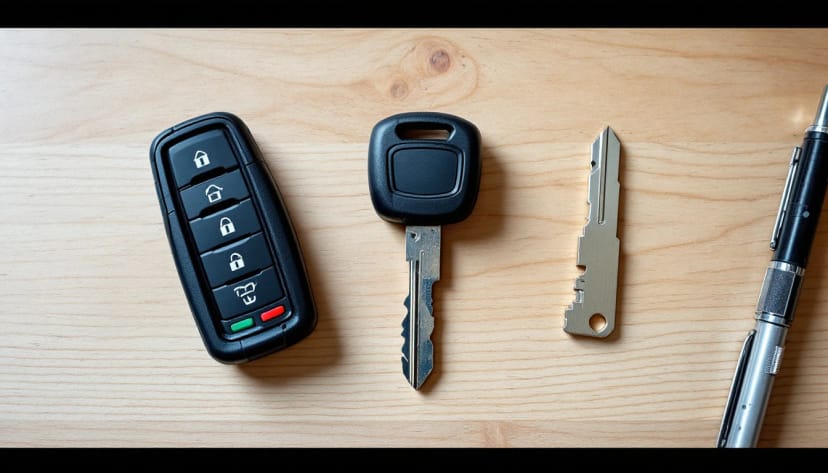
- Roughly 2011–2016 — bladed PATS transponder keys across the range. Blanks commonly in the H92-PT and H84-PT families, 80-bit PATS credential, 4D-63 style transponder. Well-understood, well-supported, low end of the band.
- Roughly 2017–2022 — the split. High-trim trucks moved to Intelligent Access proximity fobs with push-button start, commonly in the M3N-A2C931426 FCC family. Base XL and XLT work trucks stayed on bladed keys well into this window.
- 2023 and newer — proximity dominant on retail trucks, with continued tightening of security data gating. A technician confirms your exact setup by VIN before we commit.
As of August 2026, Fort Worth pricing runs $120–$200 for a bladed PATS key, $220–$500 for an Intelligent Access fob, $180–$450 when the fob is lost with no spare, and around $65 per extra key added to a job already in progress. Ignition-related mechanical repair is $150–$400; a lockout with no key work is $75–$200. For the market-wide picture, our breakdown of car key replacement cost in Fort Worth TX puts those bands in context.
Call 817-842-1256 with the VIN and the trim. On a Super Duty, those two facts are the quote.
Quick answer
If your truck has a key slot in the column, you have a bladed PATS transponder key and you are in the lower band. If it has a start button, you have an Intelligent Access proximity fob and you are in the higher one. If you hold one working key you are looking at a short job. If you hold none, you are looking at a longer one that begins with ownership paperwork. Everything else on this page is detail underneath those four sentences.
How Ford PATS works
PATS stands for Passive Anti-Theft System, and every Super Duty in this year range runs some generation of it. The architecture is the same in principle whether the credential lives in a bladed key head or a proximity fob.
An antenna reads a passive credential. The credential answers a challenge. A PATS-participating module compares the answer against the set of credentials it holds, and only a valid match releases fuel and spark. No valid credential means the engine cranks and dies, or does not crank at all depending on the platform and the fault.
Two properties of PATS matter more than anything else for owners.
First, the credential set is finite. The module holds a limited number of keys — on most Ford applications that ceiling sits in the range of eight. Fleets that add a spare every time someone loses one, without ever clearing the old credentials, eventually run into the wall. The fix is a full erase and reprogram of the keys genuinely still in service, which conveniently also removes credentials belonging to keys that left with a former employee.
Second, the onboard programming route needs two keys. Ford owner manuals for much of this era describe an onboard procedure for adding a key. That procedure requires two already-programmed keys to authorize the third. If you hold exactly one key — which describes most used-truck buyers — the onboard route is simply closed, and the work has to go through the diagnostic port with PATS-capable tooling. This is the single most common reason a Super Duty owner ends up calling us, usually after twenty minutes of cycling the ignition and getting nowhere.
Depth on the module side lives on our Ford PATS key programming page.
Super Duty key hardware by year band
Spec layer. Every part number below is what is commonly seen. Ford ran overlapping hardware, mid-cycle revisions, and heavy trim-driven variation, and the only reliable identification is by VIN.
Roughly 2011 through 2016 — the bladed PATS era
This is the generation that built the Super Duty's reputation with Tarrant County contractors, and it is the simplest key job in the lineup.
Blanks. Keys in this window commonly use blanks in the H92-PT and H84-PT families — an edge-cut style blade rather than the sidewinder milling used on many imports. That makes the mechanical side straightforward for an operator with the right code access.
Transponder. The credential is commonly in the 4D-63 family, running the 80-bit PATS variant across most of this window. Earlier 40-bit hardware exists on older Fords; by the year range in question, 80-bit is the practical assumption. The difference is not academic — tooling that handles one does not automatically handle the other.
Remotes. Many trucks carry a separate remote-entry fob distinct from the bladed key, and on others the remote buttons live in an integrated head. These are two different hardware situations that generate two different quotes, which is why we ask rather than assume.
Field reality. These trucks are now ten to fifteen years old and living hard. Worn blades, cracked key heads, and single-key survivors are the norm rather than the exception.
Roughly 2017 through 2022 — the split
The redesigned Super Duty is where the range forks.
High-trim trucks. Lariat, King Ranch, Platinum and Limited configurations commonly carry Intelligent Access proximity fobs with push-button start, frequently in the M3N-A2C931426 FCC family with variations tied to remote start and tailgate equipment. Every one of those fobs hides an emergency insert blade, and that blade still has to be cut to your key code. A fob that has been registered but never cut is a fob that will not open the door when its coin cell dies at a lay-down yard in Saginaw.
Base work trucks. XL and XLT fleet-spec trucks continued on bladed keys through much of this window. This is the part that catches people out: a 2019 Super Duty is not automatically a proximity truck. We have quoted plenty of 2019s and 2020s that turned out to be bladed.
Why it matters commercially. A contractor running eight trucks may have five bladed and three proximity. Quoting that fleet as a single line item is how a job goes wrong. We price by truck.
2023 and newer
Proximity entry dominates the retail range, and the security posture around current-model platforms has continued to tighten across the industry. We do current-model Ford work, but on the newest trucks a technician confirms your exact setup by VIN before we commit to a procedure or a price. Anyone quoting a brand-new platform flat over the phone with no questions asked is guessing, and on a truck this expensive that guess is not yours to absorb.
Super Duty calls come in two flavors. Either it is a guy with a fifteen-year-old F-250 and one bent key who finally accepted his luck was running out, or it is a job-site call at seven in the morning because the only key to the truck blocking everyone in went home in somebody's pocket to Cleburne. The first one is a twenty-minute job. The second one is why we quote a spare at the price we do — it is not the key that costs you, it is the crew standing around.
— a NASTF-registered Fort Worth automotive locksmith, ALOA Master Automotive Locksmith (MAL) credential, DFW metroplex (anonymized)
Fort Worth pricing
As of August 2026. Bands, not single numbers, because trim and key-present status move the figure.
| Scenario | Year band | What the job involves | Fort Worth band |
|---|---|---|---|
| Spare bladed PATS key, working key present | 2011–2016 | Cut blank, register transponder via port | $120–$200 |
| All keys lost, bladed truck | 2011–2016 | Ownership verify, cut, erase and register set | $120–$200 |
| Spare Intelligent Access fob, working key present | 2017+ | Cut emergency blade, register proximity credential | $220–$500, low-mid |
| Lost proximity fob, no spare | 2017+ | Ownership verify, register set, invalidate old | $180–$450 |
| Base XL work truck, bladed, 2017+ | 2017–2022 | Same as bladed PATS work | $120–$200 |
| Extra key added same visit | any | Register additional credential | around $65 |
| Ignition-related mechanical repair | bladed trucks | Lock cylinder or switch work | $150–$400 |
| Lockout, no key work | any | Non-destructive entry | $75–$200 |
Service scope: truck key replacement, car key replacement, and key fob programming.
Common problems we see
The one-key truck
Overwhelmingly the most common Super Duty situation in Tarrant County. A used truck changes hands with a single key, that key gets used ten times a day for years, and the mechanical blade wears down or the head cracks. Because it still starts the truck right up until the moment it does not, nobody addresses it. The gap between a planned spare and an unplanned all-keys-lost on a work truck is the difference between a scheduled twenty minutes and a lost morning.
Worn blade on a hard-used key
An edge-cut PATS blade that has been jammed into a door lock with gloved hands for a decade rounds off. The transponder is usually fine, so the truck starts once you get the key turned — which masks the problem until the day it will not turn at all. If the blade snaps in the cylinder, see broken car key extraction.
The onboard procedure that will not complete
Owner tries the two-key onboard method with one key, cycles the ignition per a video, nothing happens, and concludes the truck has an electrical fault. It does not. The procedure is refusing because the security precondition is not met. This is a five-second diagnosis over the phone and it saves people a wasted afternoon.
Credential limit reached on a fleet truck
A truck that has accumulated spares over the years hits the PATS ceiling and refuses to accept another. The remedy is to erase and rebuild the credential set with the keys actually in service. Fleets should treat this as a housekeeping opportunity, not an annoyance.
Fob battery in Texas heat
Coin cells in proximity fobs degrade faster in cabin temperatures that routinely clear 140 degrees on an August afternoon in a truck parked on caliche. The symptom is intermittent no-key-detected that worsens through the day. Cheapest possible fix, and always the first thing to rule out. See car key battery replacement and push-button start problems.
Half-working aftermarket fobs
Wrong FCC variant registers and starts the truck but will not operate remote start or the tailgate release. Because the failure is partial, it reads as a programming problem. It is a hardware problem, and confirming the variant against the VIN before purchase prevents the whole episode.
Spare key versus all keys lost on a work truck
For a commercial operator the spare-key math is simple enough to run on a napkin.
Spare with a working key present. Short job, low end of the band, schedulable at your convenience. Batch several trucks in one visit and the extra-key add-on rate applies to the additional keys, which is why fleet visits are the cheapest way to buy peace of mind.
All keys lost. Longer job at the top of the band, plus the part nobody puts on the invoice: the crew standing at a job site with a truck they cannot move. BLS data on employment in the construction trades makes the labor arithmetic obvious — a four-person crew idled for three hours is a bigger number than any key we have ever sold.
Proof of ownership comes first. On an all-keys-lost, expect to produce documentation before any technical work begins. For a personal truck that means the title or current registration plus a government-issued photo ID in a matching name. For a company truck, documentation tying the vehicle to the business plus ID for the person authorizing the work. The FTC's consumer guidance on hiring a locksmith treats identity verification as a baseline expectation, and legitimate operators do not skip it on a fifty-thousand-dollar truck.
The credentialed route for independent access to manufacturer security data is the NASTF Vehicle Security Professional registry, the same channel dealership technician access flows through. That is why a real operator asks for paperwork without apologizing for it.
Honest boundaries
Four things stated plainly:
- Newest platforms need a VIN check first. Current-model Super Duty work is real work we do, but independent tool coverage trails a platform release, and a technician confirms your exact setup before we quote.
- Part numbers here are guidance. Every blank family, chip designation, and FCC reference on this page is what is commonly seen across a wide production range. Verify by VIN.
- Some no-starts are not key faults. A crank-no-start with a security indicator can be a PATS antenna, a wiring fault, or a battery sitting at the edge of usable voltage — diesel trucks in particular hide weak-battery symptoms well. See no key detected and immobilizer faults.
- We do not defeat security to save you paperwork. If you cannot document the truck, we cannot build the key. That is not a policy we are flexible about.
Cross-model context: Ford brand page, the Ford F-150 key replacement guide, and the Ford Explorer key replacement guide. If your issue is the column rather than the key, see Ford Focus ignition repair for how ignition-side faults present.
How the on-site visit works in Fort Worth
We are mobile-only, seven days a week from 8AM to 8PM, and on work trucks that is the entire product. A Super Duty with no key does not drive to a dealership; it gets towed, which on a dually with a gooseneck hitched behind it is its own adventure. AAA's Your Driving Costs research — which put average annual new-vehicle ownership above $12,000 in its 2024 edition — is a reasonable frame for what a truck sitting idle actually costs a business.
On site: VIN and trim identification, a 12V load check because marginal voltage on a diesel produces convincing false security faults, a scan to confirm which modules are answering, ownership verification on any all-keys-lost, then cut, register, and test. Testing means every function on every key — crank, run, lock, unlock, remote start where fitted, tailgate release, and the mechanical blade in the driver's door.
We cover Fort Worth plus Arlington, Bedford, Hurst, Keller, and North Richland Hills, and job-site calls out to the Alliance and I-35W corridors are routine. Coverage detail sits on the Fort Worth service area page.
One licensing note: Texas locksmiths are regulated through the Texas DPS Private Security Program, under the Department of Public Safety. An operator naming a different Texas agency is not describing the law correctly, and that is a fast filter when you are calling around at six in the morning.
For the reason all this friction exists, NHTSA's material on anti-theft systems covers immobilizers as a federal theft-deterrence measure, and IIHS vehicle theft research documents how sharply loss rates fell as immobilizers became standard equipment. Full-size pickups remain among the most-targeted vehicles in the country, which is exactly why PATS is as stubborn as it is.
References
- NASTF Vehicle Security Professional (VSP) Registry — Credentialed independent access to OEM immobilizer and security data.
- Associated Locksmiths of America (ALOA) — Certification ladder including Master Automotive Locksmith.
- NHTSA — Anti-Theft Systems — Federal guidance on immobilizer and anti-theft equipment.
- IIHS — Vehicle Theft — Research on theft loss rates and immobilizer effectiveness.
- FTC Consumer Advice — Hiring a Locksmith — Verifying an operator before authorizing service.
- FTC — Business Guidance — Federal guidance on pricing and advertising disclosure.
- AAA — Your Driving Costs — Vehicle ownership and downtime cost research.
- U.S. Bureau of Labor Statistics — Construction Industry Data — Employment and labor cost context for fleet downtime.
Frequently Asked Questions
Does my Super Duty use a bladed key or a proximity fob?
Trim decides it more than the model year does. Through roughly 2011 to 2016 the entire Super Duty range used a bladed PATS transponder key. From roughly 2017 the higher trims moved to Intelligent Access proximity fobs with push-button start while base XL and XLT work trucks continued on bladed keys for years afterward. Look at the column: a key slot means bladed, a start button means Intelligent Access.
Why do I need two working keys to program a third one myself?
The onboard programming procedure that some Ford owner manuals describe requires two already-programmed keys to authorize the addition of a third. That is a security design, not a quirk. If you only hold one key, the onboard route is closed to you and the job has to be done through the diagnostic port by an operator with PATS-capable tooling and the right access. This is the single most common reason a Super Duty owner calls after trying the manual method.
How many keys can a Super Duty hold at once?
PATS platforms carry a finite limit on how many credentials the module will hold, and on most Ford applications that ceiling is in the range of eight keys. Fleets that keep adding spares without ever clearing old ones eventually hit it. When a truck reaches its limit the fix is to erase the existing credential set and reprogram every key that is genuinely still in service, which is also a good moment to remove credentials for keys that walked off with a former employee.
How much does a Super Duty key cost in Fort Worth as of August 2026?
A bladed PATS transponder key generally lands in the 120 to 200 dollar band. An Intelligent Access proximity fob sits in the 220 to 500 dollar band depending on hardware and whether a working key is present. A lost fob with no spare available runs 180 to 450 dollars. Adding an extra key alongside a job already underway is commonly around 65 dollars, which is why fleet operators do several trucks in one visit.
Can you make a Super Duty key at a job site with no working key at all?
Yes, all-keys-lost on these trucks is routine work for a credentialed mobile operator, and doing it where the truck sits is usually the entire point since a truck with no key is not driving anywhere. Expect proof of ownership before any technical work begins. For a company truck that means documentation tying the vehicle to the business along with a photo ID for the person authorizing the work, not just a verbal claim that the truck belongs to the company.
Why did the fob I bought online fail to program?
Three usual causes. The emergency or mechanical blade was never cut to your truck key code. The credential was never registered to your specific vehicle, which can only happen at the vehicle regardless of what a listing promises. Or the hardware variant is wrong, since button counts, frequency, and FCC families differ across the Super Duty range and a mismatched fob can partially work in a way that looks like a programming fault. Confirm hardware against the VIN first.
What is the smartest spare-key policy for a work fleet?
Two keys per truck minimum, held by two different people, with one set stored somewhere that is not the truck. The reason is arithmetic rather than caution. A spare added while a working key exists is a short job at the low end of the band, while an all-keys-lost on a truck stranded at a job site is a longer job at the top of it plus the crew downtime around it. Batch the spares across the fleet in one visit and the per-truck cost drops again.
Get your Super Duty back to work
Fort Worth Car Keys is a mobile-only automotive locksmith serving Fort Worth and Tarrant County, seven days a week from 8AM to 8PM. Job-site calls and multi-truck fleet visits are routine. Call 817-842-1256 or email contact@fortworthcarkeys.com. Have the VIN and the trim ready — on a Super Duty those two facts are the difference between a real quote and a guess.
More: Ford brand page, truck key replacement, spare car key, emergency car locksmith, and 24-hour car locksmith.
Reviewed against the ALOA Master Automotive Locksmith (MAL) field-service standard for Fort Worth mobile automotive work. Pricing bands current as of August 2026 and quoted as ranges only; your exact figure depends on trim, hardware, and key-present status confirmed by VIN.