What you actually need to know before you buy an Edge key
The Ford Edge has been in production in Fort Worth driveways since 2007, and across that run the key has changed three times in ways that matter to what you pay. Buying the wrong part or calling the wrong operator on an Edge usually comes down to one thing: treating "Ford Edge key" as a single item instead of a generation-specific spec.
As of August 2026, this is how the model run splits for key and immobilizer work:
- 2011-2014 (first generation, refreshed): bladed transponder key, high-security HU101-family blank, 80-bit Ford transponder, PATS immobilizer authority sitting in the instrument cluster.
- 2015-2018 (second generation): push-button start and Intelligent Access proximity fob on most trims, FCC family M3N-A2C31243300. Lower trims in this window can still ship a bladed key with a separate remote.
- 2019-2026 (second generation refresh and beyond): updated proximity fob with a different FCC ID and a revised body-control and PATS interaction. Verify the exact FCC ID by VIN rather than trusting a year chart.
Price follows the hardware, not the badge. A 2013 Edge key is a $120-$200 transponder job. A 2021 Edge key is a $260-$420 smart key job. Same nameplate, very different bill of materials, and any quote that does not first ask which generation you have is a quote that will change when the technician arrives.
The 2011-2014 Edge: bladed transponder on an HU101-family blank
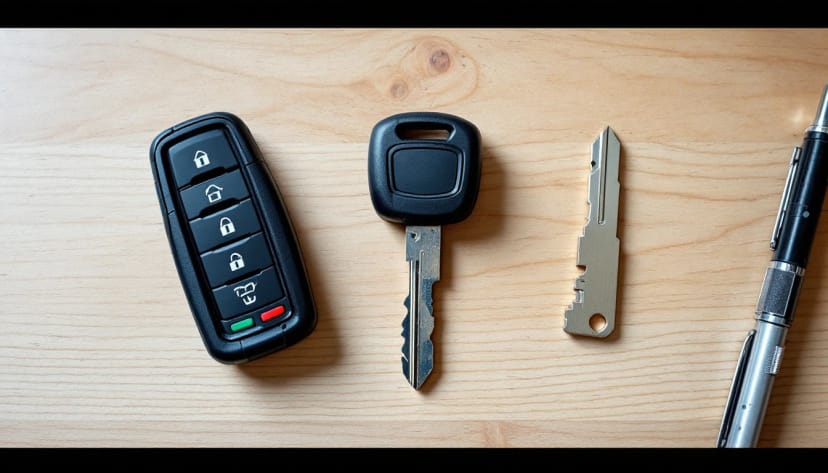
The first-generation Edge, including the 2011 refresh, uses a mechanical high-security key with a transponder chip molded into the head. The blade profile is the Ford HU101 family — a laser-cut, internally milled blade, not the old edge-cut style you can copy at a hardware kiosk. That distinction is the whole reason a $3 counter duplicate does not work on this car.
Two things have to be right for the key to work:
- The mechanical cut. The blade has to be milled to the vehicle's key code. On a mobile job that code is either decoded from an existing key, derived from the VIN through an authenticated channel, or read directly from the door lock. The cutting itself happens in the van on a code-capable milling machine.
- The transponder. The chip in the head has to be written into the PATS key table. Ford's 80-bit transponder generation is more secure than the earlier 40-bit chip and cannot be cloned from a working key the way some older systems could. It has to be programmed to the vehicle.
Fort Worth mobile pricing on this generation sits in the $120-$200 transponder band. A spare cut and programmed while you still hold a working key is the cheap end of that. An all-keys-lost 2011-2014 Edge, where the code has to be originated and the PATS table rebuilt from scratch, sits in the $180-$450 lost-key band depending on how the code is originated and how many keys you want at the end.
Older Fords also concentrate a specific failure that gets misdiagnosed as a key problem: the transponder in a daily-driver key that has ridden in a pocket for a decade eventually fails while the blade still turns the cylinder fine. The car cranks, the theft light blinks, nothing catches. That is a key problem, but it is a chip problem, not a cut problem, and the fix is a new programmed key rather than a cylinder repair. The NHTSA guidance on anti-theft systems is the plain-language explanation of why a car that turns over but refuses to fire is usually telling you the immobilizer said no.
The 2015-2018 Edge: Intelligent Access proximity fob
The second-generation Edge moved the volume trims to push-button start with a proximity fob. The relevant FCC family here is M3N-A2C31243300, shared across a wide slice of Ford's mid-2010s lineup, which is good news for parts availability and bad news for anyone assuming that shared FCC ID means shared programming.
What changed practically:
- The key is now a credential, not a cut. The fob talks to the vehicle over RF; there is no ignition cylinder to turn. The emergency blade hidden in the fob body exists only to open the driver's door if the fob battery dies, and on many of these it will not start the car by itself.
- Programming is a security-session job. Adding a fob means opening an authenticated session with the vehicle over OBD-II, writing the fob's credential into the immobilizer table, and closing the session cleanly. This is where a NASTF-registered operator with current tooling and a discount-store key cutter part ways.
- Cost moves into the smart key band. A 2015-2018 Edge proximity fob cut and programmed runs $260-$420, inside our $220-$500 smart key band. That figure includes the emergency blade being milled, which people forget until they need it.
Trim matters in this window. A base 2016 Edge SE ordered without Intelligent Access can genuinely be a bladed-key car with a separate flip remote, which lands back near the transponder band instead. This is the single most common source of a quote changing on arrival, and it is avoidable by reading the FCC ID off the back of your existing fob before you call. If you have no fob to read, the technician verifies by VIN.
The 2019-2026 Edge: updated proximity fob and revised PATS interaction
The 2019 refresh brought an updated proximity fob with a different FCC ID and a revised interaction between the body control module and the PATS function. Functionally the owner experience is identical — walk up, door unlocks, press the button, it starts — but the parts and the programming path are not interchangeable with the 2015-2018 fob, and a fob ordered off a year chart alone is a fob that may not enroll.
This is exactly where the honest answer is "verify by VIN." There are several fob variants across these years, differentiated by button count, hands-free liftgate support, and remote-start support, and the physical case looks similar across all of them. A technician pulls the correct part by VIN, not by photograph.
Programming remains OBD-based and remains mobile-doable, including all-keys-lost. Fort Worth pricing runs $290-$450 for a programmed proximity fob on these years, still inside the smart key band. All-keys-lost on a 2019-2026 Edge lands at $300-$450 within the $180-$450 lost-key band, because the security session is longer and the parts cost more.
If your Edge is showing a no-start with a proximity fob you believe is good, work the cheap causes first. A dead CR2450 coin cell in the fob is a four-dollar fix that mimics a catastrophic failure, and most Edges will still start by holding the fob against the start button, using the backup inductive coupling, if the battery is the only problem. That test costs nothing and tells you a great deal.
What the PATS parameter reset actually does to your other keys
This is the part of a Ford key job that surprises people, and it is worth reading twice before you book.
When there is no working key present — a true all-keys-lost — the tool cannot simply add a key to the existing table, because it cannot authenticate as an existing key. Instead it performs a parameter reset: the PATS module's key table is erased and rebuilt from zero with only the keys physically present in that session.
The consequences are concrete:
- Any key not in the technician's hand during that session stops working permanently. It is not disabled temporarily. Its credential no longer exists in the vehicle.
- If a spare turns up in a jacket pocket a month later, it is now a blank credential in a plastic shell. Re-adding it is a new service call.
- If you hand the technician two fobs and one is dead hardware, you end the visit with one working key, not two.
The practical instruction is simple: before the technician starts the session, say out loud how many working keys you want at the end, and hand over every fob you own including ones you think are dead. Adding a second key inside an already-open session is roughly $65. Adding it next month is a full service call.
An ALOA-credentialed automotive locksmith working Tarrant County put it this way:
The parameter reset is the moment where the customer's decision gets locked in for a year. I have had people tell me one key is fine, and I have had the same people call me from a Kroger parking lot in the rain seven months later, and now it is an all-keys-lost again. Sixty-five dollars on the day versus three hundred later is not a close call, and I would rather explain it before I open the session than after I close it.
Fort Worth Edge key matrix: generation, key type, band, on-site time
Find your year, read across. This is the entire model run compressed into one lookup.
| Edge years | Key type | Blank / FCC family | Spare add (working key present) | All keys lost | Typical on-site time |
|---|---|---|---|---|---|
| 2011-2014 | Bladed transponder, 80-bit | HU101-family high-security blank | $120-$200 | $180-$380 | 30-60 min |
| 2015-2018 (Intelligent Access) | Proximity smart fob | M3N-A2C31243300 family | $260-$420 | $260-$450 | 40-75 min |
| 2015-2018 (base, no IA) | Bladed transponder plus remote | HU101-family, verify by VIN | $140-$200 | $190-$400 | 35-65 min |
| 2019-2026 | Updated proximity smart fob | Verify FCC ID by VIN | $290-$450 | $300-$450 | 45-90 min |
The trend across that table is the point: as the key moved from a milled blade to a radio credential, the parts cost rose and the labor shifted from cutting to security-session work. Neither generation requires a tow, and neither requires the vehicle to leave your driveway.
Mobile versus the Ford dealer for Edge key work
The dealer path and the mobile path solve the same problem with different overhead. Where each one wins is predictable.
The dealer is the right call when your Edge is already at the service drive for other warranty work, when there is an open Ford program or TSB touching the immobilizer or body control module, or when a genuinely brand-new model year has outrun independent tooling coverage.
Mobile is the right call when the vehicle is sitting at your house, your job, or an apartment garage and does not currently start. This is the structural advantage and it is not a small one: a dealer that cannot receive a non-running Edge needs it towed in, and a tow inside Tarrant County is a real line item on top of the key. A mobile technician brings the tool to the vehicle, so the tow never happens.
Speed is the second differentiator. Dealer key work is scheduled around parts availability and shop capacity. A mobile all-keys-lost on an Edge is typically a same-day job. AAA's annual driving-cost research puts average new-vehicle ownership cost above $12,000 a year, roughly $1,000 a month, which is a useful way to price the days your Edge spends immobile waiting on an appointment — the downtime is not free even when nobody invoices you for it. J.D. Power's Customer Service Index research consistently finds that time-in-shop is among the strongest drivers of service satisfaction, which lines up with what Edge owners tell us: the wait, more than the invoice, is what makes a dealer key job feel expensive.
For a full breakdown of what drives the number on any job, not just an Edge, our guide to car key replacement cost in Fort Worth TX walks through how parts, security-session labor, and travel actually combine.
How to verify the operator before you authorize a Ford Edge job
Key work writes new credentials into your vehicle's anti-theft system. That is exactly the transaction the FTC's consumer guidance on hiring a locksmith warns you to verify before it happens, because the bait-and-switch pattern in this trade is well documented: a low phone number, then a much higher on-site number once your car is already opened up.
Six questions worth asking before dispatch:
- Which generation key does my Edge take, and what is the FCC ID? A real Ford operator answers this by year and asks for the VIN. Someone who says "a Ford key" has not done the work.
- What is the flat-rate range, in writing, before you arrive? Ranges are fine. Refusal to name one is not.
- Are you Texas DPS Private Security Bureau licensed? Texas licenses locksmith companies and individuals through the DPS Private Security Bureau. Ask for the company license number.
- Are you NASTF VSP registered? The NASTF Vehicle Security Professional registry is the credential that authorizes legitimate access to OEM security data. It exists specifically so key origination is traceable.
- Will you scan PATS before cutting anything? A blinking theft light has several causes and only one of them is a bad key.
- What warranty comes with the fob and the labor? Get it on the invoice, not in conversation.
The Associated Locksmiths of America maintains the Master Automotive Locksmith credential that sits behind this kind of work, and the Bureau of Labor Statistics occupational data for locksmiths shows a trade of roughly 15,000 practitioners nationally — small enough that the credentialed operators in a metro the size of DFW are a knowable set, and an operator who cannot answer credential questions is telling you something.
Related Ford key jobs in Fort Worth
Two adjacent Ford jobs come up constantly alongside Edge calls, and both have their own spec quirks worth reading before you assume the Edge answer transfers. If you also run a pony car, Mustang key replacement in Fort Worth covers a very different progression through the same PATS architecture. And if there is a work truck in the driveway next to the Edge, Super Duty F-250 and F-350 key replacement covers the heavier-duty side, where fleet keying and downtime cost change the math entirely.
The broader Ford immobilizer picture lives on our Ford brand page and the technical detail on the module itself is on the Ford PATS key programming page. For general pricing structure across all makes, see car key replacement in Fort Worth, and if you are trying to get ahead of the problem rather than react to it, spare car key service is the cheapest hour you will ever spend on this vehicle.
According to IIHS research on vehicle theft, immobilizer-equipped vehicles show substantially lower theft rates than comparable vehicles without them — which is the same security architecture that makes your Edge key expensive to replace. The cost and the protection are the same fact viewed from two sides.
Frequently Asked Questions
What kind of key does a Ford Edge take?
It depends on the generation. A 2011-2014 Edge uses a bladed transponder key cut on an HU101-family high-security blank with an 80-bit Ford transponder. A 2015-2018 Edge with push-button start uses a proximity smart fob from the M3N-A2C31243300 family. A 2019-2026 Edge uses an updated proximity fob with a different FCC ID. Base trims in the 2015-2018 window can still be bladed. Verify the exact FCC ID by VIN before ordering anything.
How much does Ford Edge key replacement cost in Fort Worth?
Mobile pricing in 2026: a 2011-2014 bladed transponder key runs $120-$200 cut and programmed. A 2015-2026 proximity smart key runs $260-$420, inside our $220-$500 smart key band. All-keys-lost with no original present runs $180-$450. Adding a second fob on the same visit is about $65 extra because the tool is already connected and the security session is already open. Dealer pricing for the same work is typically higher and usually adds a tow when no key works.
Can you program a Ford Edge key in my driveway?
Yes. Every Edge generation from 2011 through 2026 is OBD-programmable on-site with current NASTF-authenticated tooling, including all-keys-lost. That is the practical advantage of a mobile job on a no-start Edge: the vehicle never moves, so there is no tow bill. The one honest caveat is that tooling coverage on the newest model years moves quarter to quarter, so a technician confirms your specific VIN before dispatch rather than promising blind.
What is the PATS parameter reset on a Ford Edge?
PATS is Ford Passive Anti-Theft System. When a technician writes keys to an Edge with no working key present, the tool performs a parameter reset that erases every previously learned key from the immobilizer and starts a fresh key table. Any key not physically present during that session stops working permanently. That is why you tell the technician up front how many working keys you want to end the visit with, and why a key that turns up in a coat pocket two weeks later has to be re-added.
Do I need two keys programmed at once on a Ford Edge?
Ford PATS accepts a single key, so one is technically enough to drive away. Two is the smarter buy. The parameter reset already erased everything, the tool is already connected, and the marginal cost of the second fob on the same visit is roughly $65 rather than a whole new service call later. Owners who leave with one key are the owners who call back for a full-price all-keys-lost job after a single fob goes missing.
What do I have to show you for an all-keys-lost Ford Edge job?
Photo ID plus registration or title that matches the vehicle. The name on the ownership document and the name on the ID have to line up, and the VIN on the paperwork has to match the VIN on the dash. This is not paperwork for its own sake. Writing keys to a vehicle means writing new credentials into its immobilizer, and no credentialed operator does that without proving the person authorizing it owns the car.
My Edge cranks but will not start and the theft light is blinking. Is that the key?
Probably an immobilizer handshake failure rather than a lost key. A blinking theft indicator during crank means the PATS module did not accept the transponder. Common causes are a failed transponder in a worn key, a damaged antenna ring at the ignition or the start button coil, low battery voltage confusing the module, or a previous failed programming attempt that left the module in a protection state. A technician scans PATS codes before cutting any new key, because replacing a key that was never the problem is money burned.
References
- NHTSA — Anti-Theft Systems — federal guidance on immobilizer and anti-theft equipment.
- NASTF Vehicle Security Professional Registry — credentialed access to OEM vehicle security data.
- Associated Locksmiths of America — trade association behind the Master Automotive Locksmith credential.
- FTC Consumer Advice — Hiring a Locksmith — how to verify a locksmith before service.
- IIHS — Vehicle Theft — research on immobilizers and theft rates.
- AAA — Your Driving Costs — annual vehicle ownership cost study.
- U.S. Bureau of Labor Statistics — Locksmiths and Safe Repairers (49-9094) — national employment and wage data.
- J.D. Power — Customer Service Index — dealership service satisfaction and cost research.
Related Pages
- Ford Brand Page
- Ford PATS Key Programming
- Car Key Replacement Fort Worth
- Spare Car Key Service
- Smart Key Replacement
- All Keys Lost
Book Ford Edge key replacement in Fort Worth
We are mobile only. There is no shop to drive to and no counter to wait at, which means an Edge that will not start does not need to be towed anywhere to get sorted out. Have the VIN and your ownership documents ready and the technician handles the rest at your driveway, your workplace, or wherever the vehicle is sitting.
Call or text 817-842-1256, Mon-Sun 8AM-8PM, anywhere in Fort Worth and Tarrant County. You can also reach us through the contact page.