TL;DR — Tesla key work in one screen
Tesla key pairing is structurally different from every other automotive brand. There is no AVDI subscription that covers Tesla. There is no NASTF SDRM event for Tesla key work. There is no dealer scan-tool. Pairing happens on the vehicle's own center-console touchscreen by an authorized driver who's already logged into the Tesla account.
Tesla supports three key types depending on model and configuration:
- NFC key card (Model 3, Model Y standard, Model S Refresh, Model X Refresh): credit-card-shaped passive NFC tag. Tesla sells replacement cards direct for $35 as of 2026. Pairing is done by tapping the card on the center console behind the cup holders, then naming the key on the touchscreen.
- Phone-as-key (all current Teslas): the Tesla mobile app on a paired phone acts as a Bluetooth key. No physical hardware to replace — re-pair through the app.
- Traditional key fob (Model S pre-Refresh, Model X pre-Refresh, optional accessory for Model 3/Y): car-shaped passive transmitter. Tesla sells replacement fobs direct for $175 (Model 3/Y accessory fob) or $325 (Model S/X premium fob) as of 2026.
Per the Texas DPS Private Security Bureau and FTC consumer guidance, the credentialed third-party operator's value on Tesla work is not in replacing what Tesla sells direct — it's in the adjacent workflows: used-Tesla pre-purchase key audits, family key allocation cleanup, paired-key removal after a sale, troubleshooting NFC reader and Bluetooth pairing issues, and on-site convenience for buyers who don't want a Tesla Service Center round-trip.
As of August 2026, Fort Worth pricing ranges:
- NFC key card pairing on-site (customer-purchased card or shop-supplied): $80-$150 mobile
- Phone-as-key setup + walkthrough: $60-$120 mobile (often bundled with card pairing)
- Traditional fob pairing on-site: $150-$300 mobile (fob cost separate)
- Used-Tesla pre-purchase key audit (verify paired keys + remove unknown keys): $150-$250 mobile
- Lockout-only opening (no key work): $90-$175 mobile
Why Tesla key work is different from every other brand
Three structural differences set Tesla apart from BMW, Mercedes, Audi, Porsche, and the legacy automakers:
1. No immobilizer database to authenticate against. Traditional automotive key work routes through manufacturer-specific immobilizer authentication — VW Group Component Protection via NASTF SDRM, BMW ISTA + ICOM, Mercedes SCN coding. Tesla doesn't expose an equivalent authenticated channel because pairing is owned by the vehicle itself, gated by Tesla account credentials and physical access to the touchscreen.
2. No scan-tool requirement. AVDI, Autel IM608, and Xtool D9 — the platforms that handle 95% of independent automotive locksmith work — do not pair Tesla keys. Tesla key pairing is performed via the in-car touchscreen by an authenticated driver. The "tool" is the car. The "credential" is account access.
3. No transponder cloning. Tesla NFC cards and fobs don't carry rolling-code transponders in the legacy sense — they're cryptographically registered to the vehicle through the touchscreen pairing flow. Cloning a Tesla key card the way an HU66 transponder gets cloned isn't a workflow that exists.
The practical consequence: there is no scenario where a third-party operator legitimately programs a Tesla key without either (a) the customer being physically present with account access during the appointment, or (b) explicit account-level authorization documented in writing.
This rules out a category of scam common with other brands (the "I can program your key without you being there" line) — for Tesla, that's structurally impossible. Per BBB locksmith scam advisory, any operator claiming to be able to pair a Tesla key without account access is misrepresenting the procedure.
NFC key card pairing (Model 3, Model Y, Model S Refresh, Model X Refresh)
The NFC key card is the default key for Model 3, Model Y, and Refresh-generation Model S/Model X. Pairing workflow:
- Driver authenticated on the Tesla account, sitting in the driver's seat, vehicle awake.
- Open the touchscreen Controls panel → Locks → "Keys" section.
- Tap "Add Key." The screen displays a prompt to tap the new card on the center console NFC reader (located behind the cup holders on Model 3/Y, on the center pillar on Refresh Model S/X).
- Tap the new key card on the reader. Wait for the chime / confirmation.
- Tap an existing already-paired key card on the reader to confirm authorization.
- Name the new card on the touchscreen (e.g., "Spouse Card 2", "Valet Key").
That's the entire procedure. It takes 90-180 seconds on a fully-awake vehicle. The two complexity factors that justify mobile-locksmith involvement are:
- No working paired key. If every paired key is lost (true all-keys-lost), the customer cannot perform step 5. In that scenario, Tesla support must remotely de-authorize old keys and re-issue an authenticated pairing window. This typically requires a Tesla Service Center appointment or Tesla mobile-service visit — third-party locksmiths don't have a workaround.
- Faulty NFC reader. If the in-car NFC reader has failed, no card pairs regardless of account access. Diagnostic + module-level repair is a Tesla Service Center job.
For all other scenarios — adding spare cards, replacing lost cards while at least one working card remains, family key allocation, used-Tesla pre-purchase audits — the credentialed mobile shop is competitive on convenience and price.
Tesla access methods by model
Tesla splits access across three mechanisms, and which ones your car supports decides who can help you.
| Model | NFC key card | Phone as key | Key fob available |
|---|---|---|---|
| Model 3 | Yes, primary | Yes | Optional accessory |
| Model Y | Yes, primary | Yes | Optional accessory |
| Model S Refresh | Yes | Yes | Optional accessory |
| Model X Refresh | Yes | Yes | Optional accessory |
| Model S / X pre-Refresh | No | Limited | Yes, primary |
The pre-Refresh row is the one that changes the answer. Those cars are fob-primary and behave much more like a conventional vehicle, while every current Tesla treats the card and the phone as the real keys and the fob as an accessory.
Phone-as-key setup and the underrated convenience play
Phone-as-key works on all current Teslas via the Tesla mobile app over Bluetooth Low Energy. Setup workflow:
- Tesla account holder downloads the Tesla app on their phone, signs in.
- App detects paired vehicle on the account.
- Phone Bluetooth + location enabled.
- App prompts to enable phone-as-key. Phone needs to be in/near the vehicle for initial pairing.
- Test by approaching the vehicle with phone in pocket — door handles should auto-present and the car should unlock and accept driver authentication.
Range and reliability vary by phone model, phone case (heavy metal/wallet cases reduce BLE range), and battery state (low-battery phones throttle BLE). The credentialed shop's value-add is a quick on-site setup with reliability testing across multiple approach scenarios — drive-by, glovebox-stored phone, multiple drivers' phones in the same household.
Family key allocation is the under-served use case. A typical Tesla household has the primary driver's phone, the spouse's phone, 2-3 NFC cards split between drivers and a valet card, plus possibly a teen driver's phone. Mismanaged paired-key lists become a security and convenience problem: when someone's phone is replaced, when a driver leaves the household, when a card is lost, when a teen leaves for college. Cleaning this up takes 20-40 minutes on the touchscreen. Many Tesla owners haven't looked at their paired key list in years.
Per BrightLocal Local Consumer Review Survey 2024, service businesses that solve adjacent problems beyond the core service request earn substantially higher repeat-customer rates. Tesla family-key-allocation cleanup is exactly this kind of adjacent work — low-cost to deliver, high perceived value.
Used-Tesla pre-purchase key audits — the highest-value Tesla locksmith service
The Tesla used-car market in DFW has grown substantially since 2022 as off-lease Model 3 and Model Y inventory hit auction and independent-dealer lots. A used Tesla can ship with a paired-key list the new buyer cannot see or modify without taking authorized ownership of the Tesla account first.
The risk: a previous owner's NFC card or phone may still be paired to the vehicle when the new owner takes delivery. Combined with the vehicle's GPS-locatable nature, this is a meaningful security gap.
The pre-purchase / pre-delivery audit workflow:
- New owner has Tesla account ownership transferred (this is a Tesla-side process between buyer, seller, and Tesla support).
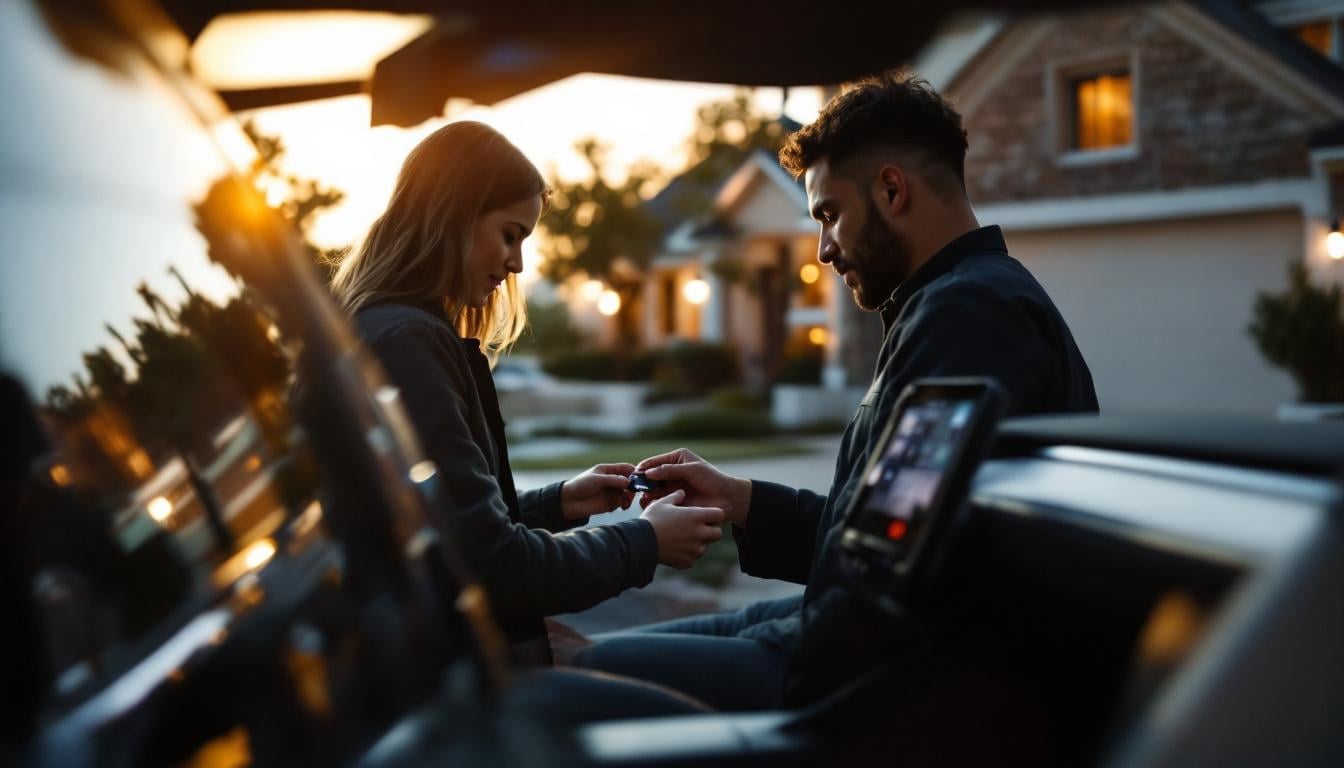
- Credentialed locksmith arrives on-site with the buyer, who's authenticated on the account.
- Together, walk through the touchscreen paired-key list — every NFC card, every fob, every phone-as-key registration.
- Remove every key the buyer doesn't personally control.
- Add the buyer's new NFC cards, phone-as-key, and any household members' phones.
- Document the final paired-key list with photos for the buyer's records.
This audit takes 30-60 minutes on-site and runs $150-$250 in the Fort Worth 2026 market. It's structurally analogous to a residential lock re-key after buying a house — same principle, same justification.
For independent used-car dealers handling Tesla inventory at scale, the audit becomes an inventory-prep workflow: every Tesla on the lot gets its paired-key list inspected at intake, unknown keys removed, and a clean handoff to whichever buyer the dealer eventually sells to. Per J.D. Power Customer Service Index trends, dealer-side service quality scores correlate with this kind of pre-delivery thoroughness.
When the Tesla Service Center is the right call (not the credentialed mobile shop)
An honest credentialed operator names the scenarios where they are not the right call. For Tesla, the Tesla Service Center is the right answer when:
- Every paired key is lost (true all-keys-lost). Tesla support must remotely de-authorize the old keys before any new key can be paired. Mobile locksmiths cannot bypass this.
- NFC reader hardware failure. The in-vehicle NFC reader module is a Tesla parts + labor diagnostic. Third-party shops don't hold Tesla replacement modules.
- Account-level lockout. If the Tesla account itself is compromised, suspended, or the wrong person legally controls the account, no amount of locksmith work helps — this is a Tesla Support + potentially legal issue.
- Active warranty work where preservation matters. Per AAA driving costs data, Tesla Service Center work performed under active warranty preserves vehicle resale documentation in ways that third-party work doesn't.
- Software-side fault diagnosis. Tesla over-the-air update issues, MCU faults, gateway communication problems — these are Tesla service workflows.
The credentialed operator who walks customers through this triage upfront builds long-term trust. The operator who tries to take every Tesla call regardless of fit is the one to avoid.
Six questions to ask any Fort Worth Tesla locksmith before booking
Tesla-specific questions, slightly different from the legacy-brand checklist:
- “Are you ALOA-credentialed and Texas DPS-licensed?” Credentialed operator names the credential. Per Texas DPS Private Security Bureau regulations, the locksmith company itself must be DPS-licensed.
- “Have you personally paired NFC key cards on the same Tesla model I drive?” Specialist gives confident yes with procedural detail naming the touchscreen pathway. Vague reassurance is a flag.
- “What's your written all-in price, including the card itself if I haven't bought one direct from Tesla?” Per FTC consumer guidance, written all-in pricing is the single most effective scam-protection step.
- “What's your honest answer about when I should go to the Tesla Service Center instead of using you?” The honest operator names specific scenarios (true all-keys-lost, NFC reader hardware failure, active-warranty preservation). The dishonest operator says "we can handle anything Tesla."
- “Will you walk me through removing unknown paired keys during the appointment?” Yes is the right answer. This is the highest-value Tesla service and should be included for used-Tesla buyers.
- “Can you handle phone-as-key setup for multiple family members during the same visit?” Yes naming Tesla app workflow. This is the adjacent-service play that justifies the visit cost.
Per BBB locksmith scam advisory, the bait-pricing pattern reported nationally applies less to Tesla work specifically — because Tesla sells cards direct for $35, the scam window is narrower. The risk shifts to operators charging $300+ for what should be a $80-$150 card pairing job, or charging anything at all when the customer could have walked into a Tesla Service Center and done the pairing themselves for free.
Documentation and account considerations
Per Texas DPS Private Security Bureau regulations, a credentialed locksmith verifies vehicle ownership before performing work. For Tesla specifically, the verification chain is layered:
Have ready:
- Valid government photo ID in your name
- Vehicle title or current Texas DMV registration showing your name + VIN, OR Tesla account showing the vehicle attached to your account
- For leased Teslas: lease documentation from Tesla Financial Services or third-party lessor
- Tesla account credentials accessible during the appointment (the locksmith doesn't handle account credentials directly — you log in yourself on the touchscreen)
Tesla account considerations. Phone-as-key, the Tesla mobile app, post-pairing sync, and any over-the-air key-related notification require an active Tesla account in good standing. If your account is suspended, has billing issues, or is shared with a previous owner who hasn't transferred ownership, key pairing problems become account problems first and locksmith problems second. The credentialed operator screens for this during the booking call and avoids wasted appointments.
Post-pairing verification. After any Tesla key work, verify on the touchscreen Keys list that the new key shows up with the name you assigned, and that any keys you intended to remove are gone. Take a photo of the final list. Test the new key with the vehicle locked, walking away, and re-approaching.
Warranty notes. Per Tesla's standard warranty terms, third-party key pairing performed through normal touchscreen workflows does not void warranty — the procedure is identical to what a Tesla mobile-service technician would perform, just on different hours and at different price points. Tesla warranty coverage on the key hardware itself (NFC cards, fobs) is generally short-term limited; the credentialed shop offers their own labor warranty in writing.
Field-operator perspective
The Tesla key conversation is the most honest customer conversation I have all week. There is no script where I can sell a Tesla owner more than they need. Tesla sells the cards direct for $35. My job is the pairing time, the family allocation cleanup, and the used-Tesla audit work — those are real services with real value, but I have to earn them honestly. I've turned away Tesla calls where the right answer was "drive to the Tesla Service Center, this is a 10-minute appointment they won't even charge you for." Those customers become my customers for the rest of their household's vehicles, because they remember I told them the truth.
— ALOA Master Automotive Locksmith (MAL), Texas DPS-Licensed, Tesla key-pairing experience across Model 3/Y/S/X, 11 years experience, DFW metroplex (anonymized)
A real-world example
Operator: Anonymized used-Tesla buyer, 2022 Model Y Long Range purchased from independent DFW dealer, pre-delivery key audit + family setup
Before:
- Customer purchased a 2022 Tesla Model Y from an independent used-car dealer in Arlington. Dealer transferred Tesla account ownership at delivery but did not perform a paired-key audit.
- Tesla Service Center wait time for a non-warranty appointment: 9 business days. Customer wanted clean key state before driving the vehicle further.
- Credentialed mobile locksmith quoted on-site $195 for full audit + new NFC card pairing + phone-as-key setup for two household drivers + valet card setup.
What changed: Locksmith arrived next-day at customer's Fort Worth home, 75 minutes total on-site. Customer logged into Tesla account on the touchscreen. Together they walked the Keys list — discovered three unknown NFC cards still paired (previous owner's family) plus one unknown phone-as-key registration. Removed all four. Paired two new NFC cards (customer-purchased from Tesla direct, $70), set up phone-as-key on customer's and spouse's phones, configured a named valet card with reduced permissions. Tested approach unlock with both phones from glovebox storage and pocket carry.
Outcome:
- Final invoice: $195 (within $150-$250 quoted range). NFC cards purchased direct from Tesla at $35 each = $70 customer-supplied.
- Four previously-paired unknown keys removed and confirmed gone from the Keys list. Photo of final state delivered to customer.
- Two NFC cards + two phone-as-key registrations + one valet card live and tested.
- 90-day labor warranty issued in writing. Customer scheduled a return appointment in 4 months for adding a teen driver's phone-as-key when the teen turns 16.
Net: Customer avoided a 9-business-day Tesla Service Center wait, eliminated security risk from previously-paired unknown keys, and completed family key allocation in one appointment. Tesla Service Center would have charged $0 for the card pairing alone but doesn't typically perform the unknown-key audit as a standalone service. Net value of the third-party visit: clean key state + family setup + documented audit, in one 75-minute appointment instead of two separate trips. Customer reported the security peace-of-mind was worth more than the dollar cost of the appointment.
Frequently Asked Questions
How much does Tesla key card replacement cost in Fort Worth?
Tesla sells NFC key cards direct for $35 each. Credentialed mobile locksmith pairing on-site adds $80-$150 for the appointment time, family setup, and any audit work. Total: $115-$185 for a single card paired on-site. If you only need pairing on a card you've already bought, the on-site fee alone covers it. Tesla Service Centers also pair customer-purchased cards, often at no charge, but appointment wait times in DFW can run 5-14 business days.
Can a Fort Worth locksmith pair my Tesla key without me being there?
No. Tesla key pairing is performed on the vehicle's own touchscreen by an authenticated driver logged into the Tesla account. There is no scan-tool workflow that bypasses this. Any operator claiming otherwise is misrepresenting the procedure. The customer must be physically present with account access during the appointment.
I bought a used Tesla — should I do a paired-key audit?
Yes, almost always. Used Teslas frequently ship with the previous owner's NFC cards, fobs, and phone-as-key registrations still paired. Combined with the vehicle's GPS-locatable nature, unknown paired keys represent a meaningful security gap. A credentialed mobile locksmith audit runs $150-$250 in Fort Worth and is structurally analogous to re-keying a house after buying it.
My Tesla phone-as-key won't connect — is this a locksmith call or a Tesla call?
Try basic troubleshooting first: confirm phone Bluetooth on, Tesla app running with location permission, phone-as-key enabled in app settings, phone battery above 20%. If basic troubleshooting fails, a credentialed locksmith can walk through re-pairing setup on-site for $60-$120. If the vehicle's Bluetooth module itself has failed, that's a Tesla Service Center diagnostic.
What happens if I lose all my Tesla keys (all-keys-lost)?
True all-keys-lost on a Tesla requires Tesla support to remotely de-authorize old keys before any new key can be paired. This is a Tesla Service Center or Tesla mobile-service workflow — third-party locksmiths cannot bypass it. Practical prevention: always maintain at least two paired keys (NFC card + phone-as-key minimum), and add a backup NFC card stored at home before you ever need it.
Will third-party Tesla key work void my Tesla warranty?
Generally no. Tesla key pairing performed through normal touchscreen workflows is structurally identical to what Tesla mobile-service technicians perform — the procedure happens entirely on the vehicle itself with the account holder present. No invasive module access, no firmware modification, no aftermarket parts swap. The credentialed shop should still walk through warranty implications during the booking call for any active-warranty Tesla.
References & external sources
- NASTF Vehicle Security Professional (VSP) Registry — National Automotive Service Task Force registry for credentialed access to OEM security data.
- Associated Locksmiths of America (ALOA) — Trade association governing locksmith certifications including the Master Automotive Locksmith (MAL) credential.
- Texas Department of Public Safety — Private Security Licensing — Texas locksmith company + individual licensing requirements.
- FTC Consumer Advice — Hiring a Locksmith — Federal Trade Commission guidance on verifying locksmith legitimacy before service.
- J.D. Power — Customer Service Index — Annual study of dealership service department satisfaction and cost.
- Better Business Bureau — Locksmith Scam Advisory — BBB consumer protection guidance on locksmith bait-and-switch operators.
- BrightLocal — Local Consumer Review Survey 2024 — Annual research on how consumers find + evaluate local service businesses.
- AAA — Your Driving Costs 2024 — Annual ownership cost study including unscheduled maintenance projections.
Related Pages
- Smart Key Fob Replacement
- Best Automotive Locksmith Fort Worth 2026
- Mobile Locksmith vs Dealership
- Push Button Start Diagnostic
- Car Key Replacement Cost
Talk to a technician about your tesla key card replacement
Every vehicle is different, and the fastest way to a real number is a short call with the VIN in front of you. We will tell you the band, the realistic time on site, and anything about your specific car that changes either.
Call or text 817-842-1256, Mon-Sun 8AM-8PM. We are fully mobile across Fort Worth and Tarrant County, or reach us through the contact page.