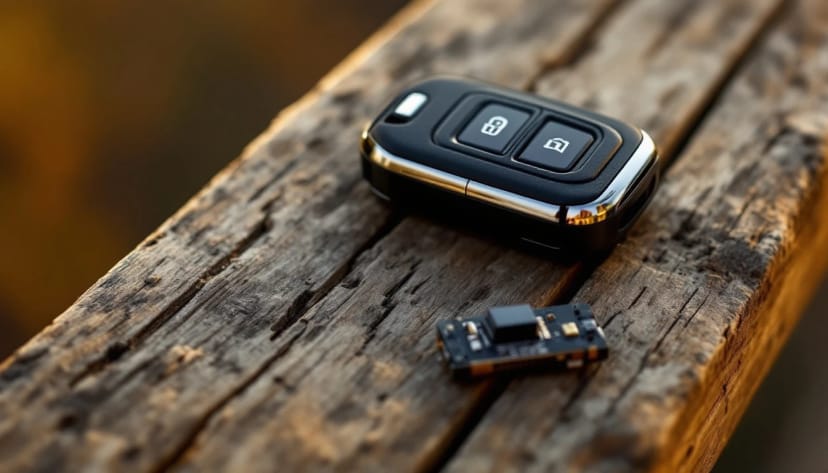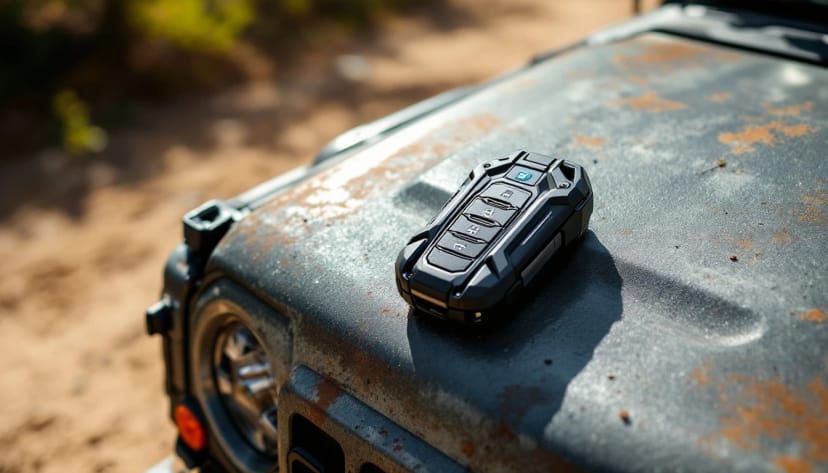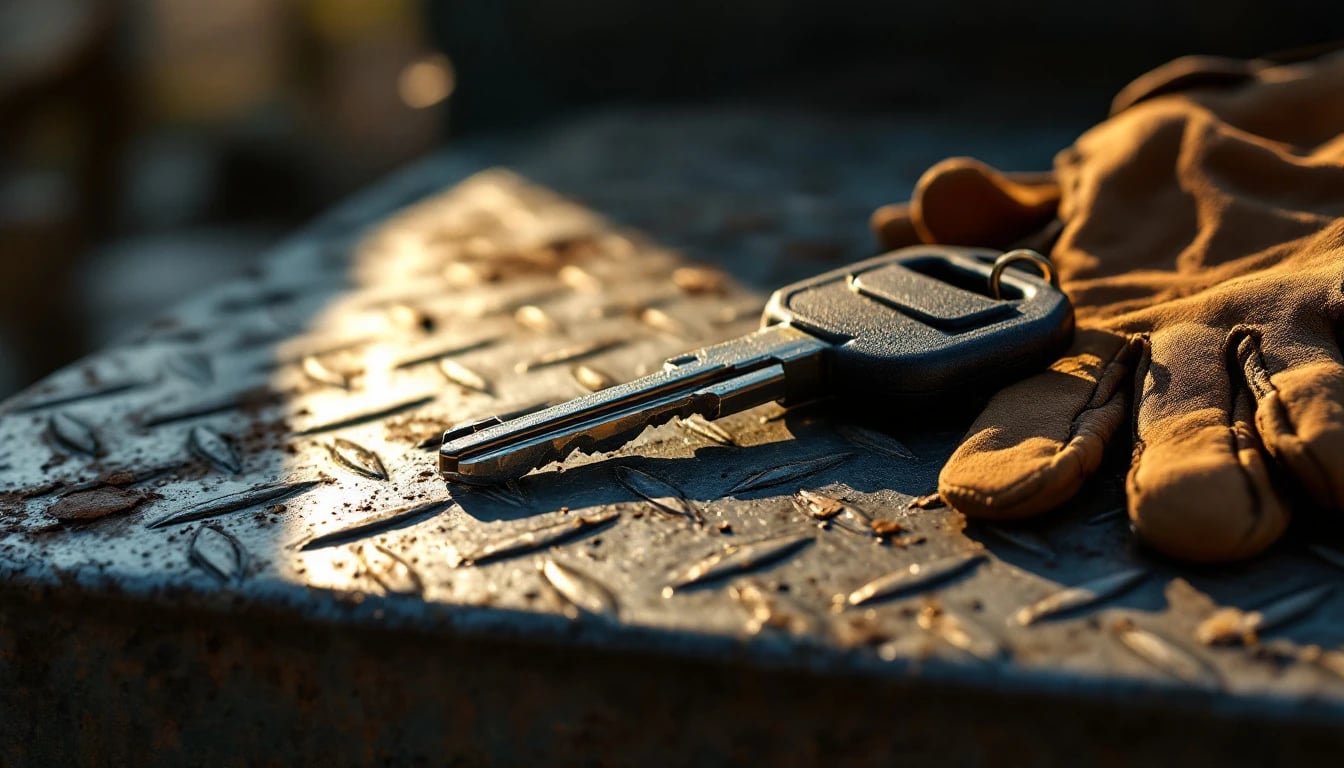
These are work trucks, so start with the downtime
A Jeep Gladiator and a Ram 2500 or 3500 rarely get called in as a car problem. They get called in as a work-stoppage problem: a crew standing at a yard in Saginaw, a loaded flatbed that cannot move off a job site, a truck that was supposed to be pulling a trailer two hours ago. The key is the small part of the call. The truck being immobile is the expensive part.
As of August 2026, here is the architecture you are dealing with on these two platforms:
- Jeep Gladiator JT, 2020-2026. Stellantis RF Hub immobilizer. Proximity smart fob with push-button start on most trims, bladed transponder key on work trims ordered without keyless enter and go.
- Ram 2500/3500, 2019-2026. RF Hub architecture on the current-body HD trucks. Proximity fob on the upper trims, bladed key on Tradesman-grade work trucks.
- Ram 2500/3500, 2013-2018. The previous-body HD trucks descend from the WCM and SKREEM lineage — Wireless Control Module and Sentry Key Remote Entry Module — with the fobik-style integrated key on most units.
Every one of those requires an authenticated PIN before a key can be written. That single requirement shapes the entire job, and it is the honest answer to why key work on these trucks costs what it does.
The RF Hub, and what it actually controls
On current Stellantis vehicles the RF Hub is the module that owns both the keyless entry radio and the immobilizer credential table. It is the authority that decides whether the thing in your pocket is allowed to start the engine.
Three practical consequences follow.
First, programming is a security session, not a procedure you can button-press your way through. A credentialed operator connects at the OBD-II port, authenticates, retrieves the vehicle PIN through an authorized channel, and writes the new credential into the RF Hub's table. There is no owner-side key dance on these trucks that adds a fob from scratch.
Second, the RF Hub is itself a failure point. When one goes bad, the symptom mimics a key problem almost perfectly: keyless entry gets flaky, the truck intermittently reports no key detected, and eventually it will not start with a fob that is provably good. Replacing keys on a truck with a failing RF Hub is money set on fire. A technician scans before writing anything, and if the module rather than the credential is the fault, that is a different repair — covered on our Dodge and Jeep RF Hub issues page.
Third, the fob families do not cross-shop by eye. Gladiator and Ram HD proximity fobs share a physical design language across a wide slice of the Stellantis lineup, and several visually identical shells are not interchangeable in the vehicle. Read the FCC ID off the back of an existing fob, or have the technician verify by VIN. A fob ordered from a marketplace listing on year alone is a fob that may simply refuse to enroll.
Older Ram HD: the WCM and SKREEM lineage
The 2013-2018 Ram 2500 and 3500 trucks sit on the earlier architecture, where the immobilizer authority carries the WCM and SKREEM naming from Chrysler's older system generations. Functionally the concept is the same — a module holds the list of credentials the truck will accept — but the hardware, the programming path, and the failure modes differ.
Most of these trucks use the fobik-style integrated key, where the transponder, the remote, and the blade live in one plastic body that inserts and twists in the ignition. Two field notes matter on them:
- The fobik body is a wear item. Years of twisting in an ignition wears the plastic and the internal contacts. A fobik that starts the truck only when held at a particular angle is failing mechanically, not electronically, and that presents to the driver as an ignition problem.
- The blade still has to be right. The SIP22-family blade in these fobiks has to be cut correctly, and a worn blade in a worn cylinder is the same wear-pair story as any other vehicle. On a truck with 200,000 hard miles on it, both sides are worn.
Pricing on these older trucks generally lands more favorably than the current-body trucks because the parts are cheaper and more widely available. A programmed fobik typically sits in the $180-$450 lost-key band for an all-keys-lost job and in the smart key band when a working key is present, depending on configuration. A technician confirms which by VIN.
Bladed work trims versus proximity trims
This trips up fleet managers more than anyone else, because both configurations sit in the same yard wearing the same badge.
A Tradesman-grade Ram HD or a Sport-trim Gladiator ordered without keyless enter and go is a bladed transponder truck. There is a physical cylinder, a physical blade, and a chip. Key work on those sits in the $120-$200 transponder band with a working key present.
The same model year in a higher trim is a proximity truck with push-button start, no ignition cylinder, and a radio credential. Key work there sits in the $220-$500 smart key band, typically $260-$450 for a programmed fob on these platforms.
The difference between those two numbers on a fleet of eight trucks is real money, and it is decided by how the trucks were ordered rather than by anything you can see from the driver's door. Reading the FCC ID off the existing fobs and recording it against each unit number is a twenty-minute afternoon that pays for itself the first time somebody loses a key.
PIN retrieval: why the technician needs your VIN before rolling
The PIN is a vehicle-specific security code the immobilizer requires before it accepts a new credential. No tool writes a key without it, and no legitimate operator obtains it anonymously.
Credentialed operators retrieve the PIN through an authenticated channel tied to their registration — the mechanism the NASTF Vehicle Security Professional registry exists to govern. The registry is the reason key origination on a modern vehicle is a traceable transaction with a named, licensed operator attached to it rather than an anonymous one.
For you, the practical effects are:
- The technician asks for your VIN before dispatch, not on arrival. An operator who does not ask for the VIN on a Stellantis truck has not thought about the job yet.
- Ownership verification is not optional on all-keys-lost. Photo ID plus registration or title matching the vehicle, with the VIN on the document matching the VIN on the dash and the name matching the ID. Company-titled trucks need the business documentation that connects you to the entity.
- This is not a step anybody skips to save you money. An operator willing to skip it is telling you something about how they would handle a stranger asking about your truck.
Gladiator and Ram HD key matrix
One table. Match your truck to the row.
| Vehicle and years | Immobilizer authority | Key type | With working key | All keys lost | Extra fob same visit |
|---|---|---|---|---|---|
| Jeep Gladiator 2020-2026, proximity trims | RF Hub | Proximity smart fob, verify FCC ID by VIN | $260-$450 | $280-$450 | ~$65 |
| Jeep Gladiator 2020-2026, work trims | RF Hub | Bladed transponder key | $120-$200 | $180-$400 | ~$65 |
| Ram 2500/3500 2019-2026, upper trims | RF Hub | Proximity smart fob, verify FCC ID by VIN | $260-$450 | $280-$450 | ~$65 |
| Ram 2500/3500 2019-2026, Tradesman-grade | RF Hub | Bladed transponder key | $120-$200 | $180-$400 | ~$65 |
| Ram 2500/3500 2013-2018 | WCM / SKREEM lineage | Fobik integrated key, SIP22-family blade | $220-$400 | $200-$450 | ~$65 |
| Any of the above with a failing RF Hub | Module fault, not a key fault | Diagnosis first | Scan before any key work | Scan before any key work | N/A |
That last row is the one that saves people the most money and gets read the least. A truck that intermittently reports no key detected with a fob that works most of the time is describing a module or antenna problem, and buying keys for it does not fix it.
The fleet math on keyed spares
For an owner-operator with one truck this is a judgment call. For anyone running three or more, it is arithmetic.
Cost of a spare programmed alongside a working key: $120-$200 for bladed trucks, $260-$450 for proximity trucks, plus about $65 for each additional fob written during that same open session.
Cost of an all-keys-lost call on the same truck: $180-$450 plus ownership verification plus a longer session, and it happens on the truck's schedule rather than yours — which in practice means the least convenient possible moment, because that is when keys get lost.
Cost of the truck not moving: this is the number that dominates and the one nobody puts on an invoice. A loaded HD truck idle for half a day takes a crew, a schedule, and often a customer commitment with it. AAA's driving cost research puts average ownership cost for a full-size pickup among the highest of any vehicle category it tracks, well above $12,000 a year before any lost-revenue accounting, which is a floor rather than a ceiling for a truck that earns its keep.
Three habits separate fleets that never have key emergencies from fleets that have them constantly:
- One spare per truck, stored off the truck. A spare in the glovebox is not a spare. It is a second key in the same place as the first one.
- Record the FCC ID and key type against each unit number. Twenty minutes once, and every future key call is a five-minute phone conversation instead of a guessing game.
- Key up new units when they arrive, not when they fail. The spare is dramatically cheaper while the original key is still in hand, and adding a second fob during that same session is about $65.
An ALOA-credentialed automotive locksmith working Tarrant County put it this way:
The fleet calls and the family-car calls are the same job technically and completely different jobs economically. When a guy loses the only key to a 3500 with a trailer hooked to it, he is not asking me what the fob costs, he is asking me how fast I can get there, because his day is already gone. The outfits that got smart about this called me on a Tuesday with all their trucks parked and had me cut spares for the whole yard at once. Those guys do not call me at six in the morning anymore.
Mobile versus the dealer on a work truck
The structural advantage of mobile work is larger on trucks than on anything else we service, for one reason: a non-running HD truck is genuinely expensive to move. A tow that is a nuisance on a sedan is a specialty call on a dually with a bed load, and that cost lands before a single minute of key labor is billed.
Mobile key work happens where the truck sits. Yard, job site, driveway, apartment lot, anywhere in Fort Worth and Tarrant County. Nothing about RF Hub or WCM programming requires a service bay.
The dealer path still makes sense in a narrow set of cases: an open manufacturer program or TSB touching the immobilizer or the RF Hub, a truck already at the service drive for warranty work you can bundle with, or a brand-new model year that has outrun independent tooling coverage. Outside those, the calculus favors the driveway. J.D. Power's Customer Service Index research consistently identifies time-in-shop as a leading driver of service dissatisfaction, which matches exactly what fleet owners tell us — the wait, not the invoice, is what actually hurts.
For a full walk through how parts, session labor, PIN retrieval, and travel combine into a final number, see our breakdown of car key replacement cost in Fort Worth TX.
Related truck and Stellantis key work
Two neighboring guides are worth reading if your driveway or your yard holds more than one of these. On the Stellantis car side, Dodge Charger key replacement in Fort Worth covers the same RF Hub and WCM lineage on a very different vehicle, which is a useful way to see what is platform behavior and what is truck-specific. On the competing heavy-duty side, Ford Super Duty F-250 and F-350 key replacement covers PATS architecture and is the direct comparison for any mixed fleet running both blue and red trucks.
The broader Jeep picture lives on our Jeep brand page, and the general heavy-vehicle service page is truck key replacement in Fort Worth. If your truck has never lost a key and you want to keep it that way, spare car key service is where that starts, and if you are already past that point, all keys lost covers the procedure and the documentation.
Verifying the operator before you hand over a VIN
Key work on these trucks means retrieving a security PIN and writing credentials into an anti-theft module. That is a security transaction and deserves the same scrutiny you would give anyone else touching the truck.
The FTC's guidance on hiring a locksmith documents the low-phone-quote-then-higher-arrival-price pattern well enough that the agency publishes about it directly. Four things worth confirming before dispatch:
- Texas licensing. Locksmith companies and individual technicians in Texas are licensed through the Texas DPS Private Security Bureau. Ask for the company license number.
- NASTF VSP registration. The credential that authorizes legitimate access to OEM security data and PIN retrieval.
- A written flat-rate range before arrival. Ranges are honest. A refusal to name any number is not.
- Whether they will scan the RF Hub before writing keys. On these platforms that is the difference between fixing the problem and selling you parts.
The credential ladder behind this work is maintained by the Associated Locksmiths of America, and per Bureau of Labor Statistics occupational data locksmithing is a small trade of roughly 15,000 practitioners nationally — the operators with current Stellantis tooling in a metro this size are a knowable set. The reason your truck is this hard to key in the first place is documented by NHTSA's anti-theft equipment guidance and IIHS vehicle theft research, both of which trace how sharply theft rates dropped once immobilizers became standard equipment. Full-size pickups remain among the most-stolen vehicle categories in the country, which is precisely why the RF Hub does not hand out credentials to anyone with a scan tool.
Frequently Asked Questions
What immobilizer does a Jeep Gladiator or a Ram 2500 use?
Current Gladiators and 2019-2026 Ram HD trucks use the Stellantis RF Hub, the module that owns both the keyless entry radio and the immobilizer credential table. Older Ram HD trucks in the 2013-2018 range descend from the WCM and SKREEM lineage, which does the same job with earlier hardware and a different programming path. Both require an authenticated PIN before any key can be written, and both are OBD-programmable on-site with current tooling.
What is a PIN and why do you need one to program my truck key?
The PIN is a vehicle-specific security code the immobilizer requires before it will accept a new key credential. Without it, no tool can write a key regardless of how good the tool is. Legitimate operators retrieve the PIN through an authenticated channel tied to their credentials, which is why key work is traceable rather than anonymous. It also means the technician needs your VIN before dispatch, not just your address.
How much does Jeep Gladiator or Ram 2500/3500 key replacement cost in Fort Worth?
A proximity smart fob programmed on a Gladiator or a 2019-2026 Ram HD runs $260-$450, inside our $220-$500 smart key band. A bladed key on a base-trim truck runs $120-$200. All-keys-lost with no working key present runs $180-$450 depending on the key type. Adding a second fob during the same visit is about $65 because the session is already open and the PIN is already retrieved.
Can you program a truck key at a job site instead of a shop?
Yes, and for work trucks that is usually the entire point. Gladiator and Ram HD key work is OBD-based and mobile, so the truck stays where it is parked, whether that is a yard, a job site, or a driveway anywhere in Tarrant County. A truck that will not start does not have to be towed to be fixed, which on a loaded work truck is the difference between an inconvenient afternoon and a genuinely expensive one.
What do you need from me for an all-keys-lost truck job?
Photo ID plus registration or title matching the vehicle. The VIN on the paperwork has to match the VIN on the dash, and the name on the ownership document has to match the name on the ID. For a company truck titled to a business, expect to show the business documentation that connects you to that entity. This is not bureaucracy for its own sake. All-keys-lost writes new credentials into the truck's anti-theft system, and no credentialed operator does that without proving ownership.
Does my base-trim Ram or Gladiator use a bladed key instead of a proximity fob?
It might. Work-trim trucks are frequently ordered without keyless enter and go, which means a bladed key with a transponder rather than a proximity fob and push-button start. Higher trims on the same model year are proximity trucks. Because the trims sit side by side in the same fleet, verify by VIN rather than by model year, and read the FCC ID off the back of any fob you already have.
How many spare keys should a fleet carry per truck?
At least one spare per truck, held somewhere other than the truck, and ideally a second for any unit that runs multiple drivers. The reason is cost structure, not caution. A spare programmed alongside an existing key is a fraction of an all-keys-lost job, the extra fob on an already-open session is about $65, and a truck sitting immobile with a crew standing around it is the most expensive line item in the whole equation. Fleets that key up proactively stop having emergency key calls.
References
- NASTF Vehicle Security Professional Registry — credentialed access to OEM security data and vehicle PIN retrieval.
- NHTSA — Anti-Theft Systems — federal guidance on immobilizer and anti-theft equipment.
- IIHS — Vehicle Theft — research on theft rates by vehicle category and immobilizer effectiveness.
- FTC Consumer Advice — Hiring a Locksmith — verifying a locksmith before authorizing service.
- Associated Locksmiths of America — Master Automotive Locksmith credential standard.
- AAA — Your Driving Costs — annual ownership cost research including pickup categories.
- J.D. Power — Customer Service Index — service satisfaction and time-in-shop research.
- U.S. Bureau of Labor Statistics — Locksmiths and Safe Repairers (49-9094) — national occupational employment data.
Related Pages
- Jeep Brand Page
- Dodge and Jeep RF Hub Issues
- Truck Key Replacement
- Jeep Key Programming
- All Keys Lost
- Spare Car Key Service
Book Gladiator or Ram HD key replacement in Fort Worth
We are mobile only, which on a work truck is the whole value proposition — a 3500 that will not start does not need to be dragged anywhere to get a key written. Have the VIN ready, tell us whether the truck is a proximity unit or a bladed work trim, and have your ownership documents on hand if every key is already gone. If you run a yard, we would rather cut spares for the whole fleet on a quiet Tuesday than meet you at a job site on a bad Friday.
Call or text 817-842-1256, Mon-Sun 8AM-8PM, throughout Fort Worth and Tarrant County. You can also reach us through the contact page.