Start with the symptom, not the part
A 2008-2019 Ford Taurus or a 2009-2019 Ford Flex that refuses to start gets diagnosed backwards more often than almost any other car we see in Tarrant County. The owner searches for an ignition switch, buys an ignition switch, installs an ignition switch, and the car still does not start — because the failure was in the lock cylinder, or the column lock, or a relay, and the switch was fine the whole time.
As of August 2026, three distinct failures on these platforms produce symptoms an owner reasonably describes the same way:
- Worn lock cylinder wafers. The key enters but will not rotate, or rotates only with heavy pressure and a specific wiggle. This is mechanical wear inside the cylinder.
- Failed electrical ignition switch. The key rotates normally through accessory, run, and start, but the dash does not light or the starter never engages. This is the plastic switch block behind the cylinder.
- Bound steering column lock. The key will not turn because the column lock pin is loaded against the lock plate. Nothing is broken. The wheel is under side load.
They cost different amounts, take different amounts of time, and require different parts. Getting the order of diagnosis right is worth more to your wallet than any parts discount, and it is the entire reason a competent operator asks a string of questions on the phone before quoting.
The three failures, and how to tell them apart in your driveway
You can narrow this yourself in about four minutes without tools. Do these in order.
Test one: rock the wheel. With the key in and light rotational pressure applied, gently rock the steering wheel left and right. If the key suddenly frees up and the car starts, you have a column lock binding symptom. That happens constantly on cars parked on the sloped driveways and crowned residential streets common across the older Fort Worth neighborhoods, and it happens more often as the lock plate and pin wear. If this trick works every single time, note it — that is diagnostic information, not a workaround to live with forever.
Test two: confirm the shifter is fully in Park. On an automatic Taurus or Flex, the shift interlock has to be satisfied. A shifter resting a hair out of the Park detent will refuse to release the key or refuse to allow rotation. Push the lever firmly into Park and try again. This is a free fix that gets misdiagnosed as an ignition failure with real regularity.
Test three: try the spare key. If you have a second key that has lived in a drawer instead of a pocket, try it. A drawer key is an unworn key. If the drawer key turns and the pocket key does not, your key is the worn part and a fresh factory-code cut solves it at key-work prices rather than ignition-repair prices. If both keys behave identically, the cylinder is worn and a new key changes nothing.
Test four: watch the dash during rotation. Turn the key to run. If the cluster lights, chimes sound, and the accessory circuit works but the starter never engages, the mechanical side is fine and you are looking at the electrical switch, the starter relay, the transmission range sensor, or battery voltage. If the key rotates but the dash stays completely dark, the electrical ignition switch moved to the top of the suspect list.
Those four tests separate a $0 fix from a $150 fix from a $400 fix. What they do not do is prove anything about the immobilizer — if the engine cranks strongly but never catches while the theft indicator flashes, the ignition hardware is doing its job and the problem is the key credential instead. Our comparison of a transponder key vs a key fob explains why a chip failure and a mechanical failure feel completely different from the driver's seat.
Why a new key does not fix a worn cylinder
This is the single most common misunderstanding on ignition calls, so it is worth being blunt about the mechanism.
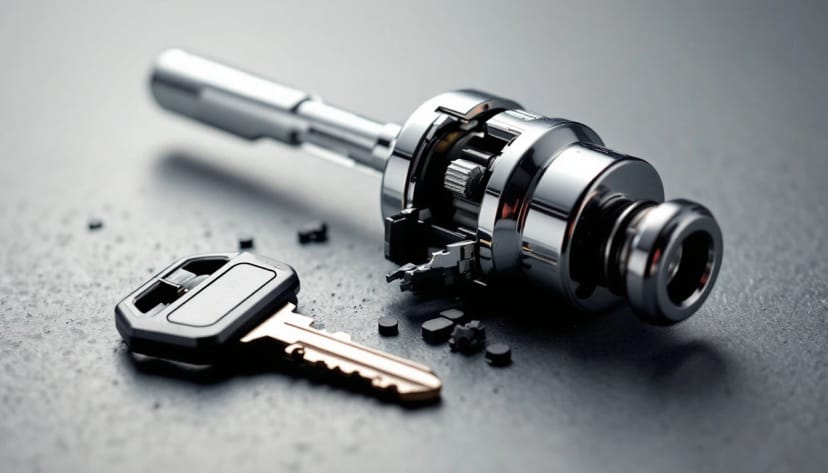
An ignition lock cylinder contains a stack of spring-loaded wafers. The cuts on your key blade push each wafer to a specific height. When every wafer sits flush with the cylinder wall, the plug is free to rotate. That is the entire mechanism.
Wear happens on both surfaces at once. The key blade loses material where it contacts the wafers, and the wafers lose material and spring tension where they contact the blade. For a while, the two worn parts stay matched — your worn key works fine in your worn cylinder even though neither is to spec. Then one of them crosses a threshold and rotation stops.
Which one crossed the threshold determines the repair:
- Key crossed first: a new key cut to the factory code restores correct wafer heights and the cylinder rotates again. This is key work, in the $120-$200 transponder band for a bladed Taurus or Flex, and it is genuinely a fix rather than a band-aid if the cylinder still has meat on it.
- Cylinder crossed first: the wafers are worn, chipped, or sticking. A geometrically perfect new key pushes worn wafers to the wrong heights, or pushes them and they do not spring back. No key solves this. The cylinder gets replaced and re-keyed so your existing key still works it.
An ALOA-credentialed automotive locksmith working Tarrant County put it this way:
On a Taurus I always cut a fresh code key before I sell anybody a cylinder, because about a third of the time the code key turns and the job is done for a fraction of the price. The other two thirds, the customer watches me try a brand new key in their ignition and it does exactly nothing, and now the cylinder replacement is not a sales pitch, it is something they just watched me prove. That test costs me ten minutes and it is the difference between a customer and a complaint.
The on-site repair sequence on a Taurus or Flex
When the diagnosis lands on the cylinder or the switch, here is what actually happens in your driveway, in order.
- Verify and document. Confirm the symptom, confirm ownership, note the odometer and the existing key condition. On a no-crank car the battery gets load-checked first, because low voltage produces symptoms that mimic a switch failure and replacing a switch will not fix a dying battery.
- Cut a factory-code test key. As above. Ten minutes that can end the job.
- Drop the column shrouds. Upper and lower plastic shrouds come off with the tilt column lowered. This exposes the lock housing, the cylinder, the electrical switch, and on some trims the transponder antenna ring.
- Release the cylinder. A healthy Ford cylinder releases with the key turned to the run or accessory position and a pin depressed through the release hole in the housing. This is the fork in the road: if the cylinder rotates, the job stays short. If it is seized and will not reach the release position, the housing has to be worked mechanically and the labor goes up.
- Replace or re-key. The replacement cylinder is re-keyed to your existing key wherever the wafer stack allows it, so you do not walk away with two different keys for one car. If it cannot be re-keyed, a new key is cut and programmed, and that is quoted separately.
- Electrical switch, if that was the fault. The switch block behind the cylinder unclips and unplugs. It is a straightforward swap once the shrouds are off, which is why bundling it with cylinder work when both are marginal is usually cheaper than two separate visits.
- Reassemble and function-test. All key positions, accessory power, crank, start, key release in Park, column lock engagement, and a scan for stored codes before the invoice is written.
The airbag caution matters here and is worth stating plainly: this work happens around the clockspring and the driver airbag circuit. A technician who starts yanking a steering wheel without disabling and discharging the restraint system is not someone to have working on your car.
Taurus and Flex ignition diagnostic matrix
One table, everything above compressed. Match your symptom to the row.
| Symptom | Most likely cause | Confirming test | Repair | Cost band | On-site time |
|---|---|---|---|---|---|
| Key will not enter fully | Debris or bent blade | Inspect blade, try spare key | Clean cylinder or cut new key | $120-$200 key work | 20-40 min |
| Key enters, will not rotate, wheel rocking frees it | Steering column lock pin binding | Rock wheel under light key pressure | Column lock service or lock plate repair | $150-$400 | 45-90 min |
| Key rotates only with heavy force and one exact wiggle | Worn cylinder wafers | Factory-code test key feels the same | Cylinder replacement, re-keyed to your key | $150-$400 | 45-90 min |
| Key rotates fully, dash stays dark | Failed electrical ignition switch | Check power at switch outputs | Ignition switch replacement | $150-$400 | 45-75 min |
| Key rotates, dash lights, no crank, no click | Electrical switch, relay, or range sensor | Voltage test at start circuit | Targeted component replacement | $150-$400 | 45-90 min |
| Strong crank, no start, theft light flashing | Immobilizer or key credential fault | Scan PATS codes | Key programming, not ignition work | $120-$450 key work | 30-75 min |
| Key will not release from Park | Shift interlock or cylinder wear | Push shifter firmly into Park | Interlock adjust or cylinder service | $150-$400 | 30-60 min |
Note the last row of key-work pricing in that table: those jobs sit in the key bands rather than the $150-$400 ignition repair band, because they are not ignition repairs at all. That distinction is exactly what the diagnosis is for.
The push-button trims are a different car
Taurus and Flex trims ordered with Intelligent Access and push-button start have no ignition lock cylinder. There is no key to turn, no wafer stack to wear, and no mechanical column release in the conventional sense.
When one of those will not start, the fault tree changes completely: fob battery, RF receiver, start button switch contacts, brake pedal position switch, and the immobilizer handshake. The most common real-world cause is the most boring one — a flat coin cell in the fob. Most Ford push-button vehicles let you hold the fob directly against the start button to start via backup inductive coupling, which is a free thirty-second test that tells you whether you have a battery problem or a vehicle problem.
If you press the button, the dash wakes, and the car reports that it cannot detect a key, that is a credential or receiver issue and belongs on the key-programming side of the house. Our ignition repair page covers the mechanical side, and the steering column lock repair page covers the specific case where the column lock rather than the cylinder is what is holding you hostage.
What this costs and why the range is wide
Ignition repair on these platforms runs $150-$400. That is a real range, not a hedge, and where you land inside it is driven by three variables:
- Which part failed. A re-keyable cylinder is the cheapest outcome. An electrical switch is mid-range. A seized cylinder that requires extended mechanical work on the housing is the top.
- Whether the cylinder can be re-keyed to your existing key. When it can, you avoid buying key work on top of ignition work. When it cannot, a new key is cut and programmed and that is priced separately in the $120-$200 transponder band.
- How much column disassembly is required. Shrouds off is routine. Working a seized lock housing is not, and it is the honest reason a technician will not commit to the bottom of the band sight unseen.
The comparison that matters is not our band against a dealer's parts price. It is total cost including getting there. A car that will not start does not drive to a service department, so the dealer path on a seized ignition includes a tow inside Tarrant County before any labor is billed. Mobile work removes that line item entirely because the tool comes to the car. AAA's driving cost research puts average annual ownership cost above $12,000, and the days a sedan spends sitting immobile in a service queue are days you are paying for a car you cannot use.
J.D. Power's Customer Service Index research consistently finds that time-in-shop is one of the strongest drivers of service satisfaction — which lines up with what we see on ignition calls, where the same-day driveway fix beats a four-day appointment on every measure the owner actually cares about.
Other Ford and GM ignition jobs worth reading
Ignition work is model-specific in ways that surprise people, and the neighboring guides are genuinely different jobs rather than the same article renamed. If you also run a compact Ford, Ford Focus ignition repair in Fort Worth covers a much tighter column and a different cylinder release. On the GM side, Chevrolet Impala ignition repair walks through a platform where the ignition and the anti-theft system are wired together far more tightly than Ford's, which changes the diagnostic order completely.
Before you authorize anyone to disassemble your steering column, verify who you are hiring. The FTC's guidance on hiring a locksmith exists because the phone-quote-versus-arrival-price gap in this trade is well documented. In Texas, locksmith companies and individual technicians are licensed through the Texas DPS Private Security Bureau — ask for the company license number and expect a straight answer. Credentialed automotive work is also governed by the NASTF Vehicle Security Professional registry and the Associated Locksmiths of America certification ladder, and per Bureau of Labor Statistics occupational data this is a small trade nationally, roughly 15,000 practitioners, which means the qualified operators in a metro this size are a knowable group.
One last piece of context on why these systems are built to be this stubborn: IIHS research on vehicle theft and NHTSA's anti-theft equipment guidance both document how much theft rates fell once immobilizers and hardened column locks became standard. The column lock that is currently refusing to release your key is the same hardware that keeps someone else from driving your Taurus away.
Frequently Asked Questions
Will a new key fix a Ford Taurus that will not turn in the ignition?
Only if the key is the worn part. A key and a cylinder wear against each other, so a fresh key cut to factory code sometimes engages worn wafers well enough to buy months of service. But if the wafers themselves are worn, chipped, or spring-bound, a perfect new key turns just as poorly as the old one. The honest test is a factory-code test key: if the new cut turns smoothly, the key was the problem. If it feels identical, the cylinder is the problem and no amount of key cutting fixes it.
What is the difference between the ignition lock cylinder and the ignition switch?
They are two parts stacked together. The lock cylinder is the mechanical piece your key enters, full of spring-loaded wafers that read the cut. Behind it sits the electrical ignition switch, a plastic block that rotates with the cylinder and closes the accessory, run, and start circuits. A worn cylinder means the key will not turn. A failed electrical switch means the key turns normally but the dash stays dark or the starter never engages. Different parts, different prices, different repairs.
My Taurus key turns but nothing happens. Is that the ignition?
It can be, but it is not the only candidate. If the key rotates fully to start and you get no crank and no click, the electrical ignition switch is a prime suspect, along with the starter relay, the transmission range sensor, and battery voltage. A technician verifies power at the switch outputs before anything is replaced. Replacing a good ignition switch to chase a bad relay is one of the most common wasted repairs on these cars.
Why does jiggling the steering wheel sometimes let the key turn?
Because the steering column lock pin is loaded against the lock plate. When the wheel is parked under side load, on a driveway crown, against a curb, or with the wheels turned, the pin binds and the cylinder cannot rotate. Rocking the wheel gently left and right while applying light key pressure unloads the pin. If that trick works every time, you have a column lock symptom rather than a worn cylinder, and forcing the key is the fastest way to snap a blade off inside the lock.
Can you repair a Taurus or Flex ignition at my house?
Most of the time, yes. Lock cylinder replacement and re-keying to your existing key is a normal driveway job, and so is electrical switch replacement on most trims. The exception is a seized cylinder that will not rotate to the service release position, which means the column shroud comes off and sometimes the lock housing has to be worked mechanically. That is still mobile work, it just takes longer. A technician tells you which case you are in before touching anything.
How much does Ford Taurus or Flex ignition repair cost in Fort Worth?
Ignition repair runs $150-$400 depending on which part failed and how much column disassembly it takes. A lock cylinder replaced and re-keyed to your existing key sits in the lower half of that band. An electrical ignition switch replacement sits in the middle. A seized cylinder requiring extended column work sits at the top. If a new key has to be originated at the same time, that is priced separately as key work, and a technician quotes both before starting.
Does my push-button Taurus or Flex have an ignition cylinder at all?
No. Trims equipped with Intelligent Access and push-button start have no mechanical ignition lock in the column, so there is nothing to wear out or seize. When one of those cars will not start, the diagnosis moves to the start button itself, the brake pedal switch, the RF receiver, fob battery, and the immobilizer handshake. It is a completely different repair path from a keyed car, which is why the technician asks whether you turn a key or press a button before quoting anything.
References
- NHTSA — Anti-Theft Systems — federal guidance on immobilizers and vehicle anti-theft equipment.
- IIHS — Vehicle Theft — research on theft rates before and after immobilizer adoption.
- FTC Consumer Advice — Hiring a Locksmith — verifying a locksmith before authorizing work.
- NASTF Vehicle Security Professional Registry — credentialed access to OEM vehicle security data.
- Associated Locksmiths of America — certification ladder including the Master Automotive Locksmith credential.
- AAA — Your Driving Costs — annual vehicle ownership cost research.
- J.D. Power — Customer Service Index — service department satisfaction and time-in-shop research.
- U.S. Bureau of Labor Statistics — Locksmiths and Safe Repairers (49-9094) — national occupational employment data.
Related Pages
- Ignition Repair Fort Worth
- Steering Column Lock Repair
- Ford Brand Page
- Ford PATS Key Programming
- Car Key Replacement Fort Worth
- Transponder Key Programming
Book Taurus or Flex ignition repair in Fort Worth
We are mobile only, which is the whole point on an ignition job — a car that will not turn over also will not drive itself to a shop, and we would rather bring the tools to your driveway than have you pay a tow to move a car that only needs a cylinder. Tell us the year, the trim, and whether you turn a key or press a button, and we will tell you what we expect to find before we roll.
Call or text 817-842-1256, Mon-Sun 8AM-8PM, across Fort Worth and Tarrant County. You can also reach us through the contact page.