The worst-case scenario is still a routine job
Losing every key to your vehicle — no spare in a drawer, no backup on a hook by the door — feels like a dead end. It isn't. Replacing a car key with no original is a well-understood procedure that a credentialed mobile automotive locksmith performs routinely, and as of July 2026 it's almost always done on-site in Fort Worth without a tow to the dealer.
This guide explains exactly how all-keys-lost programming works: the two technical paths (onboard and EEPROM), the proof of ownership you'll need before anyone makes a key, why the job costs more than a duplicate, how it varies by make, and why you almost never need to tow the car. The aim is to replace panic with a clear picture of what's about to happen and what it should cost.
Fort Worth Car Keys is a mobile operation — we bring the tooling to your vehicle. Reach a technician at 817-842-1256 or contact@fortworthcarkeys.com.
What "all keys lost" actually means
"All keys lost" (AKL in the trade) means the vehicle has zero working keys. It's a specific technical state, not just an inconvenience, because it changes how the job has to be done.
When you have a working key, a locksmith reads the immobilizer's security data straight from that key and adds a new one — fast and inexpensive. With no working key, there's nothing to read from. The security data that authorizes a key to start the engine has to be recovered from the vehicle's own electronic modules and then used to enroll freshly cut keys. That recovery step is the entire difference between a spare and an AKL job.
Per the National Highway Traffic Safety Administration's anti-theft systems guidance and Federal Motor Vehicle Safety Standard 114, immobilizer systems are engineered to make exactly this hard — unauthorized key generation is what they're built to prevent. The security that protects your car from thieves is the same reason recovering access with no key takes more work. That's not a markup; it's the nature of the job.
The two technical paths: onboard vs EEPROM
There are two main ways a locksmith recovers the security data and enrolls new keys with no original. A skilled technician chooses the least invasive method your specific vehicle supports.
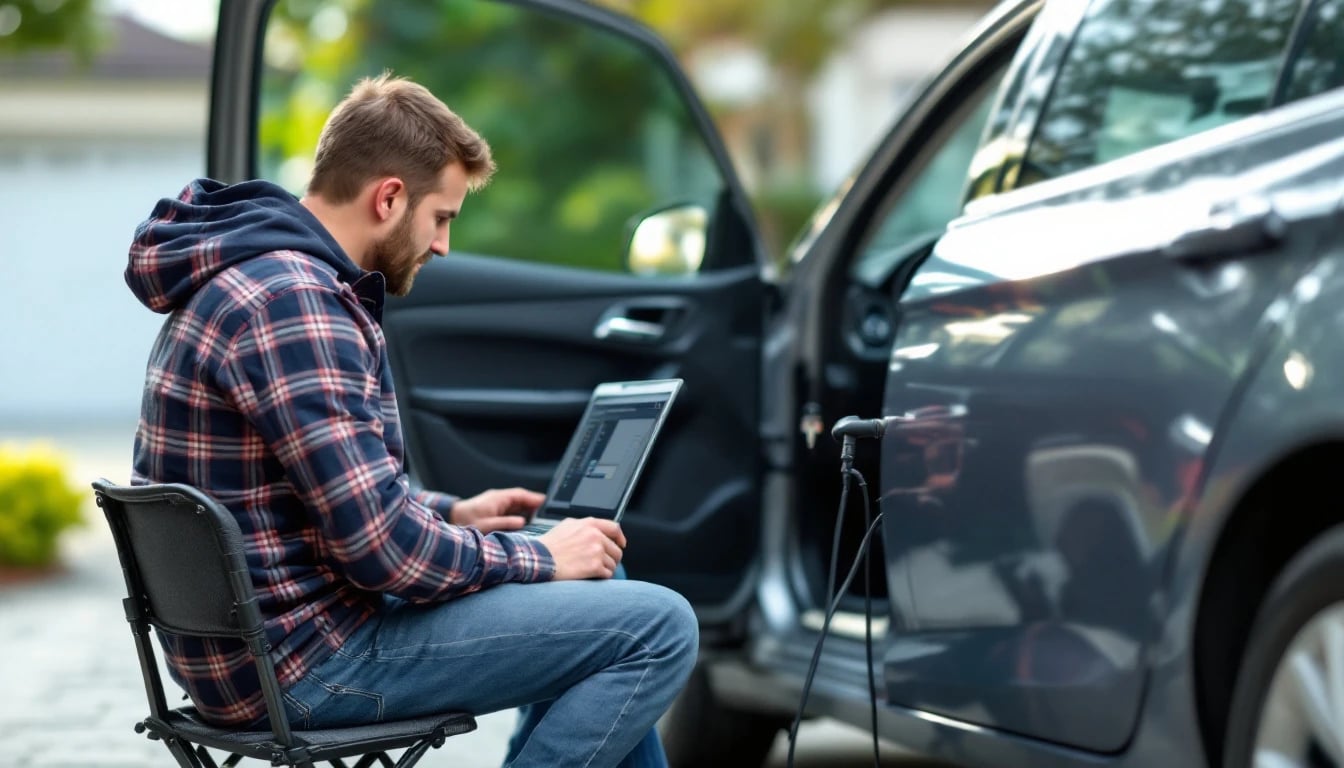
Onboard programming. Many platforms allow a new key to be enrolled through the vehicle's diagnostic (OBD) port using the manufacturer's supported all-keys-lost procedure, sometimes combined with data retrieved through the NASTF Vehicle Security Professional registry. This is the cleaner method — no modules come apart, and the work happens through the car's own diagnostic system. When a platform supports onboard AKL, it's the preferred route.
EEPROM programming. When onboard programming isn't possible with no working key, the technician recovers the security data directly from a memory chip (the EEPROM) inside one of the vehicle's modules — typically the immobilizer, BCM, or instrument cluster. The module is accessed, the chip is read on the bench, the key data is extracted, new keys are cut and programmed, and the module is reinstalled. It's more involved and takes longer, which is why EEPROM jobs sit toward the top of the price range.
Both methods end the same way: freshly cut blades enrolled into your immobilizer, tested to start the vehicle. For a deeper walk-through of the EEPROM route specifically, the all-keys-lost service page covers the on-site process, and the broader recovery playbook lives in the lost car keys service page.
Proof of ownership — the step that protects you
Before any key is cut, a credentialed locksmith verifies that you own the vehicle. This isn't friction — it's the single most important consumer protection in the trade, and an operator who skips it is one you should not hire.
What you'll need:
- Government-issued photo ID — a Texas driver's license is standard.
- One document tying you to the vehicle — the title, current registration, or an auto insurance card listing your name and the vehicle.
- Matching paperwork for edge cases — if the car is in a spouse's name, a shared insurance card or marriage certificate usually works; a company vehicle needs corporate authorization.
The reason this matters is obvious once you think about it: a locksmith who will make keys to any car without checking ownership is a locksmith who will make keys to your car for a thief. The verification step is exactly what stops that. Per the Federal Trade Commission's guidance on hiring a locksmith, a legitimate operator states the documentation requirement up front — and a credentialed technician will decline the job on the spot if ownership can't be shown. Treat that refusal as a sign of a professional, not an obstacle.
Why it costs more — and what "more" actually is
An all-keys-lost job costs more than a spare because it's genuinely more work: recovering security data with no key to read from, potentially opening a module for EEPROM access, and more programming time. That's the honest reason — not a surcharge for your bad day.
Here's the pricing in published Fort Worth bands. The comparison table shows the AKL job against the spare-key job it would have been if you'd had a working key, so you can see exactly what the missing key costs.
| Scenario | With a working key (spare) | All keys lost (no original) |
|---|---|---|
| Basic transponder (older domestic/Asian) | $120-$200 | $180-$450 |
| Smart / proximity fob (2015+ mass market) | $220-$500 | $180-$450 |
| European luxury (BMW, Mercedes, Audi, Porsche) | $350-$800 | $350-$800 |
| Extra key added in the same visit | ~$65 | ~$65 |
| Standard lockout (entry only, no key made) | $75-$200 | $75-$200 |
Two takeaways. First, on mass-market vehicles the AKL premium is real but bounded — $180-$450 covers most domestic and Asian platforms. Second, European luxury is where AKL is most expensive ($350-$800), because those immobilizer systems are the most involved. And note the "extra key in the same visit" row: once the technician has done the hard recovery work, adding a second key is often only around $65 — which is why you should always have a second key cut during an AKL visit. It converts a future AKL emergency back into a cheap spare.
For the record, a lockout ($75-$200) is a separate service — it gets you into a car you're locked out of but doesn't make a key. If you've lost all keys, you need AKL programming, not just entry.
Four numbers that frame the decision
A few statistics put the AKL job in perspective. First, the price spread: AKL runs $180-$450 on mass-market platforms versus $120-$500 for a spare — the missing key is the difference. Second, the same-visit second key at around $65 is the cheapest key you'll buy all day. Third, per AAA's Your Driving Costs research, the average vehicle covers roughly 10,000-14,000 miles a year, so the downtime from an unresolved AKL event is a genuine cost, not a rounding error. Fourth, per the Insurance Institute for Highway Safety, the personal vehicle is central enough to daily life that same-day, on-site resolution — which mobile AKL provides — is worth more than the sticker difference alone.
The practical read: resolve it once, on-site, and have a second key cut in the same visit so you never face the expensive column again.
You almost never need a tow
The most expensive mistake in an all-keys-lost situation is calling a tow truck to deliver the car to the dealer. That path stacks a towing charge plus a multi-day dealer wait plus dealer key pricing on top of each other — and it's almost always avoidable.
A mobile automotive locksmith performs AKL programming wherever the vehicle sits: your driveway, an apartment garage, a workplace lot, or a shopping center. The only genuine exceptions are (a) a handful of low-volume makes where OEM tooling truly isn't available to independents, or (b) an open recall or technical service bulletin that requires dealer-only programming. For the overwhelming majority of vehicles on Fort Worth roads, the job is done on-site with no tow.
Per the Federal Trade Commission's locksmith guidance, once a vehicle is at the dealer, the dealer controls the conversation and the price. Keeping the car where it is and bringing a mobile locksmith to it keeps you in control of both.
Per-make notes
All-keys-lost varies by manufacturer, and knowing roughly where your vehicle falls helps set expectations.
- Domestic (Ford, Chevrolet, Dodge, GMC, Jeep, Chrysler, Cadillac). Generally the quickest and least expensive AKL jobs, most in the $180-$450 band, often onboard-programmable. See the Ford and Chevrolet brand pages for platform notes.
- Asian mass market (Toyota, Honda, Nissan, Hyundai, Kia). Also typically in the $180-$450 band; newer encrypted platforms take longer to program but are routine for a NASTF-registered operator. See the Toyota and Honda brand pages.
- Luxury Japanese (Lexus, Acura, Infiniti). More involved than their mass-market siblings but still on-site work for a credentialed technician.
- European luxury (BMW, Mercedes, Audi, Porsche, Volkswagen). The most involved AKL jobs, sitting at the top of the range ($350-$800), often requiring EEPROM procedures or registry data access. See the BMW and Mercedes-Benz brand pages.
- Land Rover / Jaguar. Among the more complex platforms; a NASTF-registered operator handles most on-site, but expect the longer end of the time estimates.
In every case, the technician confirms the exact method and price for your specific make and model year before starting work.
Credentials — who should do all-keys-lost work
Because AKL programming touches your vehicle's security core, credentials matter more here than on any other key job. In Texas, locksmith companies and technicians are licensed by the Texas Department of Public Safety Private Security Bureau — not a general contractor or trade board. Ask for the DPS license number; a legitimate operator provides it without hesitation, and you can verify it.
Two more credentials define a serious AKL operator. The Associated Locksmiths of America governs certifications including the Master Automotive Locksmith standard — the training that covers EEPROM and immobilizer work. The NASTF Vehicle Security Professional registry is the sanctioned channel for retrieving manufacturer security data on modern vehicles, which is what makes an independent locksmith a full substitute for the dealer on AKL jobs. An operator who holds these credentials can do onboard or EEPROM programming the same way a dealer can — at your location, on your schedule, and without a tow.
Field-operator perspective
All-keys-lost sounds scary to the customer, but for us it's a Tuesday. The two things I want people to know: bring your ID and your title or registration, because I'm not making keys to a car I can't confirm you own — and let me cut you a second key while I'm there. The hard part of the job is recovering the data with no key to read; once that's done, the second key is cheap. People who lose all their keys and then leave with only one just set themselves up to call me again.
— ALOA Master Automotive Locksmith (MAL), NASTF VSP-registered, DFW metroplex (anonymized)
A real-world example
Operator: Anonymized 2016 Toyota Highlander owner, all keys lost, Fort Worth workplace parking lot
Before:
- Owner's only two keys went missing during a move; neither turned up after a thorough search.
- The vehicle was parked at their workplace, undriveable.
- First instinct was to call a tow to the Toyota dealer, expecting a multi-day wait.
What changed: Before towing, the owner called a mobile operator. Over the phone they got a flat-rate range in the $180-$450 mass-market AKL band and an ETA. The technician arrived at the workplace lot, verified ownership (Texas driver's license plus current registration), performed onboard all-keys-lost programming on the Highlander's platform, cut two fresh blades from the VIN, and enrolled both keys into the immobilizer — de-authorizing the missing keys in the process. A second key was included in the same visit per protocol.
Outcome:
- Vehicle driveable the same afternoon, in the same parking spot.
- Two working keys, both tested; the lost keys de-authorized so they can't start the car if found by someone else.
- No tow, no dealer appointment, no multi-day wait.
Net: The dealer-plus-tow path would have added a towing charge and a multi-day wait on top of the key cost, with the car sitting undriveable the whole time. The mobile AKL path resolved everything on-site the same day and left the owner with the redundancy — two keys — that prevents a repeat. The de-authorization step also closed the security gap the lost keys created.
The bottom line
Replacing a car key with no original in Fort Worth is a routine, on-site job — not a dead end. A credentialed mobile locksmith recovers your vehicle's security data through onboard or EEPROM programming, cuts fresh keys from your VIN, and enrolls them into the immobilizer, almost always without a tow. You'll need a photo ID and proof of ownership, because a professional won't make keys to a car they can't confirm you own — and that safeguard protects you.
As of July 2026, all-keys-lost runs $180-$450 on mass-market vehicles and $350-$800 on European luxury, with a second key in the same visit often around $65. Have that second key cut while the technician is there; it's the cheapest insurance against ever facing all-keys-lost again.
To get a firm quote for your make and year, call Fort Worth Car Keys at 817-842-1256, text the same number, or email contact@fortworthcarkeys.com. We're mobile and come to you.
Frequently Asked Questions
Can a locksmith make a car key with no original key in Fort Worth?
Yes. This is called all-keys-lost, and a credentialed mobile automotive locksmith handles it routinely. Instead of reading the security data from a working key, the technician pulls it from the vehicle's modules through onboard programming or, on some platforms, an EEPROM procedure, then cuts a fresh blade from your VIN and enrolls the new key into the immobilizer. It's done on-site — no tow to the dealer.
Why does all-keys-lost cost more than a spare key?
Because it's a fundamentally different job. With a working key, the technician copies existing security data quickly. With zero keys, that data has to be regenerated from the vehicle's own modules — more diagnostic time, more specialized tooling, and sometimes EEPROM work. As of July 2026, all-keys-lost runs $180-$450 on mass-market vehicles and $350-$800 on European luxury, versus $120-$500 for a spare cut from a working key.
What proof of ownership do I need for an all-keys-lost job?
A government-issued photo ID plus one document tying you to the vehicle: the title, current registration, or an insurance card listing your name and the vehicle. A credentialed locksmith will not make keys to a car without verifying ownership — that refusal protects you and every other vehicle owner. If the car is in a spouse's or company's name, bring the matching paperwork.
Do I need to tow my car to replace a key with no original?
Almost never. A mobile locksmith performs all-keys-lost programming wherever the vehicle sits — your driveway, a parking lot, or a workplace. A tow to the dealer is only necessary on a small number of low-volume makes where OEM tooling genuinely isn't available to independents, or when an open recall requires dealer-only programming. For the vast majority of vehicles, the job is done on-site.
How long does all-keys-lost programming take?
It depends on the platform. Older transponder systems can be done in 30-60 minutes. Modern encrypted immobilizers, EEPROM procedures, and European platforms can run 60-180 minutes or longer. The technician gives you an ETA and a time estimate when you call with your year, make, and model, and works entirely on-site.
Is onboard programming the same as EEPROM?
No. Onboard programming enrolls a new key through the vehicle's diagnostic port using the manufacturer's supported procedure — the cleaner method when a platform supports it with no working key. EEPROM programming reads the security data directly from a memory chip inside a module (removed and read on the bench, then reinstalled) when onboard isn't possible. A skilled locksmith uses the least invasive method your specific vehicle allows.
Will replacing all keys make my old lost keys stop working?
It can, and often should. During all-keys-lost programming the technician can re-enroll the immobilizer so that only the newly cut keys start the vehicle, de-authorizing any keys that are still missing. This matters if the keys were lost somewhere identifiable or stolen — it closes the security gap. Ask for this explicitly when you book the job.
References & external sources
- NHTSA — Anti-Theft Systems & FMVSS 114 — Federal guidance on immobilizer architecture that makes all-keys-lost recovery a distinct, more involved job.
- NASTF Vehicle Security Professional Registry — National Automotive Service Task Force channel for credentialed access to OEM security data used in onboard AKL programming.
- Federal Trade Commission — Hiring a Locksmith — Consumer guidance on ownership verification, flat-rate quotes, and avoiding the tow-to-dealer trap.
- Associated Locksmiths of America (ALOA) — Trade association governing certifications including the Master Automotive Locksmith standard covering EEPROM and immobilizer work.
- AAA — Your Driving Costs — Annual research on vehicle mileage and the cost of downtime.
- Insurance Institute for Highway Safety — Vehicle Choice — Data on the central role of the personal vehicle in daily mobility.