TL;DR — the first 30 minutes
If you've just lost your car keys in Fort Worth: (1) do a focused 15-minute search before committing to an all-keys-lost call — the savings between AKL ($350-$900) and "lost one key, have a spare" ($120-$300) are large enough to justify the search; (2) do not call a tow truck unless the dealership is genuinely the only path (it rarely is); (3) call a NASTF-registered mobile automotive locksmith, ask for a flat-rate quote range over the phone, and dispatch only after you have that range in writing or by text; (4) have ownership documents ready (ID + title or registration). The technician will need them.
Per Better Business Bureau locksmith scam research, the highest single-event consumer-protection risk in this trade is the bait-and-switch quote — a $19 over-the-phone "starting at" that becomes a $385 invoice after the technician arrives and the customer feels they have no choice but to pay. The fix is a pre-dispatch flat-rate range. Every honest operator will give one.
Step 1 — search before you spend
Before you commit to the locksmith call, run a 15-minute structured search. Pockets, bags, couch cushions, between the seats of the car, inside the car (look through windows — a key on the driver's seat is not the same problem as a key that's vanished). Coat checks, valet desks, and the freezer (yes — keys end up there).
The reason this matters: the price delta between "I have one working key, need a spare" and "I have zero working keys, need AKL" is typically 2-3× on most platforms. For a 2018 Honda Civic, a spare cuts at $120-$180; an all-keys-lost job runs $250-$400. For a 2020 BMW 5-series, a spare runs $300-$450; AKL on the FEM module is $640-$900. A focused 15-minute search has a roughly $100-$500 expected value depending on platform.
After 15 minutes, if the key is genuinely gone, move to step 2.
Step 2 — do not tow if a mobile locksmith can reach you
The single most expensive mistake in this scenario is calling a tow truck to deliver the vehicle to the dealership. That sequence: $150-$300 tow + 3-7 day dealer wait + $700-$1,800 at the dealer for keys.
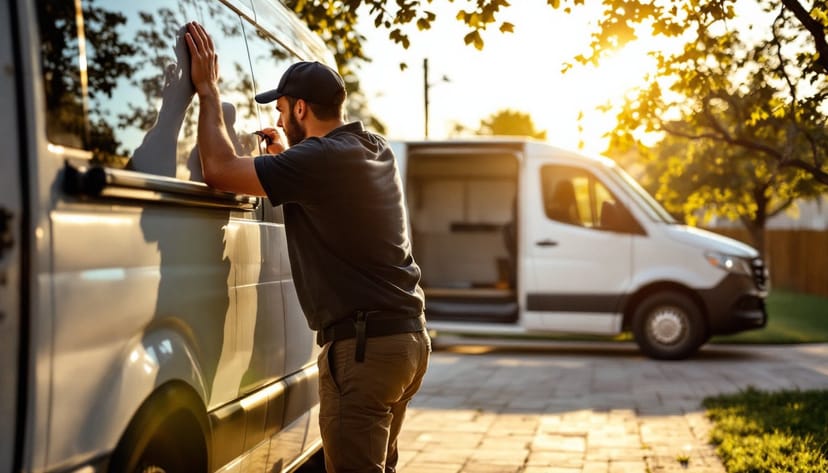
A mobile automotive locksmith with NASTF VSP registry access and OEM-level diagnostic tooling can program a new key, in your driveway or wherever your vehicle currently sits, in 30-180 minutes depending on the platform. The only time the dealer is truly the only path is when (a) the vehicle is a low-volume make where OEM tooling is genuinely unavailable to independents (Bentley, Rolls-Royce, some early Tesla Model S), or (b) there is an open recall or TSB that requires dealer-only programming.
Per J.D. Power's Customer Service Index study, dealer service department satisfaction scores have plateaued for the last five years as wait times have extended — and the cost premium has widened, not narrowed. For routine automotive locksmith work, mobile is faster, cheaper, and more flexible by every measurable dimension.
Step 3 — call a credentialed mobile operator
When you call, share: year, make, model, your current location, and whether you have any working key. The operator should respond with a flat-rate price range, an ETA window, and a request to confirm ownership-document availability.
As of August 2026, reasonable Fort Worth ranges:
- Lost one key, have a spare (basic transponder, domestic/Asian, 2005-2015): $120-$250
- Lost one key, have a spare (smart proximity fob, 2015-2024): $220-$500
- All keys lost, mass-market domestic/Asian: $275-$475
- All keys lost, luxury Japanese (Lexus, Acura, Infiniti): $375-$650
- All keys lost, BMW / Mercedes / Audi / VW: $450-$1,100
- All keys lost, Jaguar / Land Rover / Range Rover / Porsche: $550-$1,200
Per the Federal Trade Commission's published guidance on hiring a locksmith, a flat-rate-before-dispatch quote is the single most reliable scam filter. Operators who refuse to commit to a price range over the phone, or who quote $19 / $29 "starting at," should be deprioritized.
Step 4 — credential verification (60 seconds)
Before you authorize dispatch: (a) ask for the Texas DPS Private Security license number and look it up on the DPS public lookup while you're still on the phone; (b) ask whether the technician is ALOA-credentialed and NASTF VSP-registered — credentialed operators answer "yes" without hesitation and can give you their registry number if asked.
The check takes 60 seconds. It moves you from "I picked the first Google ad result" to "I picked a verifiable credentialed operator." Per BrightLocal's Local Consumer Review Survey 2024, 73% of consumers read reviews before hiring a local service business but only 27% verify credentials — closing that 46-point gap is the single highest-leverage protective move available to you.
Step 5 — when the technician arrives
Expect the technician to: (1) confirm the price range from the phone call before any work starts, (2) ask for your photo ID + title or current registration, (3) scan the vehicle for stored diagnostic trouble codes and immobilizer system status, (4) explain the work plan in plain language, (5) execute.
Skipping the diagnostic scan is a red flag. Many "I lost my key" scenarios turn out to be something else once a scan tool is plugged in — a weak fob battery, a failed antenna ring, a BCM/KVM/CAS/FEM module fault, or an anti-theft lockout from a previous failed programming attempt. The right protocol is to diagnose before cutting anything.
If after diagnosis the actual problem is module-level (e.g., a failing CAS module on a 2010 BMW 3-series), the operator should re-quote — module work is genuinely different from key replacement and the price should reflect it. Re-quoting is fine; surprise charges at the end of the job are not.
Step 6 — always request a second key in the same visit
When the technician programs your replacement, ask for a second key to be programmed in the same visit. The marginal cost is typically 30-40% of the first-key price — much cheaper than another full AKL call if you lose the new key in the future.
Operationally: keep one key in a secure home location (a fire safe is best; a magnetic case in a wheel well is not secure and is exactly where thieves look). Consider a Bluetooth tracker (AirTag, Tile) on your daily-carry fob — at $25-$30 the tracker turns a $500 AKL event into a recoverable 10-minute walk to the laundry basket.
What your replacement will cost by key type
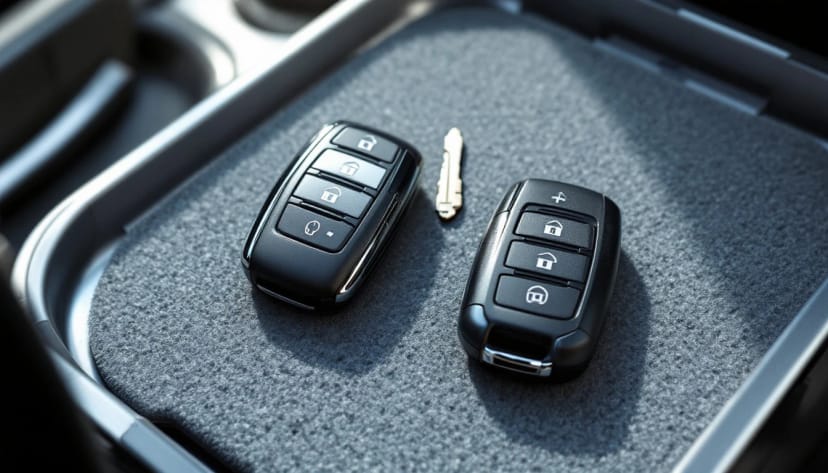
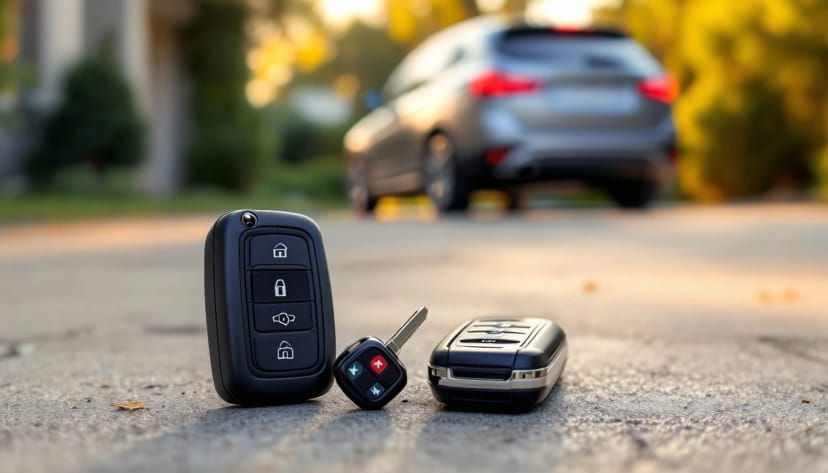
Before you call anyone, identify which of these four you actually have. It is the single biggest driver of your bill.
| Key type | How to recognise it | Fort Worth range | Typical on-site time |
|---|---|---|---|
| Basic transponder key | Metal blade, thick plastic head, no buttons | $120-$200 | 30-60 min |
| Remote-head key | Blade plus lock/unlock buttons in one unit | $120-$200 | 40-70 min |
| Smart / proximity fob | No blade in normal use, push-button start | $220-$500 | 60-120 min |
| European smart key | Prox fob on a BMW, Mercedes, Audi, Porsche, Jaguar or Land Rover | $350-$800 | 90-180 min |
Add roughly $65 if you order a second fob during the same visit. That is the cheapest key you will ever buy, because the technician is already on-site and the vehicle is already in a programming session.
Pricing context — why "$19 starting at" is the scam
Per the BBB locksmith scam advisory and the FTC's consumer protection guidance, the $19-$29 over-the-phone "starting at" quote is the most consistently reported scam pattern in the trade. The mechanism: the operator advertises an absurdly low base rate that gets you to commit to dispatch, then layers on "trip charges," "drill fees," "high-security cylinder fees," and "after-hours markups" once the technician arrives and you're emotionally invested.
The arithmetic of why the $19 base rate cannot be real: a single mobile locksmith van has approximate operating costs of $0.50-$0.70 per mile (per AAA's Your Driving Costs 2024 commercial-equivalent rates), plus technician labor at $35-$65 per hour all-in, plus key blank + transponder hardware ranging from $8-$120, plus liability insurance allocation. A 1-hour service call has roughly $80-$160 in baseline cost before any margin. A $19 advertised rate cannot cover that — so the markup happens after arrival, not on the phone.
A locksmith quoting a $120-$250 transponder-key range is doing the cost math correctly. A locksmith quoting $19 is doing a marketing trick.
What if I'm in a bad location? Impound, garage, mall
Mobile automotive locksmith work can be performed almost anywhere the technician can physically reach the OBD port — impound lots, apartment parking garages, airport long-term parking, mall lots, hospital parking decks.
Restrictions: some impound lots require pre-authorization from the lot operator before allowing service. Apartment complexes typically don't require authorization but can. Airport lots may charge an access fee for vans. Tell the operator the location when you call; an experienced dispatcher knows the protocols for the major DFW lots and can advise.
For vehicles inside locked private garages where the owner doesn't have a working garage opener, the protocol becomes more complex and may genuinely require a tow. These are rare.
Insurance — when it makes sense to file a claim
Per Texas Department of Insurance consumer guidance on auto coverage, comprehensive auto coverage on most policies includes some provision for key replacement, typically under "miscellaneous personal effects" or specific key-replacement endorsements. The deductible structure usually makes this only worthwhile for the most expensive AKL scenarios.
Rough math: if your deductible is $500 and the AKL job is $700, you net $200 after the claim — minus the potential rate increase at next renewal, which often eats the savings. For a $300 transponder-key job with a $500 deductible, filing makes no financial sense.
Where it does make sense: catastrophic key-replacement events on European luxury platforms where the bill runs $1,000+ and your deductible is $250-$500. Also: situations where the key loss is connected to a theft or break-in, where you'll be filing a comprehensive claim regardless. Ask your agent before authorizing work.
Preventing the next event
The reason all-keys-lost is so expensive is that the entire pricing structure of automotive locksmith work assumes you'll always have at least one working key — that lets the technician extract immobilizer security data from the working key rather than from the vehicle's internal modules. The moment you're down to zero working keys, the work moves from "duplicate this signal" to "regenerate this signal from scratch with OEM data access," and the price reflects it.
The prevention: always own two keys. Keep one in a fire safe at home. Put a Bluetooth tracker on the daily-carry. If you've already lost a fob once, the probability you'll lose another is meaningfully higher than the base rate — set up the second key + tracker permanently after the first event.
Per BLS Occupational Employment data on the locksmith trade, demand for automotive locksmith services has grown steadily as vehicle electronics complexity has increased — but the cost-control levers are entirely on the consumer side. A $30 tracker prevents the $500 event.
Field-operator perspective
The biggest mistake we see in DFW is the tow-to-dealer reflex. Customer calls a tow truck before they call us, the tow goes to the BMW dealer, the dealer quotes $1,400 and an 8-day wait. We could have done the same job in their driveway in 90 minutes for $640. The tow itself is unrecoverable money — once the car is at the dealer, the dealership controls the conversation.
— ALOA Master Automotive Locksmith (MAL), NASTF VSP-registered, 14 years experience, DFW metroplex (anonymized)
A real-world example
Operator: Anonymized 2019 Toyota Camry owner, Sundance Square parking garage, single-key-lost scenario
Before:
- Customer lost only working key sometime during a 4-hour downtown visit; vehicle was on Level 3 of a Sundance Square garage.
- Spent 25 minutes retracing steps — no recovery.
- First call was to Toyota dealer service: $610 + $185 tow quoted, 4-day wait for the new key to arrive.
What changed: Customer called a NASTF-registered mobile operator. Flat-rate phone quote: $295-$345 for AKL programming on the 8A-encryption Camry platform. Technician arrived in 32 minutes, verified ownership in the garage (TX DL + registration), executed AKL programming in 47 minutes on-site, programmed a second key during the same visit per protocol.
Outcome:
- Final invoice: $385 ($295 first key + $90 spare). No tow. No dealer wait.
- Customer drove out of the garage 79 minutes after the initial locksmith call.
- Total savings vs. dealer + tow path: $410 hard cost + 4 days of work-impact.
- Spare key now stored in customer's home safe.
Net: The dealer-path total economic cost would have been roughly $795 hard plus 4 days of rideshare / coworker rides, which per AAA driving-cost averages runs another $150-$280 in indirect costs. The mobile path total cost was $385 with zero downtime — a ~$560 net savings on an event that resolved the same day.
Frequently Asked Questions
How long does it take a mobile locksmith to program a new key in Fort Worth?
Pre-2005 vehicles with simple transponder systems: 20-45 minutes. 2005-2015 mass-market platforms (Toyota DST40, Honda, Ford 4D63): 30-60 minutes. Newer encrypted systems (Toyota 8A, BMW FEM/EWS, Mercedes FBS3/FBS4, VW MQB): 60-180 minutes. Range Rover BCM coding and certain Porsche immobilizer-5 jobs can run longer.
What documents do I need when the locksmith arrives?
Government-issued photo ID (Texas driver's license is standard), plus one of: vehicle title, current registration, or auto insurance card listing your name and the vehicle. If the vehicle is in a spouse's name, a marriage certificate or shared insurance card usually works. Company vehicles require corporate authorization paperwork. A credentialed operator will refuse the job without ownership verification — this is a feature, not friction.
Can the locksmith come to me if I'm in an impound lot?
Usually yes. Most DFW impound lots allow mobile locksmith access with vehicle-owner authorization. The mechanics: you call the locksmith, they call the lot to confirm access, the lot logs the entry. Some lots add an access fee. Apartment garages and mall parking decks rarely require pre-authorization. Tell the operator the exact location when you call so they can confirm access policy before dispatch.
Will my comprehensive insurance pay for key replacement?
Sometimes. Per Texas Department of Insurance guidance, comprehensive auto policies often include key replacement under "miscellaneous personal effects" or specific endorsements — but the deductible (typically $250-$1,000) usually makes filing only worthwhile for the most expensive AKL scenarios on luxury vehicles. Ask your agent before authorizing work; rate-increase exposure at next renewal can eat the savings.
What is "NASTF VSP" and why does it matter for my locksmith?
NASTF stands for National Automotive Service Task Force. Its Vehicle Security Professional (VSP) registry is the legitimate channel for an independent locksmith to retrieve VIN-keyed security data from vehicle manufacturers — the data needed to program keys for modern immobilizer-equipped vehicles. A NASTF-registered locksmith can work on most makes the same way a dealer can. A non-registered operator either skips this work entirely or runs it gray-market, which is a regulatory exposure for them and a quality risk for you.
How much does it cost to lose ALL keys versus losing one?
Roughly 2-3× difference on most platforms. Domestic/Asian mass-market: $120-$250 spare vs $275-$475 AKL. Luxury Japanese: $200-$350 spare vs $375-$650 AKL. European luxury (BMW, Mercedes, Audi, VW): $300-$500 spare vs $450-$1,100 AKL. Jaguar / Land Rover / Porsche: $400-$650 spare vs $550-$1,200 AKL. The math is why a 15-minute focused search before calling has high expected value.
References & external sources
- Better Business Bureau — Locksmith Scam Advisory — BBB consumer protection guidance on locksmith bait-and-switch operators.
- FTC Consumer Advice — Hiring a Locksmith — Federal Trade Commission guidance on verifying locksmith legitimacy before service.
- Texas Department of Public Safety — Private Security Licensing — Texas locksmith company + individual licensing requirements.
- NASTF Vehicle Security Professional (VSP) Registry — National Automotive Service Task Force registry for credentialed access to OEM security data.
- Associated Locksmiths of America (ALOA) — Trade association governing locksmith certifications including the Master Automotive Locksmith (MAL) credential.
- J.D. Power — Customer Service Index — Annual study of dealership service department satisfaction and cost.
- AAA — Your Driving Costs 2024 — Annual ownership cost study including unscheduled maintenance projections.
- BrightLocal — Local Consumer Review Survey 2024 — Annual research on how consumers find + evaluate local service businesses.
- Texas Department of Insurance — Auto Insurance Coverage Types — TDI consumer guide to comprehensive coverage and key-replacement claims.
- U.S. Bureau of Labor Statistics — Occupational Employment and Wages, Locksmiths (49-9094) — BLS OEWS national wage + employment data for locksmith occupation.
Related Pages
- Lost Car Keys Service Page
- Car Key Replacement Cost Guide
- European Car Locksmith
- 24-Hour Emergency Locksmith
- Contact for a Firm Quote
Talk to a technician about your lost car keys
Every vehicle is different, and the fastest way to a real number is a short call with the VIN in front of you. We will tell you the band, the realistic time on site, and anything about your specific car that changes either.
Call or text 817-842-1256, Mon-Sun 8AM-8PM. We are fully mobile across Fort Worth and Tarrant County, or reach us through the contact page.