TL;DR — CR-V spare key in one screen
The Honda CR-V is everywhere in Tarrant County, and a striking share of them are running on exactly one key. Here is the compressed case for fixing that this month.
- RW generation (2017-2022) — Smart Entry proximity fobs commonly in the
KR5V2Xfamily, push-button start, HON66 emergency blade inside the fob. - RT generation (2023-2025) — newer platform, newer fob part numbers including the
KR5V44family. Not interchangeable with RW hardware. - Immobilizer — Honda's system, coordinated through the vehicle's body electrical management (the MICU on Honda platforms), validates the fob credential before the engine is released to start.
- The two-key quirk — some Honda programming paths clear the accepted-key table and re-register only the fobs physically present. Bring every fob you own to the appointment.
Fort Worth pricing, as of July 2026: a CR-V Smart Entry prox sits in the $220-$500 smart-key band. All-keys-lost sits in the $180-$450 lost-fob band with a longer procedure and mandatory ownership verification. An extra fob added during another job is roughly $65.
Call 817-842-1256. Mobile-only, 8AM to 8PM, seven days a week.
Why so many CR-Vs are one-key households
The CR-V has been a top-five seller in the compact crossover segment for the better part of two decades, and North Texas buys crossovers at a rate well above the national mix. That gives us a large enough sample to see the pattern clearly, and the pattern is not about carelessness.
A CR-V fob works flawlessly, every day, for years. Nothing about the ownership experience prompts you to think about redundancy. Then one of three things happens:
- The car changes hands and only one fob comes with it. Used-car transactions are the single largest source of one-key households we see.
- The spare goes into a drawer during a move, a renovation, or a household reshuffle, and quietly stops being findable.
- The only fob is lost — a storm drain, a washing machine, a jacket pocket that went to a donation bin.
By the time the phone rings, the cheap version of the job is no longer available. That is the entire dynamic, and it repeats on nearly every all-keys-lost call we take.
Generation map: RW versus RT
RW CR-V (2017-2022)
The fifth-generation CR-V launched for 2017 on Honda's compact global platform.
- Fob: Smart Entry proximity, commonly in the
KR5V2Xfamily. Button count varies by trim — lock, unlock, panic, and on higher trims remote engine start and power tailgate. - Start system: push-button start on Smart Entry trims. Lower trims in the early years could still be found with a turn-key ignition and a conventional chipped key, which is a completely different parts list. Confirm before dispatch.
- Emergency blade: HON66 profile insert key stored inside the fob body, released by a slide latch.
- Immobilizer: Honda's credential validation, coordinated through the body electrical management system.
The 2020 refresh brought trim and equipment changes; the key architecture stayed in the same family, but model year still drives parts selection.
RT CR-V (2023-2025)
The sixth-generation CR-V arrived for 2023 with a new body, new interior, and updated electrical architecture.
- Fob: newer Smart Entry hardware including the
KR5V44family and related part numbers. Different case, different internals. - Start system: push-button start across the Smart Entry range.
- Emergency blade: still HON66, still inside the fob.
- Immobilizer: revised handling with a slightly longer security session in practice.
RW and RT fobs are not interchangeable. Neither is the case shape a reliable identifier — aftermarket listings routinely muddle the two. The FCC identifier printed on the back of your existing fob is the ground truth. Photograph it and send it with your quote request; that one photo eliminates the most common cause of a second visit.
What is actually inside a CR-V Smart Entry fob
Owners often use "key," "fob," and "transponder key" as if they were the same object. On a modern Honda they describe genuinely different hardware, and the difference decides what a replacement costs. Our plain-language breakdown of transponder key vs key fob covers the distinction in full, but the short version is that a Smart Entry fob contains four independent systems:
- RF remote transmitter — lock, unlock, panic, remote start, tailgate at range. Battery-powered.
- Low-frequency passive transponder — the part that makes touch-to-unlock at the door handle and push-button start work.
- Immobilizer credential — the cryptographic element the vehicle validates before permitting the engine to run.
- HON66 emergency blade — the physical door key inside the shell.
These fail independently, which is why a diagnostic step comes before a parts sale. A fob with a flat coin cell has a perfectly healthy immobilizer credential. A fob that went through the wash may have a good blade and dead everything else. Selling a $500 fob to fix a $4 battery problem is the most common avoidable expense on this platform, and it is entirely preventable with five minutes of checking.
The HON66 blade, and why it matters more than owners think
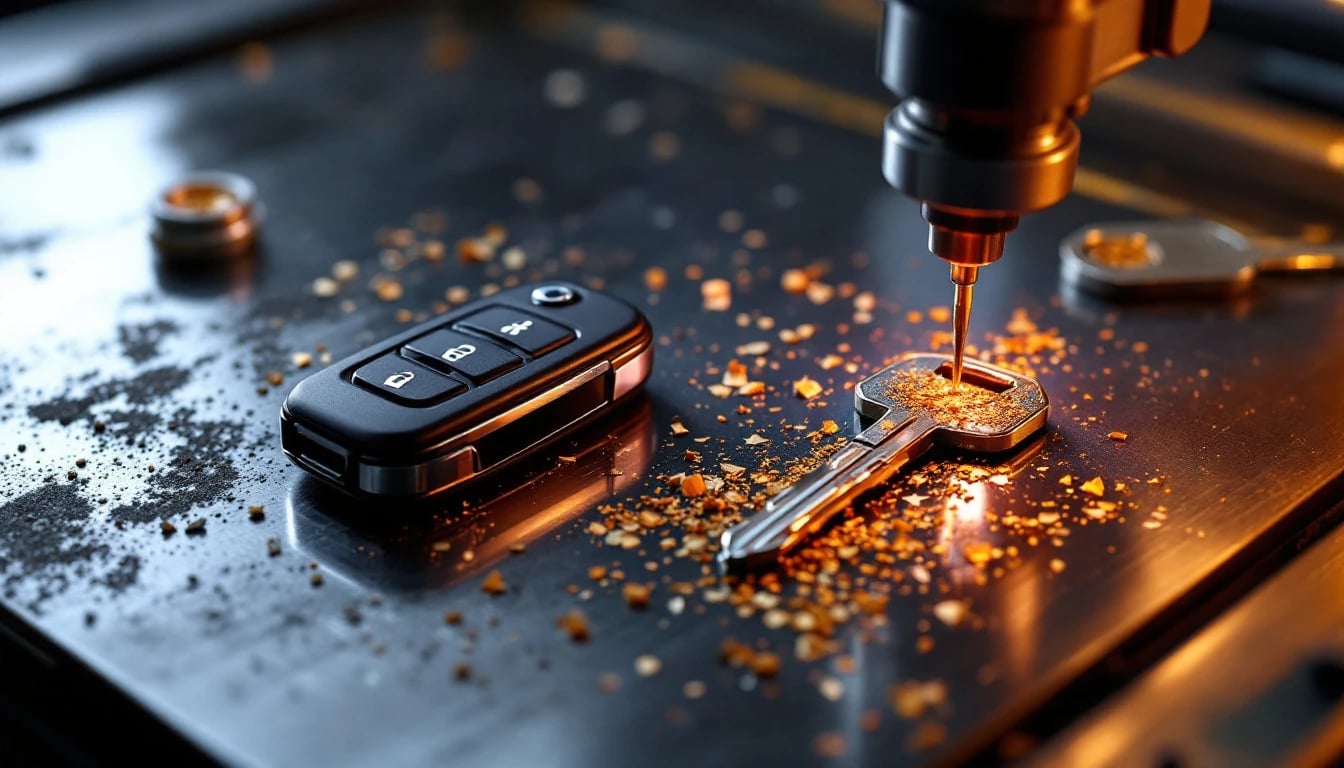
HON66 is Honda's high-security blade profile: a laser-cut pattern milled into the flat faces of the blade rather than the edges. It is stronger than a traditional edge-cut key, harder to pick, and considerably harder to duplicate without proper equipment.
For a Smart Entry CR-V owner, three practical consequences follow:
- The blade is your only way into the cabin when the electronics are dead or the fob is gone. If your emergency insert key is missing from the fob, you have quietly lost your non-destructive entry path.
- Cutting one requires code access and the right machine. A hardware-store key duplicator cannot produce a HON66. This is code-cutting work from the VIN-derived key code, done on site.
- The door cylinder is hidden. On most CR-V trims the driver-door lock cylinder sits behind a small trim cap on the handle. Owners often do not know it exists until we pop the cap.
Check right now whether your fob still has its blade. It takes ten seconds and it is the single cheapest piece of preventive maintenance on the vehicle.
The Honda two-key behavior that catches owners out
This is the detail most worth reading twice.
Depending on model year and the specific path the vehicle's security system takes during a session, a Honda programming procedure may clear the accepted-key table and re-register only the fobs physically present. That behavior is not a bug. It is a deliberate security design: if the vehicle is going to trust a new credential, it re-establishes the whole trust list from scratch.
The consequences for you:
- A fob left at home stops working. If you show up with one fob and leave the second in a kitchen drawer, that second fob may be erased and will need to be re-added — a second appointment and a second charge.
- A "dead" fob may not actually be dead. Owners routinely leave behind a fob they assume is finished when it just needs a battery. Bring it. If its credential is intact it can be re-registered alongside the new one at essentially no incremental cost.
- Two-fob sessions are usually cheaper than two one-fob sessions. The math is not subtle.
The rule: bring every fob you own to a Honda appointment, working or not. No exceptions, no judgment calls.
Spare now versus rescue later
| Scenario | On-site time | Our Fort Worth range | Ownership docs | Risk to existing fobs |
|---|---|---|---|---|
| Spare added, working fob present (RW) | 25-45 min | $220-$500 smart-key band | Registration recommended | Absent fobs may be cleared |
| Spare added, working fob present (RT) | 30-50 min | $220-$500 smart-key band | Registration recommended | Absent fobs may be cleared |
| Second fob added during another job | +10-20 min | ~$65 extra fob | Same as parent job | None if present |
| Lost one fob, one still works | 30-55 min | $180-$450 lost-fob band | Registration recommended | Absent fobs may be cleared |
| All keys lost, RW | 50-90 min | $180-$450 lost-fob band | Title or registration plus photo ID, mandatory | Full table rebuild |
| All keys lost, RT | 60-100 min | $180-$450 lost-fob band | Title or registration plus photo ID, mandatory | Full table rebuild |
| Emergency blade cut only, fob still works | 15-30 min | Quoted on request | Registration recommended | None |
| Suspected key fault, actually vehicle-side | 30-60 min diagnostic | Diagnostic-led, not a key sale | Standard | None |
Read the first three rows against the two all-keys-lost rows. Shorter, cheaper, no document scramble, no rebuild of the trust list. That is the whole argument, and it expires the moment your last fob goes missing.
All keys lost on a CR-V
If you are already past the spare decision, here is the honest shape of the job.
Proof of ownership comes first. Current title or current registration in your name, plus a matching government-issued photo ID, verified and recorded before any tool touches the diagnostic port. This is not paperwork theater — it is the load-bearing wall of legitimate automotive locksmithing. The FTC's guidance on hiring a locksmith makes the identical point from the consumer's side of the transaction. An operator who waives it for you will waive it for whoever wants your car next.
Non-destructive entry. A fresh HON66 blade cut to the VIN-derived key code opens the driver door cylinder. No slim jims, no drilled cylinders, no torn weatherstripping.
Security session and immobilizer write. Opened at the diagnostic port using tooling authenticated through the NASTF Vehicle Security Professional registry. On an all-keys-lost the table is rebuilt from scratch, which is precisely why every fob you own needs to be in the car.
Registration and function test. Passive entry at every door, tailgate, panic, remote start where equipped, push-button start, and the blade in the door cylinder.
Realistic on-site time: 50 to 100 minutes. Our all-keys-lost service page carries the full documentation checklist, and lost car keys covers the urgent version of the call.
Things that look like key problems and are not
Before you authorize a new fob, rule these out in order:
- CR2032 coin cell. Four dollars, sixty seconds, available at every pharmacy in Fort Worth. Range degrades first, then passive entry gets unreliable, then start fails.
- Weak 12V battery. A CR-V with a marginal battery throws key-detection messages that vanish the moment it is charged. Very common in the Texas summer, where heat kills batteries faster than cold does.
- Antenna fault. If passive entry works at the driver door but not the passenger door, that is vehicle-side hardware, not the fob.
- Water intrusion. A fob that has been swimming may work intermittently for weeks before failing entirely. Intermittent is the tell.
- RF interference. Wireless phone chargers, dashcam power taps, and some aftermarket lighting generate enough noise to disrupt low-frequency coupling near the fob. If the trouble started right after an accessory install, that is your lead.
- Body electrical fault. The signature is both fobs failing in the same week. Two independent fobs do not die together.
Our no key detected and immobilizer page walks the triage order, and key fob programming covers straightforward pairing work.
If you own more than one Honda, the family logic carries across with different part numbers — see our Honda Odyssey key fob programming guide for the minivan side of the lineup and how its sliding-door and power-tailgate functions change the fob spec.
Mobile versus dealership in Fort Worth
The dealership is the right call when the CR-V is already there for warranty work, when an open technical service bulletin touches the immobilizer or body electrical system, or when a module genuinely needs OEM replacement and coding. That is a real but narrow set of circumstances.
For a spare key, mobile wins outright:
- No tow on an all-keys-lost. This is the decisive one. A dealer visit with no working key starts with a tow invoice before anyone opens the hood.
- No parts queue. As of July 2026 we stock the common RW and RT Smart Entry blanks, which means same-day rather than a wait in a dealer parts pipeline.
- We come to the car. Driveway, apartment garage, office lot, or the parking area at a Trinity Trails access point — it does not matter where the vehicle is sitting.
- Flat-rate quoting. You get a range before dispatch, not a number after the work.
AAA's annual driving-cost research is a fair proxy for the hidden side of the dealer path: rental days and lost time never appear on the repair invoice, but they are real money out of the same pocket.
Coverage runs across Tarrant County seven days a week — Fort Worth, Arlington, Bedford, Hurst, Keller, and North Richland Hills.
Field-operator perspective
The Honda mistake I see constantly is the customer who brings me one fob and tells me the other one is at the house because it stopped working last year. Half the time that fob just needs a battery, and if it had been in the car it gets re-registered for basically nothing. Instead they leave it home, the table gets rebuilt without it, and now it is genuinely dead. Bring every fob. I do not care how dead you think it is.
— a NASTF-registered Fort Worth automotive locksmith (anonymized)
Verification checklist before you book
- They ask for the FCC identifier on your existing fob. KR5V2X versus KR5V44 versus something else entirely.
- They ask which generation and whether you have Smart Entry or a turn-key ignition. These are different parts lists.
- They tell you to bring every fob. An operator who does not warn you about the table rebuild has not thought about your keys.
- They quote a flat range before dispatch. Not a starting-at number.
- They are licensed under the Texas Department of Public Safety Private Security Program. Texas regulates locksmith companies through DPS. Ask for the company license number.
- They require ownership documents on an all-keys-lost.
- They issue a written invoice with parts, labor, license number, and warranty terms.
The Associated Locksmiths of America maintains the credentialing framework behind the Master Automotive Locksmith designation. NHTSA's anti-theft equipment guidance explains the federal framework immobilizers operate under, and the IIHS's vehicle-theft research documents why manufacturers made them this hard to duplicate in the first place. The Federal Trade Commission is the authority if a quoted price changes after arrival.
Book the spare while it is still the easy job
Fort Worth Car Keys is mobile-only and works 8AM to 8PM, seven days a week. Call 817-842-1256 or email contact@fortworthcarkeys.com with your model year and a photo of the back of your existing fob, and we will quote a flat range before we roll.
Start at spare car key, or read Honda and Acura key programming for the full platform detail. Cost questions are answered on our car key replacement cost page.
Frequently Asked Questions
How much does a Honda CR-V spare key cost in Fort Worth?
A CR-V Smart Entry proximity fob sits in our 220 to 500 dollar smart-key band, positioned by generation, fob part number, and button count. The same fob after all keys are lost falls into the 180 to 450 dollar lost-fob band with a longer procedure and mandatory ownership verification. If a second fob is added during the same visit as other work, the additional fob is roughly 65 dollars, which is the cheapest key you will ever put on a CR-V.
Which Smart Entry fob does my CR-V use?
The fifth-generation RW CR-V from 2017 through 2022 commonly uses the KR5V2X family of Smart Entry fobs, with variations by trim and by the number of buttons including remote start and power tailgate. The sixth-generation RT CR-V from 2023 onward moved to newer part numbers including the KR5V44 family. The two are not interchangeable. The FCC identifier printed on the back of your existing fob is the reliable answer, not the case shape.
Do Hondas require two keys to be programmed at once?
Some Honda programming procedures behave this way. Depending on model year and the path the vehicle takes, the session may clear the accepted-key table and re-register only the fobs physically present. On those procedures a single fob presented alone becomes the only key the vehicle will accept, and anything left at home stops working. The safe rule for every Honda appointment is to bring every fob you own, including ones you believe are already dead.
What is a HON66 blade and where is it on a CR-V?
HON66 is the Honda key blade profile used on modern Honda and Acura vehicles, a high-security laser-cut pattern with the milling on the flat faces of the blade rather than the edges. On a Smart Entry CR-V the blade lives inside the fob as an emergency insert key, released by a small latch. It opens the driver door through a cylinder hidden behind a cap on the handle. It does not start the vehicle because the CR-V uses push-button start.
Can a CR-V be programmed with no working key at all?
Yes. All-keys-lost on a CR-V is standard mobile work for an operator with current Honda tooling. The sequence is emergency blade cut from the key code for non-destructive entry, then a security session at the diagnostic port, then immobilizer write and registration of every fob the vehicle should accept. Ownership must be documented before any of it begins: current title or registration in your name plus a matching government photo ID.
Why does my CR-V show a key error when the fob is in my pocket?
Start with the CR2032 coin cell, a four dollar part that causes exactly this symptom as it fades. After that the usual suspects are a weak 12V battery, a failed interior or door-handle antenna, water damage inside the fob, or radio interference from a wireless charger or dashcam wiring. If both of your fobs fail in the same week, stop shopping for keys, because two independent fobs do not die together and the problem is on the vehicle side.
How long does a CR-V spare key take in a Fort Worth driveway?
A spare-key add with a working fob present typically runs 25 to 50 minutes on site including cutting and testing the HON66 emergency blade. An all-keys-lost usually runs 50 to 100 minutes depending on generation and how cleanly the security session opens. Travel across Tarrant County is separate. We are mobile-only and operate 8AM to 8PM seven days a week, so evenings and weekends are normal appointment slots rather than emergency premiums.
References
- NHTSA — Anti-Theft Systems — Federal framework for immobilizer and starting-system protections.
- IIHS — Vehicle Theft — Insurance Institute for Highway Safety research on immobilizer effectiveness and theft trends.
- NASTF Vehicle Security Professional Registry — Credentialed access to OEM vehicle security data.
- Associated Locksmiths of America (ALOA) — Credentialing standards including the Master Automotive Locksmith designation.
- FTC Consumer Advice — Hiring a Locksmith — Guidance on verifying a locksmith before service.
- Federal Trade Commission — Consumer protection authority on advertising and pricing practices.
- AAA — Your Driving Costs — Annual ownership-cost study covering downtime and unscheduled repair expense.