TL;DR — Audi Q5 keys in one screen
There is one fact that determines almost everything about an Audi Q5 key job: which generation you have.
- 8R (roughly 2009–2017) — conventional Volkswagen Audi Group immobilizer architecture, IMMO 4 and IMMO 5 era. Bladed flip keys on base cars, advanced key proximity fobs on equipped cars. Credentialed independent operators handle this generation routinely, including all-keys-lost.
- FY (2018–2025) — the MQB platform with Component Protection. Key credentials live across a chain of modules, and authorization normally runs through manufacturer online systems. This is the hardest mainstream-European key job in the market, and the honest answer on some FY all-keys-lost scenarios is that the dealer is the right call.
As of July 2026, Fort Worth and Arlington pricing for Q5 key work sits in the European band of $350–$800, with 8R spare-key work at the low end and FY all-keys-lost at the top. A lockout with no key work is $75–$200, and ignition-related mechanical repair is $150–$400. If you want the cross-brand picture, our guide on car key replacement cost in Fort Worth puts these numbers in context against the rest of the market.
Scope detail lives on European car locksmith and Audi key programming.
The 8R generation: conventional VAG immobilizer work
The 8R Q5 arrived on a platform whose security architecture is well understood by the independent trade. Two immobilizer generations span the run.
IMMO 4 era. Immobilizer data is held in the instrument cluster, which acts as the authority. Key credentials are written there and validated against the engine control unit. Well-documented, widely supported by independent tooling.
IMMO 5 era. The later architecture distributes the role differently, with a component-security code linking the participating modules. More involved than IMMO 4 but still firmly within independent capability with proper credentials.
Hardware split within the generation:
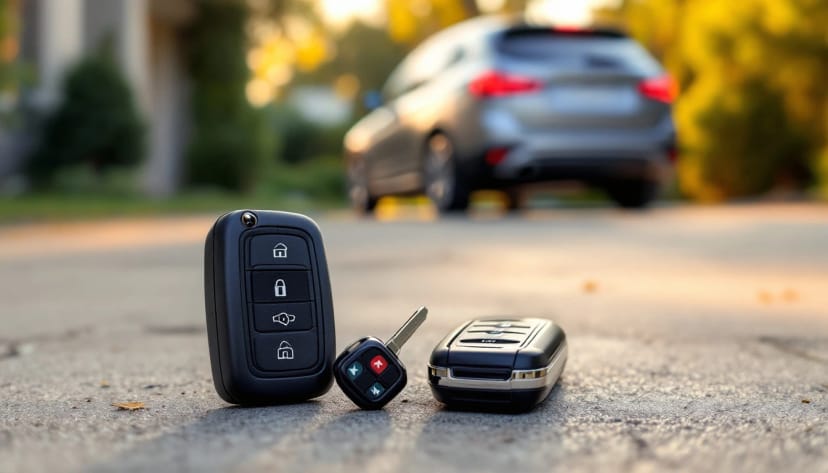
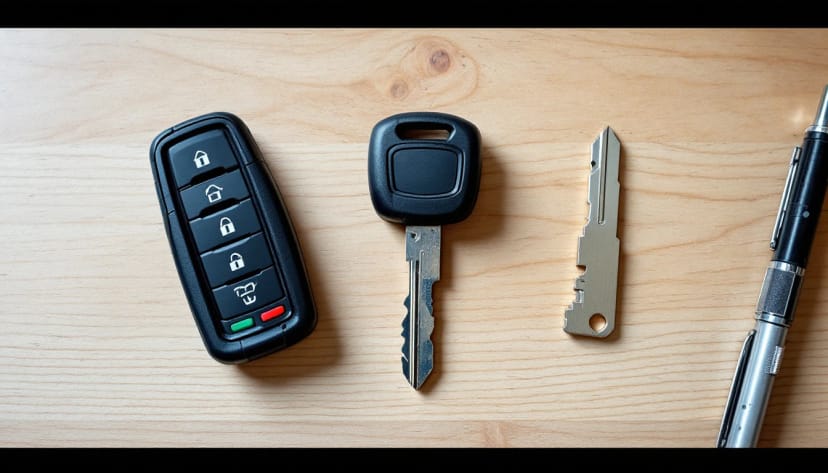
- Non-advanced-key cars use a bladed flip key with an integrated transponder and remote buttons. The blade must be cut to the vehicle key code and the transponder registered to the immobilizer.
- Advanced-key cars use a proximity fob. The vehicle detects the fob through exterior and cabin antennas, unlocks on a handle touch, and starts on a button press. There is still an emergency blade inside the fob for the driver's door, and it still has to be cut.
Common 8R-era field problems in Tarrant County:
- Flip-key hinge and spring failure. The blade stops locking into the extended position or flops loose. Purely mechanical, and it is the number-one reason an otherwise-fine 8R key gets replaced.
- Worn blade. A twelve-year-old blade rounds off and stops turning the door cylinder — invisible until the day the fob battery dies and you need the mechanical backup.
- Fob battery. Produces intermittent no-key-detected behavior that worsens with cabin heat.
- Single-key used purchases. Very common. A Q5 bought secondhand with one key is a Q5 one bad afternoon away from an all-keys-lost job at several times the cost of a spare.
That last point is worth stating plainly: on this platform the price gap between "add a spare while you have a working key" and "all keys lost" is the largest of any mainstream brand. Getting a second key made while the first one works is the single highest-return maintenance decision an Audi owner makes.
The FY generation: MQB and Component Protection
The 2018-and-later Q5 sits on the MQB platform, and MQB brings Component Protection — Komponentenschutz — into the picture.
Component Protection is a security layer that binds electronic modules to the individual vehicle they were commissioned in. A module that has not been authorized for your specific car remains partially or fully non-functional, even when it is the correct part number, correctly installed, in perfect condition. Authorization normally requires an online session with manufacturer systems.
That design has an obvious anti-theft rationale: it destroys the value of parts stripped from stolen vehicles. It also has an obvious consequence for key work.
On a Component Protection platform, a key is not simply written into one module and done. The immobilizer chain involves multiple participants — body control, cluster, engine control, steering lock — and the authorization state has to be coherent across them. A procedure that would take forty minutes on a Japanese SUV becomes a multi-stage operation with online gating in the middle of it.
This is why Audi all-keys-lost is the priciest mainstream-European key job on the road. It is not markup. It is the compounding of four separate factors:
- Credentials distributed across multiple modules rather than one.
- Online authorization gating that independents reach only through formal credentialing.
- OEM key hardware that costs materially more than Japanese-brand equivalents.
- On-site time measured in hours, not minutes.
Our dedicated guide on Audi Component Protection and immobilizer programming goes deeper on the authorization mechanics, and because the same architecture runs across the VAG family, the Volkswagen Jetta key replacement guide shows how the identical constraints look on a lower-cost platform. If you are chasing a VAG immobilizer fault rather than a key, Volkswagen immobilizer repair covers that path.
The Audi conversation I have most often is explaining why the price is what it is. People assume it is a luxury-brand surcharge. It is not. On an MQB car you are not writing one key into one box, you are getting an authorization state to line up across several modules that were deliberately engineered to refuse strangers. Every minute of that is real work. The customers who understand that stop being angry about the number very quickly.
— a NASTF-registered Fort Worth automotive locksmith, ALOA Master Automotive Locksmith (MAL) credential, DFW metroplex (anonymized)
| Scenario | Generation | What the job involves | Fort Worth / Arlington band |
|---|---|---|---|
| Spare key, working key present | 8R | Cut blade, register credential | $350–$800, low end |
| Spare advanced key, working key present | 8R | Cut emergency blade, register prox credential | $350–$800, low-mid |
| All keys lost | 8R | Ownership verify, immobilizer access, register set | $350–$800, mid-upper |
| Spare key, working key present | FY | Cut blade, register with Component Protection state intact | $350–$800, mid |
| All keys lost | FY | Multi-module authorization, online gating | $350–$800, top of band; dealer on some years |
| Ignition-related mechanical repair | 8R / FY | Cylinder or switch work | $150–$400 |
| Lockout, no key work | any | Non-destructive entry | $75–$200 |
Why online key purchases fail on this brand
Audi is the brand where "I bought a key online and it does not work" arrives most often, and the reasons are structural rather than bad luck.
Reason one: the blade is not cut to your car. Most listings ship uncut or generically cut blanks. Even a perfect electronic credential in a blade that will not turn your door lock is half a key.
Reason two: registration happens at the vehicle. No seller can register a credential to a Q5 they have never seen, regardless of what "programmed to your VIN" means in a listing title. Vehicle-side registration is the whole job.
Reason three: Component Protection. On FY cars the authorization step involves modules the seller has no relationship with. A fob that flashes an LED on the kitchen table has demonstrated that its battery works. It has demonstrated nothing about whether your Q5 will accept it.
Reason four: hardware variants. Button counts, frequency variants, and market-specific hardware differ. Ordering the wrong variant produces a fob that partially works — starts the car but will not open the tailgate, or vice versa — which is arguably worse than one that does nothing, because it looks like a programming failure.
The practical guidance: confirm hardware with the operator before buying anything. A two-minute call about your VIN prevents a two-week return process.
All keys lost: the actual sequence
This is the job class where doing it in the right order matters most.
Step one — ownership verification, before anything technical. Vehicle title or current registration, plus a government-issued photo ID whose name matches, recorded on the invoice. The FTC's guidance on hiring a locksmith treats identity verification as a baseline consumer expectation, and on a vehicle in this class it is the clearest signal separating a credentialed operator from a problem. Nobody legitimate skips it.
Step two — VIN and generation determination. 8R or FY. Advanced key or conventional. This decides the entire path and the entire price, and it is why any quote given before the VIN is a guess.
Step three — 12V battery load test. VAG electrical architecture is voltage-sensitive and a marginal battery produces convincing false immobilizer faults. It is a cheap test that occasionally ends the job right there.
Step four — network scan. Establish which modules are present, answering, and reporting faults. On a Component Protection platform this also establishes the current authorization state.
Step five — credentialed security-data access. The legitimate route for independents is the NASTF Vehicle Security Professional registry, the same channel through which dealership technician access flows.
Step six — cut, register, verify. The emergency or mechanical blade is cut from the key code, credentials are registered, and then every function on every key is tested: start, lock, unlock, tailgate, panic, and the mechanical blade in the driver's door.
Step seven — invalidate old credentials where requested. On a used-vehicle purchase you do not know how many keys exist or who holds them. Removing unknown credentials from the vehicle is often the real reason a second-owner customer called.
Cross-brand process detail is on the all keys lost and lost car keys pages.
For context on why this is deliberately difficult: NHTSA's material on anti-theft systems describes immobilizers as a theft-deterrence measure, and IIHS vehicle theft research documents the sharp reduction in theft rates for immobilizer-equipped vehicles. Audi sits at the strong end of that spectrum, and Component Protection extends the same logic from the whole vehicle down to the individual module. The friction is the feature.
Arlington, Fort Worth, and the rest of the metroplex
We are mobile-only, which matters more on this brand than most. An Audi Q5 with no working key is not driving to a dealership — that is a tow, on a vehicle where the tow is a real number and the service-department queue is measured in days.
We cover Arlington alongside Fort Worth, and Arlington gets a disproportionate share of Audi calls thanks to the density of newer-vehicle households along the I-20 and Highway 360 corridors. Same service, same bands, same day. Coverage detail is on the Arlington service area and Fort Worth service area pages, and we also run Bedford, Hurst, and Keller.
AAA's driving-cost research is a reasonable frame for pricing what the alternative actually costs: a tow, plus multiple days without the vehicle, plus rental. On an Audi all-keys-lost, the logistics around the job frequently exceed the difference between mobile and dealer pricing.
Booking checklist
Seven things. A real Audi-capable operator handles all of them without friction:
- They ask for the VIN before quoting. This is the single strongest signal on this brand.
- They can state whether your car is 8R or FY and what that means for the procedure.
- They ask whether you have advanced key or a conventional bladed key.
- They are honest about the FY all-keys-lost boundary rather than promising everything.
- They quote a flat-rate range in writing before dispatch.
- They hold Texas DPS Private Security Program licensing — Texas locksmiths are licensed through the Department of Public Safety's Private Security Program, and an operator naming any other Texas agency is not describing the law correctly.
- They are NASTF VSP registered for OEM security-data access.
The Associated Locksmiths of America certification ladder places Component Protection era European work at the Master Automotive Locksmith tier, and FTC business guidance sets the general standard that a quoted range should mean something when the invoice arrives.
Getting it done
Fort Worth Car Keys is a mobile-only operation serving Fort Worth, Arlington, and the surrounding metroplex, seven days a week from 8AM to 8PM. Call 817-842-1256 or email contact@fortworthcarkeys.com. Have your VIN handy — on an Audi it is the first thing we will ask for, and it is the difference between a real quote and a guess.
More: Audi brand page, Volkswagen brand page, European car locksmith, module programming, smart key replacement, and 24-hour car locksmith.
Frequently Asked Questions
Which Audi Q5 generation do I have, 8R or FY?
The 8R Q5 ran from roughly 2009 through 2017 and the FY generation began with the 2018 model year and continues through 2025. The split matters more than any other single fact about your car for key purposes, because the FY sits on the MQB platform with Component Protection while the 8R uses conventional Volkswagen Audi Group immobilizer architecture. If you are unsure, the VIN identifies the platform exactly, and any competent operator will ask for it before quoting.
What is Component Protection and why does it make Audi keys expensive?
Component Protection is a Volkswagen Audi Group security layer that ties electronic modules to the specific vehicle they were installed in. A module that has not been authorized for your car stays partially or fully disabled even when it is the correct part correctly installed. Authorization normally requires an online session with the manufacturer systems. For key work this means a replacement key is not simply written into one module. The authorization has to be valid across the modules that participate in the immobilizer chain, which is slower and more gated than any mainstream Japanese or domestic equivalent.
How much does Audi Q5 key replacement cost in Fort Worth or Arlington?
European platform work sits in the 350 to 800 dollar band and Audi Q5 key work lives there. Simpler cases on the 8R generation with a working key present land toward the lower end. FY generation all keys lost sits at the top of the band and is the most involved mainstream European key job on the road. A dealership quote for the equivalent work is typically considerably higher and adds a tow when there is no working key, because the vehicle cannot be driven in.
What is an Audi advanced key?
Advanced key is the Audi marketing name for the keyless entry and keyless start system, sometimes referred to as kessy within the Volkswagen Audi Group. The fob carries a proximity credential that exterior and cabin antennas detect, so the vehicle unlocks on a door handle touch and starts on a button press without the key leaving your pocket. Cars without advanced key use a conventional bladed key that has to be inserted or a fob that has to be presented. The two are different hardware and different programming procedures.
Can a mobile locksmith really do an Audi Q5 all keys lost?
On the 8R generation, generally yes with correct tooling and credentials. On the FY generation it depends on the specific model year and on current independent tool coverage, and it is the one job class where an honest operator will sometimes tell you the dealer is the right call. Be wary of any shop that treats FY all keys lost as routine without asking your VIN first. The credible answer to that question always begins with a request for the VIN, never with a flat price.
Do I need proof of ownership for an Audi all keys lost job?
Yes, without exception. A credentialed operator will ask for the vehicle title or a current registration together with a government issued photo ID in a matching name, and will record that verification on the invoice before generating any credential. Audi security data is gated behind registry credentialing precisely because the vehicles are valuable and the access is powerful. Any operator willing to skip the ownership check on a car in this class is telling you something important about how they work.
Why does an aftermarket Audi key from an online seller usually fail?
Three reasons. First, the mechanical blade must be cut to your vehicle key code, and most sellers ship uncut or generically cut blanks. Second, the transponder or proximity credential must be registered to your vehicle at the vehicle, which no seller can do in advance regardless of what the listing claims. Third, on Component Protection platforms the authorization step involves modules the seller never touched. A fob that lights up on the bench is not a fob your Q5 will accept.
References
- NASTF Vehicle Security Professional (VSP) Registry — Credentialed access to OEM immobilizer and security data.
- Associated Locksmiths of America (ALOA) — Certification ladder including Master Automotive Locksmith.
- NHTSA — Anti-Theft Systems — Federal guidance on immobilizer and anti-theft equipment.
- IIHS — Vehicle Theft — Research on theft rates and immobilizer effectiveness.
- FTC Consumer Advice — Hiring a Locksmith — Verifying a locksmith before authorizing service.
- FTC — Business Guidance — Federal guidance on pricing and advertising disclosure.
- AAA — Your Driving Costs — Vehicle ownership and downtime cost research.