The short version — Honda and Acura keys in Fort Worth
Honda and Acura are two of the highest-volume makes a Fort Worth auto locksmith touches, because they are two of the highest-volume vehicles on North Texas roads. That popularity is also why the pricing questions come up so often: a Civic transponder key and an Acura MDX smart fob are not remotely the same job, yet callers frequently expect them to cost the same.
Here is the map for 2026. Older transponder-key Hondas — most Civics, Accords, CR-Vs, and Pilots roughly through the mid-2010s — fall in the transponder band of $120-$200 for a cut-and-programmed key. Newer smart-entry models with push-button start fall in the smart-key band of $220-$500 for a proximity fob. All-keys-lost — where you have no working key at all — adds the immobilizer relearn; a lost smart fob replaced all-keys-lost runs roughly $180-$450 depending on the model year and hardware. A spare fob added while you still hold a working key can be as low as about $65 for the fob plus programming labor.
Fort Worth Car Keys is a mobile operation. We come to your driveway, workplace, or a parking lot in Arlington, Keller, Bedford, or anywhere across the metroplex, cut the blade from your VIN, and program on-site. This guide walks through each Honda and Acura family, how the immobilizer actually works, the failure modes that look like "I need a key" but are not, and the exact questions that separate a real operator from a bait-and-switch.
How the Honda immobilizer works
Every Honda and Acura built since the late 1990s carries an immobilizer. The National Highway Traffic Safety Administration's anti-theft guidance and Federal Motor Vehicle Safety Standard 114 describe why: the immobilizer exists to make sure the engine will not start unless it recognizes an authenticated key. When you insert a transponder key or bring a smart fob into the cabin, a low-frequency antenna near the ignition (or throughout the cabin, on push-button cars) powers and reads the chip, checks its rolling code against the engine control unit, and only then authorizes the fuel and spark to fire.
If that handshake fails, you get the signature symptom: the doors may unlock, the dash may light up, the engine may even crank — but it will not run, and a small green key icon typically blinks on the instrument cluster. That is not a dead battery and it is not a lockout. It is the immobilizer refusing to authenticate, and it is exactly why cutting a plain metal key that fits the door will never start a post-1998 Honda.
The Insurance Institute for Highway Safety has documented for years that Honda models rank among the most frequently stolen vehicles in the country — a big part of why Honda has steadily hardened its immobilizer and, on newer cars, moved to encrypted smart-entry systems. Stronger encryption is good news for owners and slightly harder work for locksmiths, which is the honest reason a modern smart fob costs more to replace than a 2006 Civic transponder.
Honda Civic key replacement
The Civic is the single most common Honda we work on in Fort Worth, spanning three broad key eras. Early-to-mid-2000s Civics use a straightforward transponder key — insert and twist. These are the cheapest to replace, sitting at the low end of the transponder band. Late-2000s through early-2010s Civics moved to a remote-head transponder (a metal blade with an integrated remote in the head), which sits mid-band because the remote adds hardware. From roughly the tenth generation onward, higher trims introduced smart-entry with push-button start, which moves the job into the smart-key band.
For a Civic:
- Transponder or remote-head key, spare added with a working key present: low end of $120-$200
- Transponder all-keys-lost: $120-$200 plus the relearn, generally toward the middle of that band
- Smart-entry fob, spare added: within $220-$500 depending on trim
- Smart-entry all-keys-lost: within the $180-$450 lost-fob band
Because the Civic spans so many key generations, the one detail that changes the price most is the exact year and trim. A "2015 Civic" could be either a remote-head transponder or a smart-entry car depending on trim, so confirm before you assume.
Honda Accord key replacement
The Accord follows the same arc as the Civic but tends to carry smart-entry across more of its trims earlier. Mid-2000s Accords are transponder cars. From the ninth generation on, smart-entry with push-button start became widespread, especially on EX and Touring trims. That means a larger share of Accord calls land in the smart-key band than Civic calls do.
Accord smart fobs are common enough that hardware availability is rarely an issue, which keeps all-keys-lost jobs squarely within the $180-$450 band rather than pushing to the top. If your Accord uses a traditional transponder, you are in the $120-$200 band, same as any other transponder Honda.
Honda CR-V and Pilot key replacement
The CR-V and Pilot are the family-hauler side of the Honda lineup and, like the sedans, split between transponder and smart-entry depending on year and trim. Older CR-Vs and Pilots are transponder cars; newer ones, particularly upper trims, are smart-entry. The Pilot, being a larger and more feature-rich platform, skews toward smart-entry sooner than the CR-V.
For both, the pricing follows the same bands: transponder replacements at $120-$200, smart fobs at $220-$500, all-keys-lost lost-fob jobs at $180-$450. The one practical note for SUV owners: if you lose the only key to a Pilot or CR-V, the all-keys-lost relearn is fully mobile — there is no reason to tow one of these to a dealer for a routine lost-key job.
Acura — the luxury branch
Acura is Honda's premium division, and its keys reflect that. Nearly every modern Acura — TLX, MDX, RDX, ILX — uses smart-entry with push-button start, and the fob hardware costs more than the mainstream Honda equivalents. In practice, Acura smart-fob jobs sit at the upper end of the $220-$500 smart-key band, and all-keys-lost Acura work sits toward the top of the $180-$450 lost-fob band.
The good news is that the programming procedure is the same family of immobilizer relearn as Honda, so a locksmith equipped for Honda smart-entry is equipped for Acura. The cost difference is hardware, not competence. If an operator quotes an Acura fob at Civic-transponder prices, they either misunderstand your vehicle or are setting up a price change on-site — either way, confirm the exact model before dispatch.
Fort Worth Honda and Acura price bands at a glance
The table below summarizes the 2026 ranges. Every figure is drawn from our published mobile price bands; your exact quote depends on the specific year, model, trim, and whether you still have a working key.
| Vehicle / job | Key type | 2026 mobile range |
|---|---|---|
| Civic / Accord / CR-V (older) — spare | Transponder | $120-$200 |
| Civic / Accord / CR-V — all-keys-lost | Transponder | $120-$200 + relearn |
| Accord / CR-V / Pilot (newer) — spare fob | Smart-entry | $220-$500 |
| Smart-entry Honda — all-keys-lost | Smart-entry | $180-$450 |
| Acura TLX / MDX / RDX — spare fob | Smart-entry | $220-$500 (upper end) |
| Acura — all-keys-lost | Smart-entry | $180-$450 (upper end) |
| Extra fob added with working key | Any | from ~$65 |
| Ignition cylinder repair/replace | Mechanical | $150-$400 |
| Roadside lockout (no key cut) | N/A | $75-$200 |
One table, real bands, no surprises. A car locksmith who cannot give you a range this specific over the phone is a car locksmith to keep shopping past.
Failure modes that look like "I need a key" but are not
A meaningful share of Honda and Acura "I lost my key / my key died" calls turn out to be something else once we diagnose on-site. Cutting a new key would not fix any of these:
- Dead fob battery. The single most common false alarm. A weak CR2032 coin cell makes a smart fob intermittent — works sometimes, fails when cold. Replace the battery first; it is a few dollars at any pharmacy. On push-button cars, you can usually start the engine by holding the fob against the start button even with a dead battery.
- Immobilizer antenna fault. The low-frequency ring antenna near the ignition (transponder cars) or a cabin antenna (smart cars) can fail. Symptom: the key works some of the time and not others, unrelated to the fob battery. This is a diagnosis-and-repair job, not a key job.
- 12-volt battery too weak. A marginal car battery can leave enough juice for the dash lights but not enough for a clean immobilizer handshake. The green key light blinks and the car will not start. Charging or replacing the battery — not the key — is the fix.
- Worn ignition cylinder. If the key physically sticks or will not turn, the cylinder, not the key, is worn. Ignition repair on Honda and Acura falls in the $150-$400 band.
- A previous bad programming attempt. When an under-equipped operator starts an immobilizer relearn and fails partway, the system can lock out further attempts temporarily. A credentialed operator resets and completes the job correctly.
The through-line: a competent operator diagnoses before cutting. Per the Federal Trade Commission's guidance on hiring a locksmith, an operator who wants to start cutting or drilling before establishing what actually failed is an operator to stop.
Mobile vs. the Honda dealer
The dealership makes sense in a narrow set of cases: your Honda is already there for other warranty work you can bundle the key into, or there is an open technical service bulletin touching the immobilizer. For everything else — and especially for all-keys-lost — mobile wins on both cost and time.
The Associated Locksmiths of America sets the credential standard for this trade, and its Master Automotive Locksmith (MAL) designation covers exactly the smart-entry and immobilizer work modern Hondas require. A properly credentialed mobile operator carries the same class of tooling the dealer uses, quotes a flat range on the phone, and comes to the car. The dealer, by contrast, typically requires an all-keys-lost car to be towed in — an added cost the American Automobile Association's driving-cost research shows can add meaningful expense and days of rental-car downtime on top of the key itself.
Access to OEM security data for modern immobilizer work runs through the National Automotive Service Task Force Vehicle Security Professional registry — a credential worth asking any operator about before you book a Honda or Acura smart-key job.
Field-operator perspective
Hondas are our bread and butter, and the mistake I see customers make every week is assuming their car is a transponder when it is actually a smart-entry, or the other way around. Tell me the exact year, model, and trim on the phone and I will quote you a real number before I ever leave. The operators who won't do that — who say "we'll figure it out when we get there" — are the ones who show up cheap and leave expensive.
— ALOA Master Automotive Locksmith (MAL), Honda-specialty operator, DFW metroplex (anonymized)
What we cover across the metroplex
Fort Worth Car Keys is fully mobile. We handle Honda and Acura key replacement across Fort Worth and the surrounding cities — Arlington, Keller, Bedford, and the rest of the Mid-Cities. Whether you are stranded in a grocery-store lot with a dead smart fob or you have lost the only key to your CR-V at home, we come to you, cut from your VIN, and program on-site.
If you want the deeper technical background before you call, our guides on the Honda and Acura brand page and our Honda and Acura key programming service page go model-by-model. For the broader picture on chips versus fobs, see our explainer on transponder keys versus key fobs. And if your Honda's dash is showing the immobilizer light, start with our no-key-detected / immobilizer diagnostic page.
Licensing and what to verify
Texas regulates locksmiths through the Texas Department of Public Safety Private Security Bureau. Before you authorize any operator to touch your Honda or Acura, confirm four things: they are DPS-licensed, they quote a flat-rate range in writing before dispatch, they will diagnose before cutting, and they issue a written invoice with warranty terms. Fort Worth Car Keys meets all four — call 817-842-1256 or email contact@fortworthcarkeys.com for a firm phone quote.
Frequently Asked Questions
How much does a Honda key replacement cost in Fort Worth?
As of July 2026, expect $120-$200 for a transponder key on older Civics, Accords, and CR-Vs, and $220-$500 for a smart-entry (push-button start) fob on newer models. If all keys are lost, add the immobilizer relearn — a lost smart fob with all-keys-lost programming typically runs $180-$450 depending on model year. A spare added while you still have a working key can be as low as about $65 for the fob hardware plus programming. Acura runs at the upper end of these bands because its smart-entry hardware costs more.
Can you program a Honda smart key without the original?
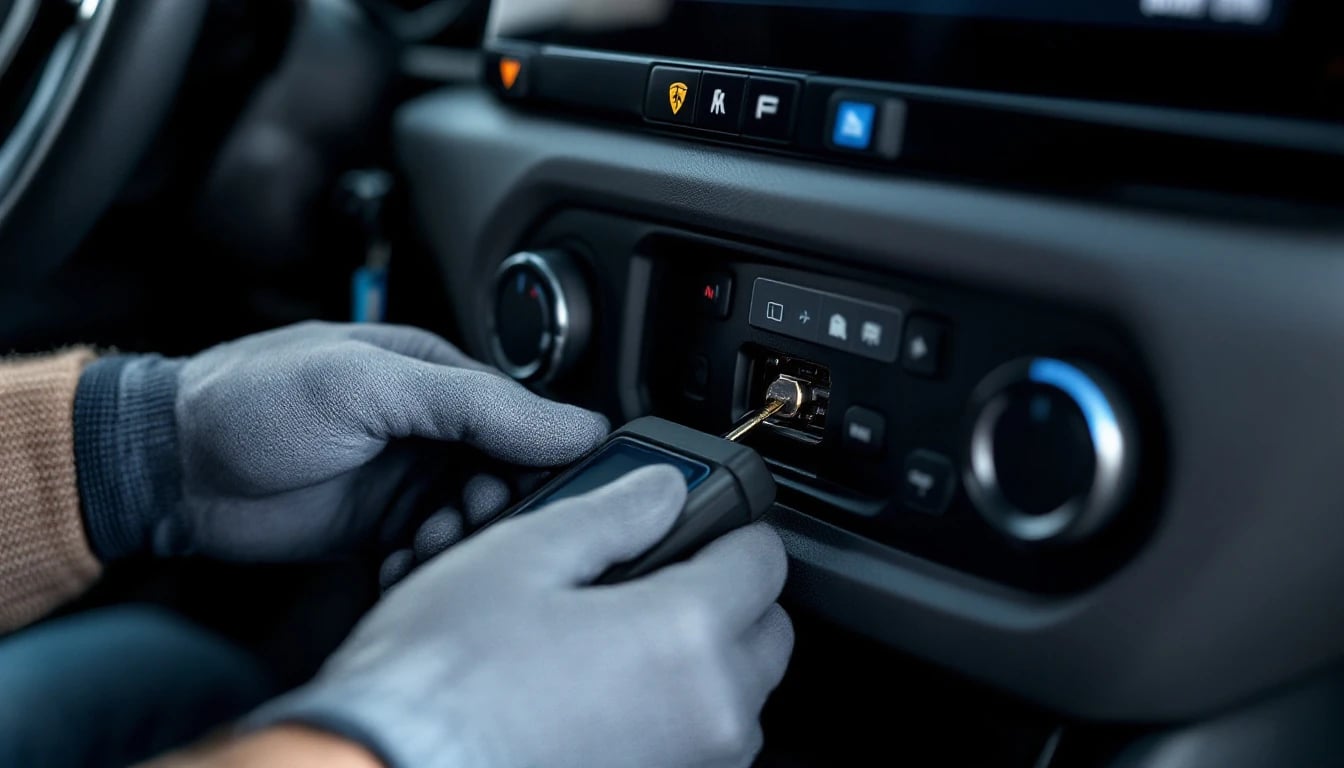
Yes. All-keys-lost programming is a standard mobile job on Honda and Acura through current model years. A credentialed operator connects an immobilizer tool to the OBD-II port, verifies ownership, and performs the relearn that registers a brand-new fob to your car's ECU — no original key required. It takes longer than a spare-key add because the tool has to establish a fresh security session with the immobilizer, but it is done on-site in your driveway.
Why won't my Honda start even though the key unlocks the doors?
That is the classic immobilizer symptom, not a lockout. The remote unlock and the engine-start authorization are two separate systems. If the doors respond but the engine cranks-and-dies or shows a blinking green key icon on the dash, the transponder or smart fob is failing to authenticate with the immobilizer. Try a fresh fob battery first; if that does not fix it, the chip, the fob, or an immobilizer antenna needs diagnosis before any key is cut.
Is a mobile locksmith cheaper than the Honda dealer?
For routine key and fob work, almost always. Dealers add service-writer overhead, parts markup, and often require the car to be towed in if all keys are lost. A mobile operator gives you a flat-rate range on the phone and does the job where the car sits. The savings are largest on all-keys-lost jobs, where the dealer tow-in requirement adds cost and days of downtime a mobile visit avoids entirely.
Does my Honda have a transponder chip or a smart key?
If you physically insert a metal key and twist it to start, you have a transponder key (common on Civic, Accord, CR-V, and Pilot roughly through the mid-2010s). If you carry a fob in your pocket, touch the door handle to unlock, and push a button to start, you have a smart-entry system. Many mid-2010s models offer both depending on trim. When in doubt, tell us your exact year, model, and trim and we will confirm before dispatch.
How long does Honda key programming take on-site?
A spare transponder or fob added with a working key present is typically 20-45 minutes. All-keys-lost on a transponder model runs 45-75 minutes. All-keys-lost on a smart-entry Honda or Acura runs 60-90 minutes because the immobilizer relearn is longer. These are realistic on-site windows for a properly tooled operator; a quote of "10 minutes" for all-keys-lost is a red flag.
Are Honda keys expensive to replace because of theft risk?
Partly. Honda models are perennially among the most-stolen vehicles in the U.S., which is exactly why the immobilizer and smart-entry encryption exist. Stronger anti-theft security means more sophisticated programming, which is reflected in the price of newer smart fobs. The upside is that a properly programmed key makes your Honda meaningfully harder to steal than a pre-immobilizer vehicle.
References & external sources
- NHTSA — Anti-Theft Systems & FMVSS 114 — Federal Motor Vehicle Safety Standard governing key-code and immobilizer disclosure.
- Insurance Institute for Highway Safety — Vehicle Theft — IIHS/HLDI data on theft rates and anti-theft technology.
- Associated Locksmiths of America (ALOA) — Trade association governing locksmith certifications including the Master Automotive Locksmith (MAL) credential.
- NASTF Vehicle Security Professional (VSP) Registry — National Automotive Service Task Force registry for credentialed access to OEM security data.
- Texas DPS — Private Security Bureau — Texas locksmith company and individual licensing authority.
- FTC Consumer Advice — Hiring a Locksmith — Federal Trade Commission guidance on verifying locksmith legitimacy before service.
- AAA — Your Driving Costs — Annual ownership cost study including unscheduled maintenance and rental projections.