TL;DR — Malibu key work in one screen
The Chevrolet Malibu is two different key jobs wearing one nameplate, and the split is clean:
- Gen 8 (roughly 2013-2015, plus the 2016 Malibu Limited) — bladed flip key cut on the HU100 high-security profile, commonly referenced through the B119 blank family, with a transponder chip in the head. There is a key cylinder in the steering column. Price band: $120-$200.
- Gen 9 (2016-2025) — smart proximity fob in the HYQ4EA / HYQ4AA FCC-ID families, push-button start, hidden emergency blade inside the fob. No key cylinder. Price band: $220-$500.
The 2016 model year is the confusing one, because Chevrolet sold the outgoing car as the Malibu Limited alongside the all-new ninth-generation Malibu in the same showroom. Two cars, same model year, completely different keys.
Other working numbers as of July 2026:
- Lost fob rather than duplicate: $180-$450
- Additional fob programmed during the same visit: about $65
- Vehicle lockout, no key work: $75-$200
Before you call anyone, it is worth understanding how a flat-rate quote is actually assembled — the breakdown of car key replacement cost in Fort Worth covers what belongs in the number and what should never be added on arrival.
Step one: identify which Malibu you actually have
Do not start from the model year. Start from the steering column.
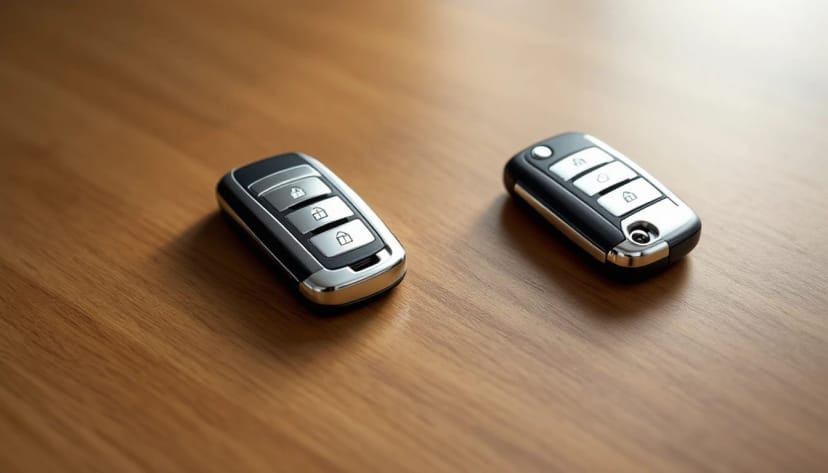
If there is a key cylinder — a slot you insert a key into and rotate — you have the eighth-generation car. The key is a flip design: the blade folds into the fob body and springs out at the press of a button. That blade is an HU100 high-security cut, and the chip is inside the plastic head.
If there is a start button and the steering column has no key slot at all, you have the ninth-generation car. The key is a smart proximity fob that the car detects when it is inside the cabin. There is a small emergency blade hidden in the fob body, released by a catch, and a backup start location inside the cabin where the fob is held against an antenna if its battery is dead.
That thirty-second check settles the entire quote. Anyone who quotes a Malibu key over the phone without asking it is quoting a coin flip.
The 2016 trap. For the 2016 model year Chevrolet ran both cars at once. The redesigned ninth-generation Malibu launched, and the previous-generation car continued in production as the Malibu Limited, largely for fleet and rental buyers. A 2016 Malibu Limited is a Gen 8 car with a flip key. A 2016 Malibu is a Gen 9 car with a smart fob. Same year on the title, different job on the driveway. Check the trunk badge and check the column.
Gen 8 (2013-2015 plus 2016 Limited): the flip key era
The eighth-generation Malibu is now deep in the used market, which is exactly where key problems concentrate. Second and third owners routinely receive one key at purchase and never make a spare, and a flip key that has been folded and unfolded for a decade has a hinge and a blade that both wear.
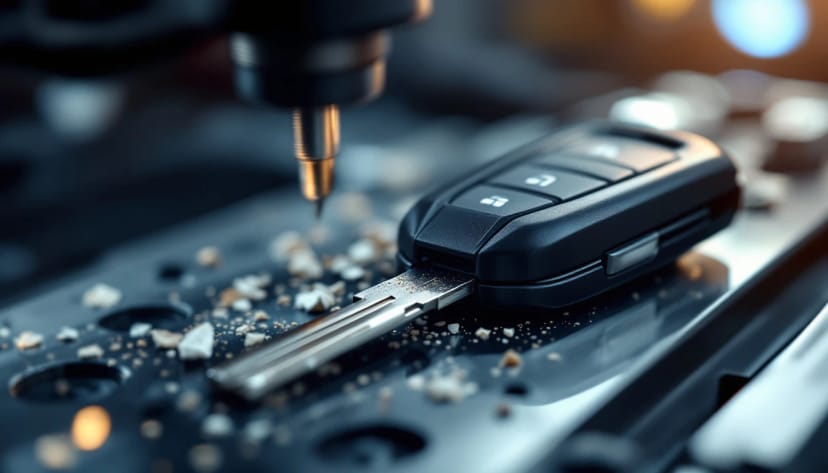
The blade. HU100 is a high-security, laser-cut, or sidewinder profile. Instead of sawtooth cuts along the edge, the code is milled as a wavy channel down the flat of the blade. Two consequences matter for you. It cannot be duplicated on a hardware-store machine — it needs a laser or milling code cutter. And it can be cut from the vehicle key code derived from the VIN through a credentialed lookup, which is what makes all-keys-lost work possible without disassembling a lock.
The chip. A transponder sits in the head of the flip key. A coil around the ignition lock energizes it when you turn the key to run, the chip answers with an encrypted response, and the body control module compares that answer to its stored key list. Match, and the engine is authorized. No match, and you get the signature symptom: crank, fire for about a second, die.
That symptom is worth memorizing because it routes you away from the starter, the battery, and the fuel pump entirely. It is an immobilizer refusal, and it belongs on the no key detected / immobilizer path.
Common Gen 8 complaints that are not lost keys. A worn flip hinge that lets the blade wobble will eventually stop turning a marginal cylinder. A worn blade will do the same. Both are cheaper to fix by cutting a fresh key to code than by replacing anything. And a genuinely bound ignition lock cylinder is a mechanical repair under ignition repair at $150-$400, not a key job at all.
Gen 9 (2016-2025): the HYQ4EA smart fob era
The ninth-generation Malibu moved to push-button start across the range and to a smart proximity fob in the HYQ4EA and HYQ4AA FCC-ID families. Button counts vary by trim and by whether remote start was equipped, which is the main reason the price band on a Gen 9 fob is as wide as it is — a four-button fob and a five-button fob with remote start are different parts at different costs.
Three things every Gen 9 owner should know before they need them:
The emergency blade exists. A small mechanical blade slides out of the fob body and opens the driver's door. Most owners have never removed it and do not know it is there. If your fob battery dies in a parking garage, that blade is the difference between a five-minute annoyance and a service call. Find it today, not at 10 PM.
The backup start location exists. With a dead fob battery, holding the fob in a specific spot inside the cabin lets the car read it passively through a coil antenna. The owner's manual identifies the exact location for your model year. This is why a dead battery almost never actually strands a Gen 9 Malibu owner who has read the manual.
The battery is the first suspect, always. A weak CR2032 produces intermittent no-detect, reduced range, and eventually push-button failure. It costs a few dollars. Replacing it before authorizing a $220-$500 fob is the highest-value two minutes in this entire article.
The same smart-fob logic runs across the modern Chevrolet lineup, which is why cross-model experience matters — the fob families and relearn procedures on a Chevrolet Equinox key replacement or a Chevrolet Traverse spare key job overlap heavily with the Malibu. A technician who works the Chevrolet brand catalog regularly recognizes the part on sight.
Passlock, transponders, and what GM's immobilizer is actually doing
There is real confusion in this market about GM theft-deterrent systems, largely because General Motors used several approaches over three decades and the names get applied loosely.
Passlock was an earlier approach. Rather than putting a chip in the key, it used a resistive sensor in the ignition lock housing that reported a specific resistance value when the correct key rotated the cylinder. It was inexpensive and it worked, but the sensor and its wiring were failure-prone, and the classic Passlock symptom — a security light and a no-start after a bumpy road — is still a live diagnosis on older GM vehicles around Fort Worth. Passlock faults are not fixed by cutting a new key, which is exactly why an honest operator diagnoses before selling one.
Transponder immobilizer is what the eighth-generation Malibu uses. A passive encrypted chip in the key head, a coil antenna at the lock, and an authentication check against the body control module. No resistance value, no sensor in the housing.
Smart proximity systems on the ninth generation are the same authentication principle carried over a rolling-code radio link, with interior antennas confirming the fob is actually inside the cabin before authorizing start.
The National Highway Traffic Safety Administration's material on anti-theft systems explains the design philosophy behind all three: the system is built to fail closed. It refuses to start for an unauthenticated key even when that occasionally inconveniences a legitimate owner. The Insurance Institute for Highway Safety's vehicle theft research documents the loss-side reason that trade-off is considered worth it. Neither is negotiable, and no reputable operator bypasses an immobilizer as a shortcut.
The full GM-specific diagnostic path is covered on the GM theft-deterrent system page.
Generation reference table
| Model years | Generation | Ignition type | Key type | Blade profile | Common FCC ID / blank family | Fort Worth service and range |
|---|---|---|---|---|---|---|
| 2013-2015 | Gen 8 | Key cylinder | Bladed flip key with transponder | HU100 | B119 blank family | Transponder key replacement, $120-$200 |
| 2016 (Malibu Limited) | Gen 8 carryover | Key cylinder | Bladed flip key with transponder | HU100 | B119 blank family | Transponder key replacement, $120-$200 |
| 2016-2018 | Gen 9 | Push-button start | Smart proximity fob | HU100 emergency blade | HYQ4EA / HYQ4AA family | Smart key replacement, $220-$500 |
| 2019-2021 | Gen 9 refresh | Push-button start | Smart proximity fob | HU100 emergency blade | HYQ4EA / HYQ4AA family | Smart key replacement, $220-$500 |
| 2022-2025 | Gen 9 late | Push-button start | Smart proximity fob | HU100 emergency blade | HYQ4EA / HYQ4AA family | Smart key replacement, $220-$500 |
| Any generation | — | — | Every key lost | Cut from VIN key code | — | All-keys-lost fob, $180-$450 |
| Any generation | — | — | Keys locked inside | — | — | Vehicle lockout, $75-$200 |
All-keys-lost on a Malibu
All-keys-lost, abbreviated AKL, means there is no working key anywhere — lost, stolen, or destroyed. It is the most procedure-heavy version of this job and the one where picking the wrong operator does the most damage.
Step one: ownership verification. Before any tool touches the car, expect to produce the vehicle title or current registration showing your name, plus a government-issued photo ID that matches it. Company-titled vehicles need the registration plus a letter of authorization on company letterhead. This is not paperwork theater. It is the condition under which the trade is permitted to generate keys from a VIN at all, and it is codified in the NASTF Vehicle Security Professional program. An operator who skips it is an operator who would skip it for a thief standing next to your car.
Step two: key code retrieval and cutting. The HU100 blade is cut from the VIN-derived key code through a credentialed lookup and milled on a code cutter. On a Gen 9 car this is the emergency blade inside the new fob, and it is what opens the door without damage. Nothing is drilled. If someone proposes drilling a door lock or an ignition on a Malibu as an opening move, end the call.
Step three: programming and security relearn. The new key or fob is written into the vehicle key list through the OBD-II port. GM platforms have historically used a timed security relearn on certain procedures, where the car must sit in a specific ignition state for a set interval before accepting new key data. Current tooling with proper security access often shortens or avoids that wait, but it is a real possibility and it should be in your time expectations rather than a surprise.
On AKL work the existing key list is typically erased and rebuilt. Any old key still in a couch cushion stops working. When keys were stolen rather than misplaced, that is precisely the outcome you want.
Step four: verification. Start, cycle, verify remote functions, verify the emergency blade opens the driver's door, and on a Gen 9 verify the backup start location works with the fob battery removed. A job that stops at "it started once" has not been verified.
Realistic on-site time runs roughly 60 to 120 minutes, longer if a relearn interval applies or two fobs are being built at once. The full sequence is on the all-keys-lost page, and if you are in the first hour of realizing they are gone, lost car keys covers what to do right now.
What is not a key problem
A meaningful share of Malibu key calls resolve into something else. In rough order of how often they turn up:
- Dead fob battery. CR2032, a few dollars, two minutes. Check it first, every time.
- Weak vehicle battery. A marginal 12-volt battery produces bizarre electrical behavior on modern GM cars, including intermittent no-start with a perfectly good key. Voltage gets tested before anything is sold.
- Worn flip-key hinge or blade (Gen 8). The blade wobbles, the cylinder gets picky, and eventually it stops turning. A fresh key cut to code fixes this for less than a cylinder replacement.
- Bound ignition lock cylinder (Gen 8). If the key will not rotate at all, that is mechanical wear in the wafer stack, not a key or immobilizer issue, and it falls under ignition repair at $150-$400.
- Damaged fob housing. A cracked fob that has been through a wash cycle or a parking lot may have an intact circuit board. Sometimes a shell transfer is the whole repair.
The Federal Trade Commission's guidance on hiring a locksmith makes the same point from the consumer side: a legitimate operator diagnoses before selling parts and quotes a flat range before dispatch rather than a starting-at number that inflates on arrival. The FTC's truth-in-advertising standards are the benchmark an advertised price is supposed to meet.
Mobile versus the dealership
The dealership is the right call in a narrow set of cases: an open recall or technical service bulletin touching the immobilizer, warranty work you are already bundling, or a platform so new that independent tooling has genuinely not caught up. As of July 2026, no Malibu model year falls in that last category.
Mobile wins the rest, and the advantages concentrate on exactly the calls that hurt most. Fort Worth Car Keys operates mobile only, Monday through Sunday, 8 AM to 8 PM:
- No tow on an all-keys-lost car. The largest hidden cost of the dealer path simply disappears.
- The car does not move. Driveway, office lot, apartment garage, or roadside.
- A flat-rate range before dispatch, so the number is known before anyone drives out.
- Same-day turnaround rather than a service-department appointment slot.
The AAA analysis of annual driving costs is the right frame for the second-order math. The invoice is rarely the whole number: days without the car, rental days, and rideshare fares while a vehicle sits at a service department are real money, and every one of them lands on the mobile side of the ledger.
Verification checklist before you book
Six questions, on the phone, before anyone is dispatched:
- Does the car have a key you turn or a button you push? If the operator does not ask this about a Malibu, they are guessing.
- Can they name the blade profile? HU100 for every generation covered here.
- Do they quote a flat-rate range in advance, rather than a starting-at teaser?
- Are they licensed under the Texas DPS Private Security Program? Texas locksmith licensing runs through the Department of Public Safety Private Security Program — not a general trade board. Ask for the company license number and expect it printed on the invoice.
- Are they NASTF VSP registered, and will they verify ownership before all-keys-lost work?
- Will you receive a written invoice listing parts, labor, license number, and warranty terms?
The Associated Locksmiths of America publishes the credentialing framework behind questions four and five.
Field-operator perspective
The Malibu I get wrong quotes on is the 2016. Somebody reads the year off the registration, quotes a flip key, and then pulls up to a Gen 9 with a start button — or the reverse on a Limited. Chevrolet sold both cars that year and the parts have nothing in common. I ask one question now before I say a number: is there a slot or a button? Everything else about a Malibu follows from that.
— a NASTF-registered Fort Worth automotive locksmith (anonymized)
Frequently Asked Questions
What key does my Chevrolet Malibu use?
It depends on the generation. Eighth-generation cars from roughly 2013 through 2015, plus the 2016 Malibu Limited, use a bladed flip key cut on the HU100 high-security profile with a transponder chip, commonly referenced by the B119 blank family. Ninth-generation cars from 2016 through 2025 use a smart proximity fob in the HYQ4EA or HYQ4AA FCC-ID families with push-button start and a hidden emergency blade. Check the steering column: a key cylinder means Gen 8, a start button means Gen 9.
How much does a Malibu key cost in Fort Worth?
As of July 2026 a Gen 8 flip key with transponder programming runs 120 to 200 dollars. A Gen 9 smart proximity fob runs 220 to 500 dollars depending on the fob variant and whether remote start is included. If every key is lost rather than duplicated, expect 180 to 450 dollars for the fob replacement. An extra fob programmed during the same visit is about 65 dollars. Dealer pricing for equivalent work is generally higher once parts markup and shop labor are added.
What is Passlock and how is it different from the newer GM immobilizer?
Passlock was General Motors earlier theft-deterrent approach, built around a resistive sensor in the ignition lock housing rather than a chip in the key. By the time the eighth-generation Malibu arrived, GM had moved to a true transponder immobilizer where an encrypted chip in the key head authenticates to the body control module. The Gen 9 smart fob system is the same principle over a rolling-code radio link. Passlock-era symptoms still show up on older GM cars in this market, which is why a proper diagnosis starts with identifying which system the car actually has.
Can a mobile locksmith program a Malibu key in my driveway?
Yes, for both generations. Gen 8 flip keys are cut on the HU100 profile from the vehicle key code and programmed through the OBD-II port. Gen 9 smart fobs are programmed the same way with a diagnostic platform carrying current GM security coverage. Fort Worth Car Keys is mobile only, working Monday through Sunday, 8 AM to 8 PM, so the car never moves. That is the decisive advantage on an all-keys-lost car, which a dealership would normally require you to tow in.
What happens during an all-keys-lost Malibu job?
First, ownership verification: the title or current registration in your name plus a matching government-issued photo ID, or for a company car the registration plus a letter of authorization on letterhead. Then the key code is retrieved from the VIN through a credentialed lookup and the blade is cut. Then the new key or fob is written into the vehicle key list through the OBD-II port, which on GM platforms typically includes a security relearn cycle. Finally the technician verifies start, remote functions, and the emergency blade in the door.
Why does GM programming sometimes involve a waiting period?
General Motors platforms have historically used a timed security relearn on certain procedures, where the vehicle sits in a specific ignition state for a set interval before it will accept new key data. It is an anti-theft measure, not a fault, and it is one reason a Malibu key job can take longer on site than the same job on another make. A credentialed technician using current tooling can often bypass or shorten that wait through the proper security access path, but the possibility should be built into your time expectations.
Should I replace the fob battery before calling for a new key?
Always. A dead CR2032 coin cell in a Gen 9 Malibu fob produces symptoms that look exactly like a failed fob: intermittent no-detect, short range, and eventually a car that only starts when the fob is held in the backup start location. The battery costs a few dollars at any pharmacy and takes two minutes. Ruling it out before spending 220 to 500 dollars on a replacement fob is the single highest-value thing a Malibu owner can do.
References
- NHTSA — Anti-Theft Systems — Federal guidance on immobilizer and anti-theft equipment.
- NASTF — Vehicle Security Professional Program — Registry governing credentialed access to OEM key-code and security data.
- Associated Locksmiths of America (ALOA) — Trade association behind the Master Automotive Locksmith credential.
- FTC Consumer Advice — Hiring a Locksmith — Verifying a locksmith before service.
- FTC — Truth in Advertising — Standards for advertised service pricing.
- IIHS — Vehicle Theft — Research on theft losses and anti-theft technology.
- AAA — Your Driving Costs — Annual vehicle ownership and downtime cost study.
Related Pages
- Chevrolet Brand Page
- Car Key Replacement Fort Worth
- GM Theft-Deterrent System
- Smart Key Replacement
- Key Fob Programming
- Arlington Service Area
Ready when you are
Whether you need this handled today or you are planning ahead, the first step is the same: tell us the VIN and what the car is actually doing.
Call or text 817-842-1256, Mon-Sun 8AM-8PM. We come to you anywhere in Fort Worth and Tarrant County, and you will have a band and a realistic duration before work starts. More ways to reach us on the contact page.