TL;DR — what EEPROM AKL is and isn't
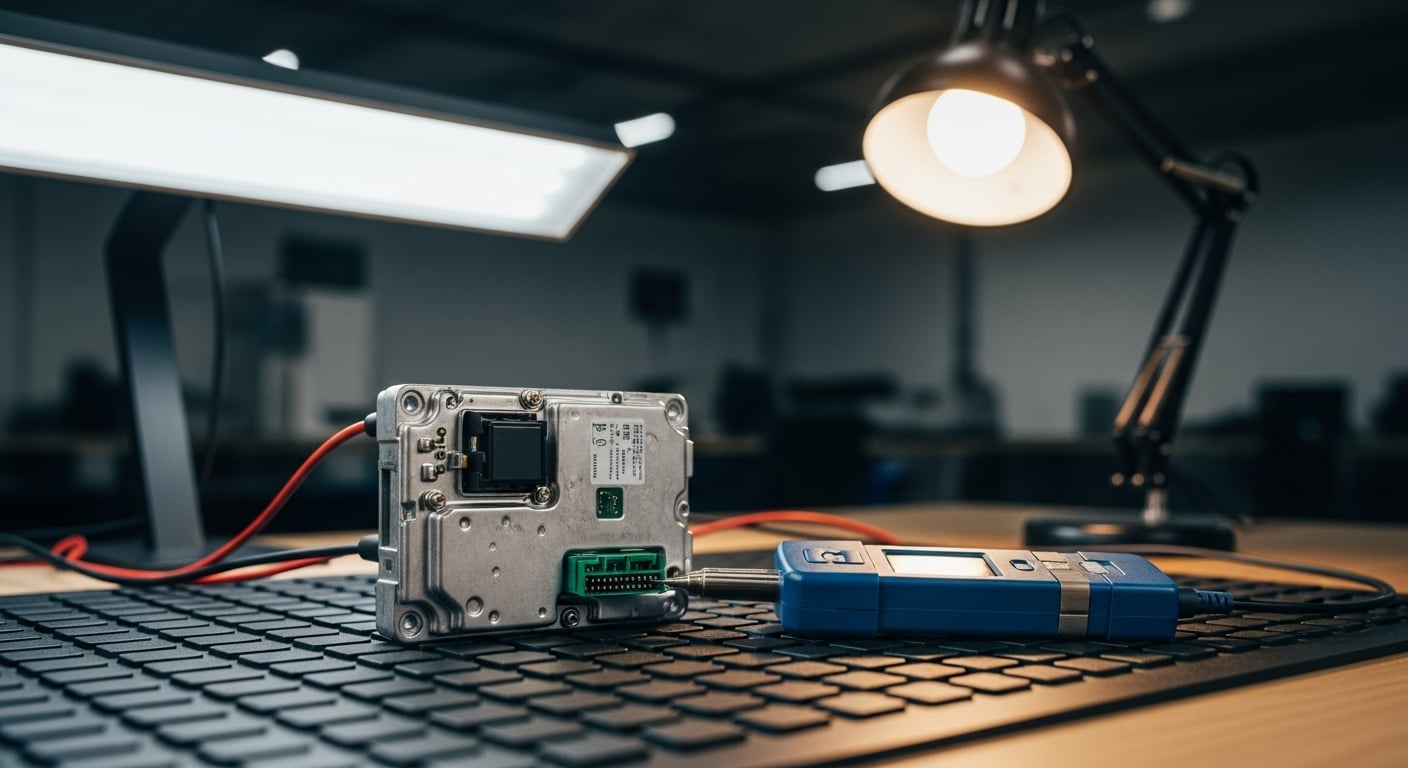
EEPROM (Electrically Erasable Programmable Read-Only Memory) programming, in the automotive locksmith context, refers to bench-level work on the vehicle's immobilizer module — removing the module from the vehicle, reading or writing the EEPROM chip directly through a programmer like CG Pro, VVDI Prog, Orange5, or Xprog, and reinstalling.
EEPROM is the right approach when:
- The vehicle's immobilizer is genuinely OBD-II-blocked for AKL (older Land Rover / Range Rover BCM, certain VAG immobilizer-2 platforms, specific Mercedes ESL repairs).
- The OBD path has been damaged (failed prior programming attempts, anti-theft lockout).
- The module has been replaced and needs to be virginized + paired to the vehicle.
- Cost arbitrage: on some platforms EEPROM is genuinely faster than OBD AKL even if both work.
EEPROM is NOT the right approach when:
- A working OBD-II AKL path exists with current tooling.
- The vehicle is under any active warranty (module removal can void coverage).
- The operator can't credibly explain why EEPROM beats OBD on this specific job.
Per the Associated Locksmiths of America Master Automotive Locksmith credential standards, EEPROM-level work is the highest specialist tier in the trade — most credentialed operators don't do it routinely; a smaller subset of specialists handle it as a regular workflow.
When EEPROM is the right call (specific platforms)
The honest answer is that EEPROM has narrowed significantly as OBD AKL tooling has improved. The remaining cases in Fort Worth in 2026:
Range Rover / Land Rover BCM (pre-2014): Discovery 3, Range Rover Sport L320, LR3, certain LR4 production windows. BCM-level immobilizer data is genuinely not accessible via OBD for AKL on these — EEPROM bench read is the legitimate path.
Older VAG immobilizer-2 platforms (pre-2009 some chassis): Audi A4 B6/B7, certain VW Touareg, some Skoda — these have OBD AKL paths but EEPROM is sometimes faster and more reliable.
Mercedes ESL (Electronic Steering Lock) repair on W211/W219/W203 production windows: when the ESL motor fails, the steering lock won't release; the only repair path is bench-level reflashing of the ESL controller. Not strictly AKL but the same skill set.
Anti-theft lockout recovery: after a failed prior programming attempt, the immobilizer often enters a protected state that OBD cannot reset. EEPROM bench-level work can repair the lockout state.
Module virginization after module replacement: when an immobilizer module has been swapped in from a donor vehicle, the new module's EEPROM has to be reset to a virgin state before it can be paired to the recipient vehicle.
What EEPROM work actually involves
The workflow:
- Diagnosis: confirm that EEPROM is the right path. Run OBD scans first — if OBD AKL is doable, do that instead (faster, less invasive, lower risk).
- Module removal: remove the immobilizer module from the vehicle. Location varies: BCM under dash, FEM in footwell, ECU under hood, EZS/EIS in steering column area, ESL in steering column.
- PCB-level access: open the module case, expose the PCB, and locate the EEPROM chip. Common chips: 24Cxx series (I²C interface), 25Cxx series (SPI interface), 93Cxx series (Microwire). Each requires different programmer pinout.
- Read: connect a programmer (CG Pro 9S12, VVDI Prog, Orange5, Xprog M, or similar) and read the EEPROM contents. The read is typically 30-90 seconds.
- Data manipulation: depending on the goal — extract immobilizer key data for AKL, reset anti-theft lockout state, virginize a swap-in module, or repair specific corrupted fields.
- Write: flash the modified data back to the EEPROM.
- Reinstall: reassemble the module, install in vehicle, perform any required CAN-bus re-coding.
- Verify: confirm the new keys work and all module functions are restored.
Time on-site for an EEPROM AKL: typically 90-240 minutes depending on platform. The actual EEPROM operations are fast (5-15 minutes per read/write); the time is in disassembly, careful handling, and reassembly.
EEPROM cost ranges in Fort Worth 2026
Pricing reflects the specialist tooling cost and the higher labor time on-site:
- Land Rover / Range Rover BCM AKL via EEPROM: $700-$1,200
- Older VAG immobilizer-2 EEPROM AKL: $500-$900
- Mercedes ESL repair (bench reflash): $400-$800 labor + ESL part cost ($200-$500) = $600-$1,300
- Anti-theft lockout recovery (EEPROM-level): $300-$600
- Module virginization (after swap-in): $200-$500
Per J.D. Power's Customer Service Index data, dealer-side equivalents for these specialty operations typically run 2.0-3.5× the independent specialist rate — partly because dealers often replace the entire module rather than repair it at the EEPROM level. The mobile-specialist path is usually substantially cheaper.
Where EEPROM is genuinely the right path
EEPROM work is a last resort, not a default. These are the scenarios where it earns its cost.
| Scenario | Why OBD alone fails | Typical on-site time |
|---|---|---|
| Immobilizer box with locked or depleted PIN attempts | The module refuses further OBD authentication | 90-180 min |
| Discontinued platform with no current OBD tool coverage | No tool vendor maintains the protocol any more | 120-240 min |
| Module replaced with a used unit still married to another VIN | The donor data must be rewritten directly | 120-240 min |
| Corrupted immobilizer data after a failed programming attempt | The fault lives in the stored data, not the key | 90-210 min |
If your situation is not on this list, an OBD-level solution almost certainly exists and should be attempted first. Proceeding straight to EEPROM on a platform with good OBD coverage adds risk and cost for no benefit.
Risks specific to EEPROM work
EEPROM is more invasive than OBD work and carries real risks:
- PCB damage during module disassembly: small modules with tight tolerances can be damaged by careless handling. A reputable specialist uses controlled-tip soldering iron, ESD precautions, and modular tooling.
- Chip damage during read/write: rare with modern programmers but possible. A trained operator uses the right pinout reference and verifies chip ID before write.
- CAN-bus re-coding errors after reinstall: some modules require re-coding via the manufacturer's diagnostic protocol after EEPROM modification. A specialist verifies before declaring complete.
- Warranty impact: opening an immobilizer module can void manufacturer warranty on that module. For out-of-warranty vehicles (the typical EEPROM customer), this is moot.
- Anti-theft consequences if done by an unauthorized operator: EEPROM-level work outside the NASTF VSP framework can create legal exposure. A credentialed operator uses NASTF channels where applicable.
Per the NHTSA's published guidance on anti-theft systems and FMVSS 114, manufacturer immobilizer architecture is specifically designed to make unauthorized bypass difficult — and EEPROM-level work is the most invasive tier. It belongs only in the hands of credentialed specialists.
How to verify an EEPROM specialist in Fort Worth
Beyond the standard credential checks (Texas DPS license, ALOA certification, NASTF VSP registry status), specific EEPROM-specialty verification:
- Ask which programmer they use for your specific platform. A real specialist can name the tool (CG Pro 9S12 for BMW/Mini, VVDI Prog for VAG, Orange5 for older platforms) without hesitation.
- Ask about their soldering setup. Modern EEPROM work uses controlled-tip stations (Hakko, Weller, JBC), ESD-controlled workspace, and clip-on adapters where possible to avoid desoldering chips.
- Ask whether they bench-read or in-circuit-read for your platform. Both are valid; the answer should be specific.
- Get a written quote that includes both labor and any part costs (if module replacement is part of the plan).
- Confirm the warranty terms specifically for EEPROM work — most specialists offer 90 days on labor and limited warranty on flashed modules.
Per BLS Occupational Employment data on the locksmith trade, EEPROM specialists are a small minority of credentialed operators — perhaps 5-10% of the trade. The specialist is worth seeking out when EEPROM is the right path.
Dealer vs specialist for EEPROM scenarios
Dealers typically don't do EEPROM-level work — they replace the entire module instead. For a Range Rover BCM AKL, the dealer path is typically:
- Tow the vehicle to the dealer.
- Dealer orders a new BCM ($600-$1,200 part cost).
- Dealer installs and codes the new BCM.
- Dealer programs new keys to the new BCM.
- Total: $1,800-$3,000 + tow + 5-10 day wait.
A specialist EEPROM operator can read the existing BCM's data, recover the immobilizer state, and program new keys without module replacement — typically $700-$1,200, same day, in your driveway. The cost delta on Range Rover BCM AKL alone is often $1,000+ in the specialist's favor.
This is the highest-value differential in the trade. For Range Rover / Land Rover owners in DFW, finding a credentialed EEPROM specialist often pays for itself many times over across the vehicle's ownership.
Honest boundaries
EEPROM work is the deep end of automotive locksmithing, and the honest limits matter more here than anywhere else because the failure mode is an expensive module rather than a wasted trip.
Not every locked-down platform has an EEPROM answer. Where a manufacturer has moved credential issuance behind its own systems, reading the chip does not help. Mercedes FBS4 all-keys-lost is the clearest example — that is a dealer process regardless of bench skill, as our Mercedes C-Class and GLC FBS4 guide sets out. Volkswagen Audi Group Component Protection cars and Tesla's account-based pairing are similar. As of August 2026 an operator who offers to bench-read your way out of any of those is overselling.
Bench work carries genuine risk, and it should be disclosed. Removing a module, reading memory, and restoring it involves soldering or pin contact on a live control unit. Done properly it is routine; done badly it bricks a module. That is exactly why it costs more than a port-based job and why you should ask what happens if a read goes wrong before authorizing the work.
Sometimes the port-based route is available and cheaper. A good specialist checks whether your platform can be done through the diagnostic port first. Reaching for the bench when the port would have worked is padding, not expertise.
Proof of ownership comes first, always. Title or current registration verified against a government-issued photo ID in a matching name, recorded on the invoice, before any module comes out or any credential is written. The FTC's consumer guidance on hiring a locksmith treats identity verification as a baseline expectation, and bench-level immobilizer access is about as powerful as this trade gets.
How the on-site visit works in Fort Worth
We are mobile-only, 8AM to 8PM, seven days a week, across Fort Worth and Tarrant County, and EEPROM jobs are done at the vehicle — a car with no working key is not driving anywhere.
The call starts with the VIN and an honest description of what you have: no working key, a car that will not start, or a module already suspected. From that we can usually say whether your platform is a port job or a bench job, and you get a flat-rate range before anyone is dispatched.
On arrival the technician verifies ownership, load-tests the 12-volt battery, and scans the network — a marginal battery causes convincing false module faults and it would be an expensive thing to misdiagnose as an EEPROM failure. Where the port route works, that is taken. Where it does not, the relevant module is removed, its memory read, the security data extracted, and the module restored to the vehicle. New keys are then written and every function is tested before the invoice: start, restart after a full shutdown, lock, unlock, and the mechanical blade.
You get itemized paperwork listing the VIN, the module touched, and the method used. On bench work that documentation matters — it is the record of what was done inside your car.
Coverage runs across Fort Worth and out to Arlington, Bedford, Hurst and Keller. Related: all keys lost, module programming, and for the wider pricing picture, car key replacement cost in Fort Worth TX. If you are simply down to no spare on a mainstream car, lost car keys with no spare is the more likely starting point.
Talk to a technician
Call 817-842-1256 with your VIN and we will tell you whether your car is a port job, a bench job, or a dealer job — before anyone is dispatched. 8AM to 8PM, seven days a week across Fort Worth and Tarrant County.
Field-operator perspective
Most operators don't do EEPROM, and that's fine — for 90% of jobs, OBD AKL is faster and safer. Where I get called is the 10%: Range Rover BCM, certain Audi pre-MQB AKL, Mercedes ESL failures, anti-theft lockouts from someone else's failed programming attempt. Those are bench jobs and they require specific tooling — CG Pro for BMW/Mini chassis, VVDI Prog for VAG, Orange5 for older platforms. If a generalist says they can do your Range Rover BCM AKL "no problem" without naming the tool, ask for the tool.
— a NASTF-registered Fort Worth automotive locksmith, ALOA Master Automotive Locksmith (MAL) credential, DFW metroplex (anonymized)
A real-world example
Operator: Anonymized 2011 Range Rover Sport L320 owner, residential garage in Westlake, AKL after previous failed programming attempt by another locksmith
Before:
- Prior locksmith attempted AKL via OBD, failed mid-process, vehicle entered anti-theft lockout.
- Range Rover dealership quote: $2,840 (new BCM + programming + tow) with 8-day part wait.
- Customer had been without the vehicle for 11 days already by the time they called a specialist.
What changed: Customer called a NASTF-registered EEPROM specialist. Pre-dispatch flat-rate quote: $850-$1,050 covering BCM removal, EEPROM bench-read, anti-theft lockout recovery, AKL programming for 2 keys, CAN re-coding, and reinstallation. Specialist arrived in 52 minutes, verified ownership, removed BCM from vehicle (60 minutes), benched the module on a portable workbench in the garage, read EEPROM via CG Pro, repaired the lockout state, programmed 2 keys, reinstalled BCM, re-coded CAN bus, verified all functions in 4 hours 12 minutes total on-site.
Outcome:
- Final invoice: $950 (within quoted range). No tow, no new BCM part.
- Two working keys delivered, all BCM functions (lighting, central locking, immobilizer) confirmed working.
- 90-day labor warranty + 1-year transponder hardware warranty.
- Customer driving again the same evening after 11 days of vehicle downtime.
Net: Customer saved approximately $1,890 vs the dealer path, plus would have avoided another 8 days of vehicle downtime. The lockout-recovery aspect was the critical differentiator — once a vehicle is in anti-theft lockout from a failed prior attempt, most generalist operators decline the work, leaving the dealer as the only path. EEPROM specialists are how those cases get unblocked. Per BBB locksmith advisory data, the failed-prior-programming scenario is unfortunately common — and a specialist EEPROM rescue is the right resolution.
Frequently Asked Questions
What is EEPROM programming in the locksmith context?
EEPROM (Electrically Erasable Programmable Read-Only Memory) programming refers to bench-level work on a vehicle's immobilizer module — physically removing the module, reading or writing its memory chip directly through specialized programmers (CG Pro, VVDI Prog, Orange5, Xprog), and reinstalling. It's used when OBD-II-based AKL is genuinely blocked, when anti-theft lockout from prior failed programming has to be cleared, or when a swap-in module needs to be virginized.
How do I know if my AKL job needs EEPROM or can be done via OBD?
A credentialed operator will tell you on the phone after you give them year, make, and model. For most 2005-2024 mass-market vehicles, OBD AKL is the right path. The platforms that often require EEPROM in 2026 are: Land Rover / Range Rover BCM (pre-2014), older Audi/VW immobilizer-2 chassis, and any vehicle where prior failed programming has caused anti-theft lockout.
Why is EEPROM work more expensive than regular AKL?
Time and tooling. EEPROM work involves physically removing the immobilizer module, opening the case, working at the PCB level with controlled-tip soldering and specialized programmers, then reinstalling and re-coding. On-site time typically runs 90-240 minutes vs 60-120 minutes for OBD AKL. The tooling investment is also higher: $3,000-$8,000 in programmer hardware plus ongoing data subscriptions. Operators amortize this across fewer calls than OBD AKL, so per-job pricing reflects the cost.
Can EEPROM work damage my vehicle?
Done correctly by a credentialed specialist, no. The risks are: PCB damage during module disassembly (mitigated by ESD precautions and controlled-tip tooling), chip damage during read/write (rare with modern programmers and proper pinout verification), and CAN-bus re-coding errors after reinstall (mitigated by post-install verification). Done by an uncredentialed operator without proper tooling, EEPROM work can permanently damage modules — which is why this work belongs to specialists, not generalists.
What's the difference between EEPROM and just "programming a key"?
OBD-II key programming uses the diagnostic protocol exposed by the manufacturer through the OBD-II port — it's the "front door" of the immobilizer. EEPROM programming reads or writes the immobilizer chip directly at the hardware level — it's the "back door." For most modern vehicles the front door works fine. For specific older European platforms, anti-theft lockout scenarios, and module virginization, the back door is the only path.
Will EEPROM work void my Range Rover or Mercedes warranty?
On-warranty vehicles: yes, opening an immobilizer module typically voids warranty on that specific module (not the whole vehicle, per Magnuson-Moss Warranty Act). Most EEPROM customers are out-of-warranty vehicles where this is moot. If your vehicle is still under manufacturer warranty for the affected module, the dealer path is usually the right choice. If it's out of warranty, EEPROM is often $1,000+ cheaper than the dealer replacement-and-program path.
References & external sources
- Associated Locksmiths of America (ALOA) — Trade association governing locksmith certifications including the Master Automotive Locksmith (MAL) credential.
- NASTF Vehicle Security Professional (VSP) Registry — National Automotive Service Task Force registry for credentialed access to OEM security data.
- NHTSA — Anti-Theft Systems & FMVSS 114 — Federal Motor Vehicle Safety Standard governing key-code and immobilizer disclosure.
- J.D. Power — Customer Service Index — Annual study of dealership service department satisfaction and cost.
- U.S. Bureau of Labor Statistics — Occupational Employment and Wages, Locksmiths (49-9094) — BLS OEWS national wage + employment data for locksmith occupation.
- Better Business Bureau — Locksmith Scam Advisory — BBB consumer protection guidance on locksmith bait-and-switch operators.
- Texas Department of Public Safety — Private Security Licensing — Texas locksmith company + individual licensing requirements.